Department of Obstetrics and Gynecology, Faculty of Medicine, Universitas Padjadjaran/Dr. Hasan Sadikin General Hospital, Bandung, West Java, Indonesia.
Bandung Fertility Center, Limijati Mother and Child Hospital, Bandung, West Java, Indonesia.
J Neurodev Disord. 2020 Dec 13;12(1):33. doi: 10.1186/s11689-020-09347-w.
Various techniques in assisted reproductive technology (ART) have been developed as solutions for specific infertility problems. It is important to gain consensual conclusions on the actual risks of neurodevelopmental disorders among children who are born from ART. This study aimed to quantify the relative risks of cerebral palsy, intellectual disability, autism spectrum disorder (ASD), and behavioral problems in children from different ART methods by using systematic review and meta-analysis. Healthcare providers could use the results of this study to suggest the suitable ART technique and plan optimum postnatal care.
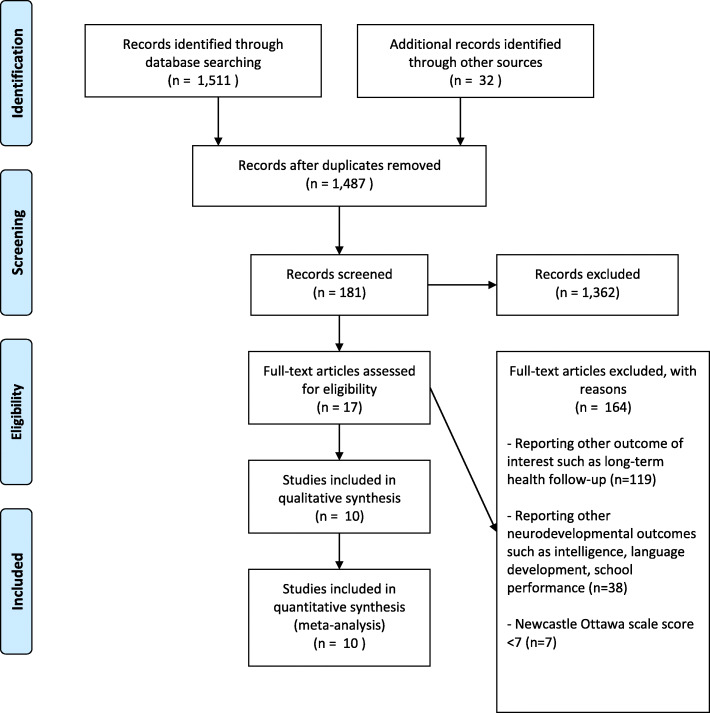
Pubmed, Google Scholar, and Scopus databases were used to search for studies up to January 2020. Of the 181 screened full manuscripts, 17 studies (9.39%) fulfilled the selection criteria. Based on the Newcastle-Ottawa scale ratings, 7 studies were excluded, resulting in 10 studies that were eventually included in the meta-analyses. Mantel-Haenszel risk ratio model was used in the meta-analysis, and the results are described using forest plot with 95% confidence interval. Heterogeneity was assessed using the I value.
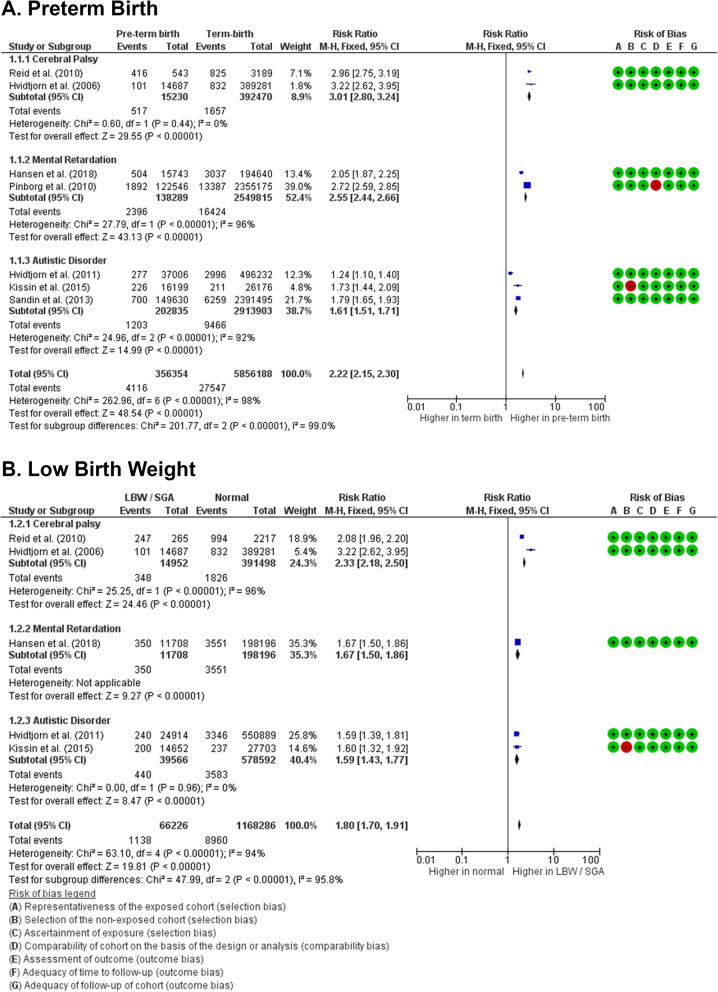
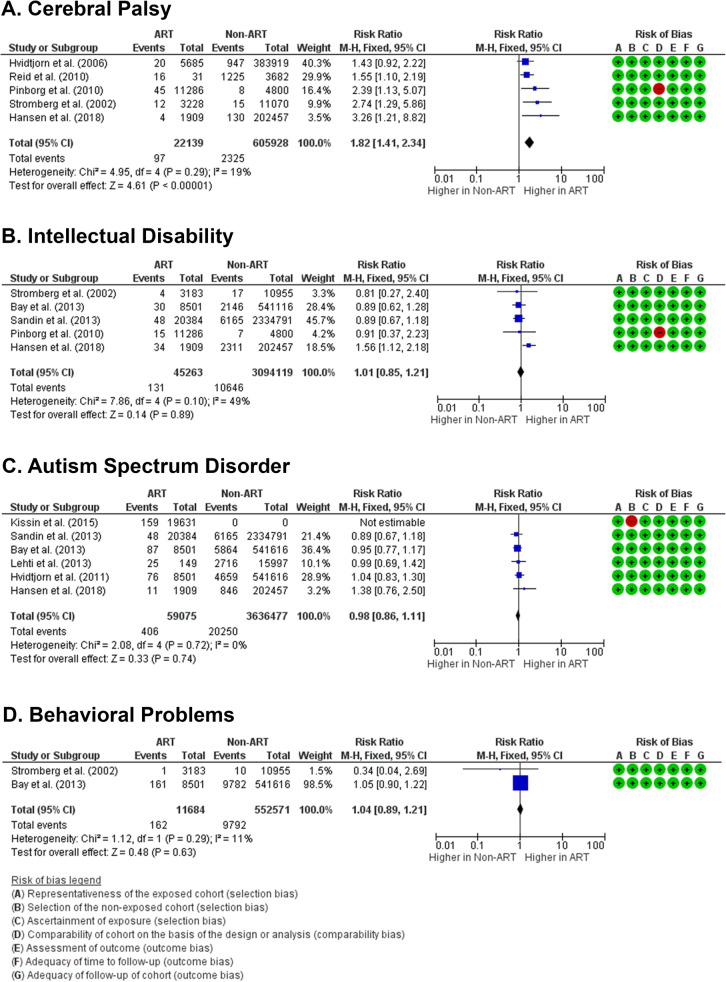
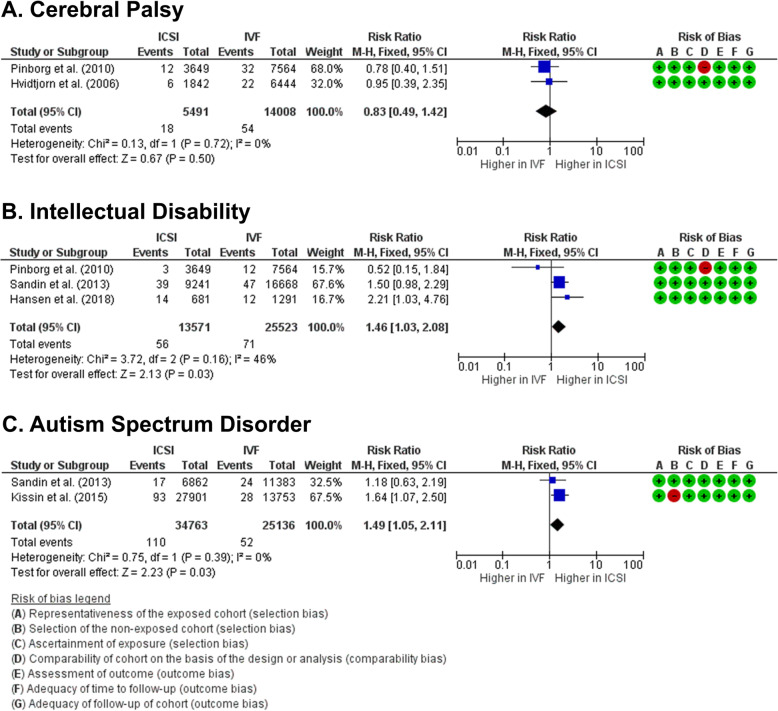
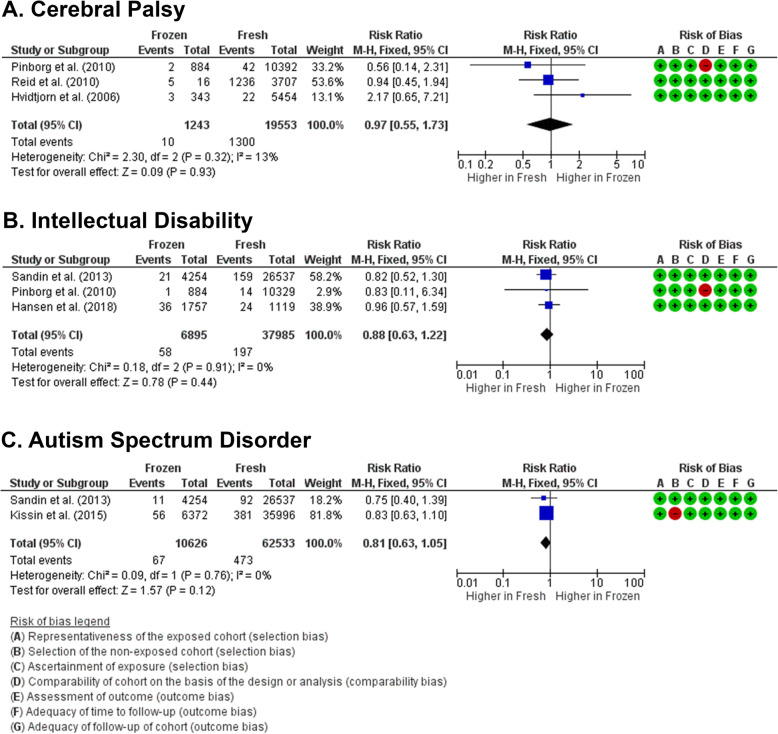
Pooled evaluation of 10 studies showed that the risk of cerebral palsy in children from assisted reproductive technology (ART) is higher than children from natural conceptions (risk ratio [RR] 1.82, [1.41, 2.34]; P = 0.00001). Risk of intellectual disability (RR 1.46, [1.03, 2.08]; P = 0.03) and ASD (RR 1.49 [1.05, 2.11]; P = 0.03) are higher in intracytoplasmic sperm injection (ICSI) children compared to conventional in vitro fertilization (IVF) children. The differences in the risk of neurodevelopmental disorders in children born after frozen and fresh embryo transfers are not significant. Analysis on potential cofounder effects, including multiple birth, preterm birth, and low birth body weight highlight possibilities of significant correlation to the risks of neurodevelopmental disorders.
Pooled estimates suggest that children born after ART are at higher risk of acquiring cerebral palsy. ICSI treatment causes higher risk of intellectual disability and ASD. These findings suggest the importance of the availability of intensive care unit at the time of delivery and long-term developmental evaluation particularly in children from ICSI.
辅助生殖技术(ART)的各种技术已被开发出来,以解决特定的不孕问题。重要的是要就 ART 所生儿童的神经发育障碍的实际风险达成共识。本研究旨在通过系统评价和荟萃分析,量化不同 ART 方法所生儿童脑瘫、智力障碍、自闭症谱系障碍(ASD)和行为问题的相对风险。医疗保健提供者可以使用本研究的结果来建议合适的 ART 技术并计划最佳的产后护理。
使用 Pubmed、Google Scholar 和 Scopus 数据库搜索截至 2020 年 1 月的研究。在筛选出的 181 篇全文中,有 17 项研究(9.39%)符合选择标准。根据纽卡斯尔-渥太华量表评分,有 7 项研究被排除在外,最终有 10 项研究纳入荟萃分析。荟萃分析采用曼-惠特尼风险比模型,结果用森林图描述,置信区间为 95%。使用 I 值评估异质性。
对 10 项研究的综合评估表明,接受辅助生殖技术(ART)的儿童脑瘫风险高于自然受孕儿童(风险比 [RR] 1.82,[1.41,2.34];P=0.00001)。与常规体外受精(IVF)儿童相比,卵胞浆内单精子注射(ICSI)儿童的智力障碍(RR 1.46,[1.03,2.08];P=0.03)和 ASD(RR 1.49 [1.05,2.11];P=0.03)的风险更高。冷冻和新鲜胚胎移植后出生的儿童发生神经发育障碍的风险差异不显著。对潜在混杂因素(包括多胎妊娠、早产和低出生体重)的分析突出了与神经发育障碍风险相关的可能性。
汇总估计表明,ART 所生儿童脑瘫风险较高。ICSI 治疗会增加智力障碍和 ASD 的风险。这些发现表明,特别是在接受 ICSI 的儿童中,分娩时需要有重症监护病房,并进行长期发育评估。