Institute for Clinical Chemistry, Medical Faculty Mannheim of the University of Heidelberg, Mannheim, Germany.
MVZ Laboratory Dr. Limbach & Colleagues, Heidelberg, Germany.
Int J Infect Dis. 2021 Feb;103:590-596. doi: 10.1016/j.ijid.2020.12.003. Epub 2020 Dec 9.
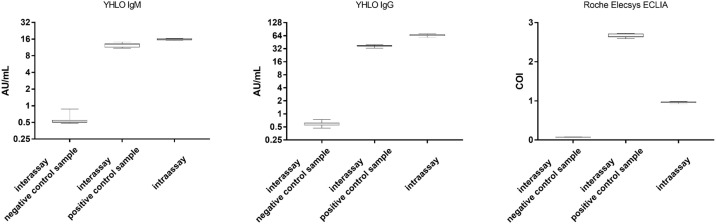
Numerous immunoassays for detecting antibodies directed against SARS-CoV-2 have been rapidly developed and released. Validations of these have been performed with a limited number of samples. The lack of standardisation might lead to significantly different results. This study compared ten automated assays from six vendors in terms of sensitivity, specificity and reproducibility.
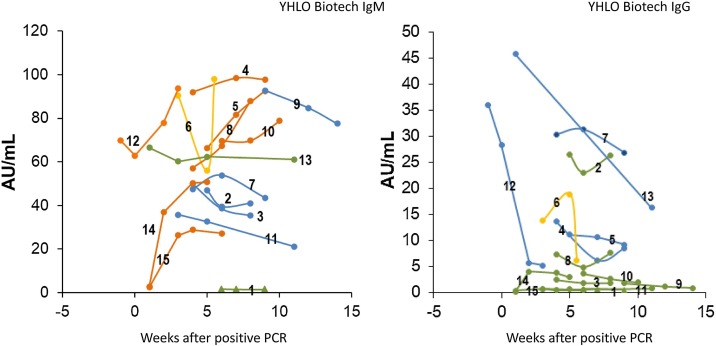
This study compared ten fully automated immunoassays from the following vendors: Diasorin, Epitope Diagnostics, Euroimmun, Roche, YHLO, and Snibe. The retrospective part of the study included patients with a laboratory-confirmed COVID-19 infection, and controls comprised patients with a suspected infection, in whom the disease was excluded. Furthermore, biobanked sera were taken as negative controls (n = 97). The retrospective part involved four groups: (1) laboratory-confirmed COVID-19 infection (n = 183); (1B) suspected COVID-19 infection (n = 167) without a qRT-PCR result but positive serological results from at least two different assays, and suspected COVID-19 infection due to a positive serological result from the Roche assay (n = 295); (2) biobanked sera obtained from patients before the emergence of SARS-CoV-2 (n = 97) as negative controls; and (2A) probably COVID-19-negative sera with negative serological results from at least two different assays (n = 152).
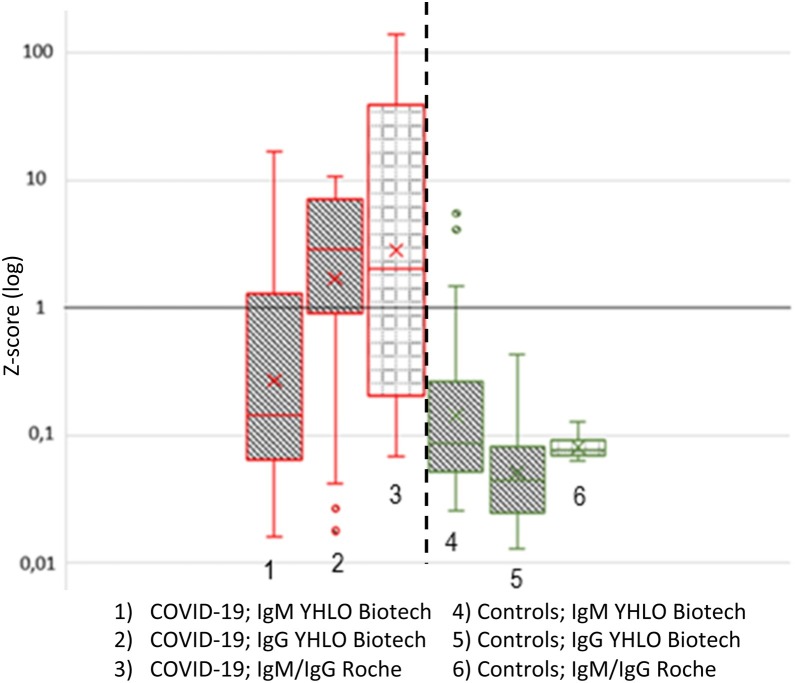
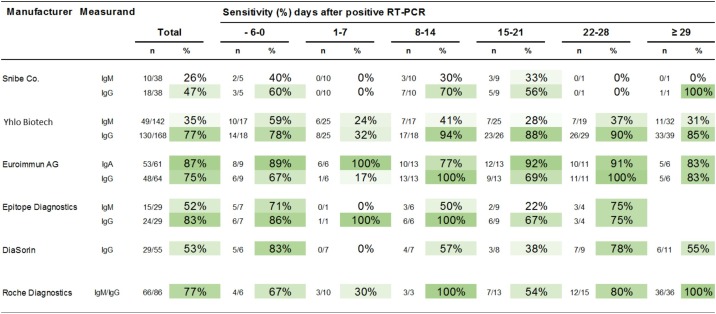
Overall diagnostic sensitivities were: Euroimmun (IgA) 87%; Epitope Diagnostics (IgG) 83%; YHLO (IgG) 77%; Roche (IgM/IgG) 77%; Euroimmun (IgG) 75%; Diasorin (IgG) 53%; Epitope Diagnostics (IgM) 52%; Snibe (IgG) 47%; YHLO (IgM) 35%; and Snibe (IgM) 26%. Diagnostic specificities were: YHLO (IgG) 100%; Roche, 100%; Snibe (IgM/IgG) 100%; Diasorin (IgG) 97%; Euroimmun (IgG) 94%; YHLO (IgM) 94%; Euroimmun (IgA) 83%.
Assays from different vendors substantially varied in terms of their performance. These findings might facilitate selection of appropriate serological assays.
已经快速开发和发布了许多用于检测针对 SARS-CoV-2 的抗体的免疫测定法。这些方法的验证是使用有限数量的样本进行的。缺乏标准化可能会导致结果有很大差异。本研究比较了来自六个供应商的十种全自动检测方法在灵敏度、特异性和重现性方面的差异。
本研究比较了来自以下供应商的十种全自动免疫测定法:DiaSorin、Epitope Diagnostics、Euroimmun、Roche、YHLO 和 Snibe。研究的回顾部分包括实验室确诊的 COVID-19 感染患者,对照组包括疑似感染但疾病排除的患者。此外,还采集了生物库血清作为阴性对照(n = 97)。回顾性部分涉及四组:(1)实验室确诊的 COVID-19 感染(n = 183);(1B)疑似 COVID-19 感染(n = 167),无 qRT-PCR 结果,但至少两种不同检测方法的血清学结果为阳性,且由于 Roche 检测方法的血清学结果阳性而怀疑 COVID-19 感染(n = 295);(2)生物库血清来自 SARS-CoV-2 出现之前的患者(n = 97)作为阴性对照;和(2A)可能 COVID-19 阴性血清,至少两种不同检测方法的血清学结果均为阴性(n = 152)。
总体诊断敏感性为:Euroimmun(IgA)87%;Epitope Diagnostics(IgG)83%;YHLO(IgG)77%;Roche(IgM/IgG)77%;Euroimmun(IgG)75%;DiaSorin(IgG)53%;Epitope Diagnostics(IgM)52%;Snibe(IgG)47%;YHLO(IgM)35%;和 Snibe(IgM)26%。诊断特异性为:YHLO(IgG)100%;Roche,100%;Snibe(IgM/IgG)100%;DiaSorin(IgG)97%;Euroimmun(IgG)94%;YHLO(IgM)94%;Euroimmun(IgA)83%。
来自不同供应商的检测方法在性能方面存在很大差异。这些发现可能有助于选择合适的血清学检测方法。