Clinical Department of Laboratory Medicine and National Reference Centre for Respiratory Pathogens, University Hospitals Leuven, Leuven, Belgium.
Laboratory of Microbiology, Jan Yperman Hospital, Ieper, Belgium.
Clin Microbiol Infect. 2020 Nov;26(11):1557.e1-1557.e7. doi: 10.1016/j.cmi.2020.07.038. Epub 2020 Jul 31.
The aim was to determine the antibody response against SARS-CoV-2 spike protein and nucleoprotein using four automated immunoassays and three ELISAs for the detection of total Ig antibodies (Roche) or IgG (Abbott, Diasorin, Snibe, Euroimmun, Mikrogen) in COVID-19 patients.
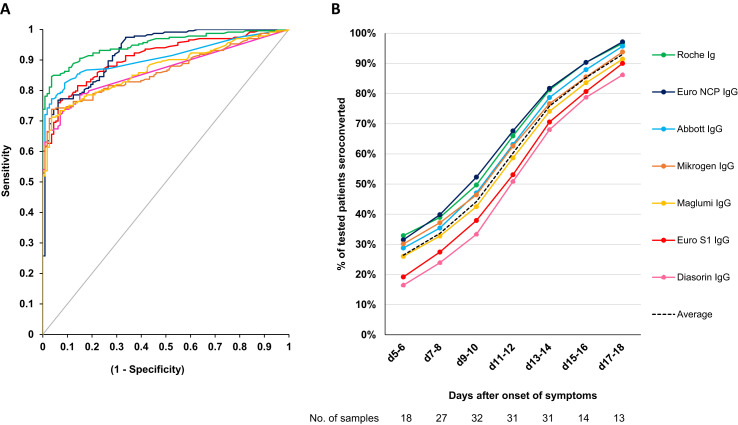
Sensitivity and dynamic trend to seropositivity were evaluated in 233 samples from 114 patients with moderate, severe or critical COVID-19 confirmed with PCR on nasopharyngeal swab. Specificity was evaluated in 113 samples collected before January 2020, including 24 samples from patients with non-SARS coronavirus infection.
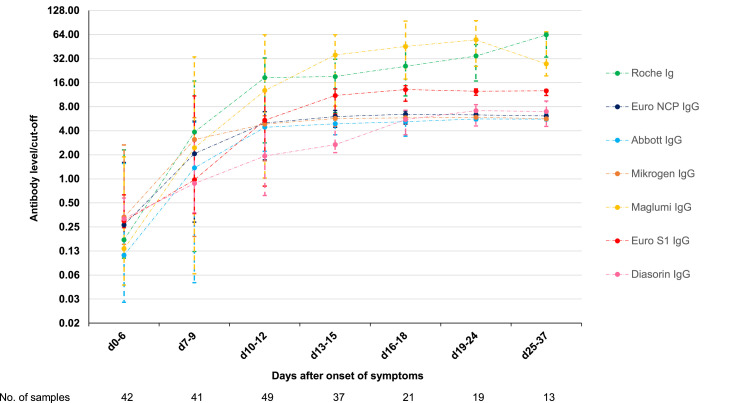
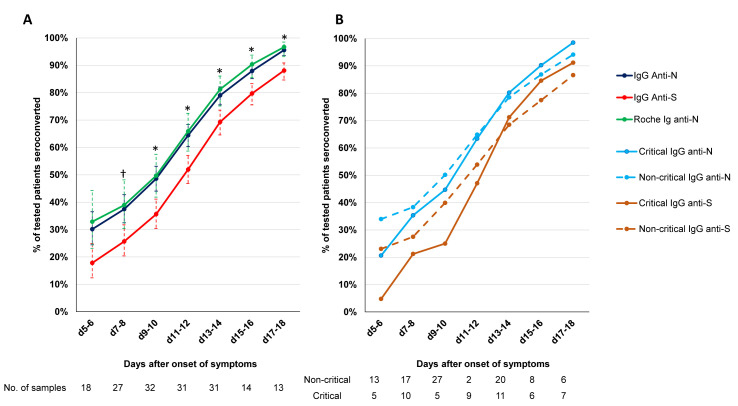
Sensitivity for all assays was 100% (95% confidence interval 83.7-100) 3 weeks after onset of symptoms. Specificity varied between 94.7% (88.7-97.8) and 100% (96.1-100). Calculated at the cut-offs that corresponded to a specificity of 95% and 97.5%, Roche had the highest sensitivity (85.0% (79.8-89.0) and 81.1% (76.6-85.7), p < 0.05 except vs. Abbott). Seroconversion occurred on average 2 days earlier for Roche total Ig anti-N and the three IgG anti-N assays (Abbott, Mikrogen, Euroimmun) than for the two IgG anti-S assays (Diasorin, Euroimmun) (≥50% seroconversion day 9-10 vs. day 11-12 and p < 0.05 for percent seropositive patients day 9-10 to 17-18). There was no significant difference in the IgG antibody time to seroconversion between critical and non-critical patients.
Seroconversion occurred within 3 weeks after onset of symptoms with all assays and on average 2 days earlier for assays detecting IgG or total Ig anti-N than for IgG anti-S. The specificity of assays detecting anti-N was comparable to anti-S and excellent in a challenging control population.
使用四种自动化免疫分析和三种 ELISA 检测试剂盒(罗氏、雅培、迪亚森、Snibe、欧蒙、美康)检测总 Ig 抗体(罗氏)或 IgG(雅培、迪亚森、Snibe、欧蒙、美康),以确定针对 SARS-CoV-2 刺突蛋白和核蛋白的抗体反应。
评估了 233 份来自 114 例经鼻咽拭子 PCR 确诊的中度、重度或危重新冠肺炎患者的样本的敏感性和血清阳性的动态趋势。在 2020 年 1 月之前采集的 113 份样本中评估了特异性,其中包括 24 份非 SARS 冠状病毒感染患者的样本。
所有检测方法的敏感性均为 100%(95%置信区间 83.7-100),症状出现后 3 周。特异性在 94.7%(88.7-97.8)和 100%(96.1-100)之间变化。在特异性为 95%和 97.5%对应的截定点计算时,罗氏的敏感性最高(85.0%(79.8-89.0)和 81.1%(76.6-85.7),除与雅培相比外,p<0.05)。罗氏总 Ig 抗-N 和三种 IgG 抗-N 检测试剂盒(雅培、美康、欧蒙)的血清转换平均比两种 IgG 抗-S 检测试剂盒(迪亚森、欧蒙)早 2 天(≥50%血清转换第 9-10 天 vs. 第 11-12 天,p<0.05)(第 9-10 天至第 17-18 天阳性患者的百分比血清阳性)。危重症和非危重症患者 IgG 抗体血清转换时间无显著差异。
所有检测方法均在症状出现后 3 周内发生血清转换,与检测 IgG 或总 Ig 抗-N 的检测试剂盒相比,IgG 抗-S 的检测试剂盒的血清转换平均早 2 天。检测抗-N 的检测试剂盒的特异性与抗-S 相当,在具有挑战性的对照人群中表现出色。