Gleeson Christina, Frost Rachel, Sherwood Larissa, Shevlin Mark, Hyland Philip, Halpin Rory, Murphy Jamie, Silove Derrick
School of Psychology, Ulster University, Coleraine, Northern Ireland.
Collaborative Network for Training and Excellence in Psychotraumatology (CONTEXT), Trinity College, Dublin, Ireland.
Eur J Psychotraumatol. 2020 Dec 1;11(1):1793567. doi: 10.1080/20008198.2020.1793567.
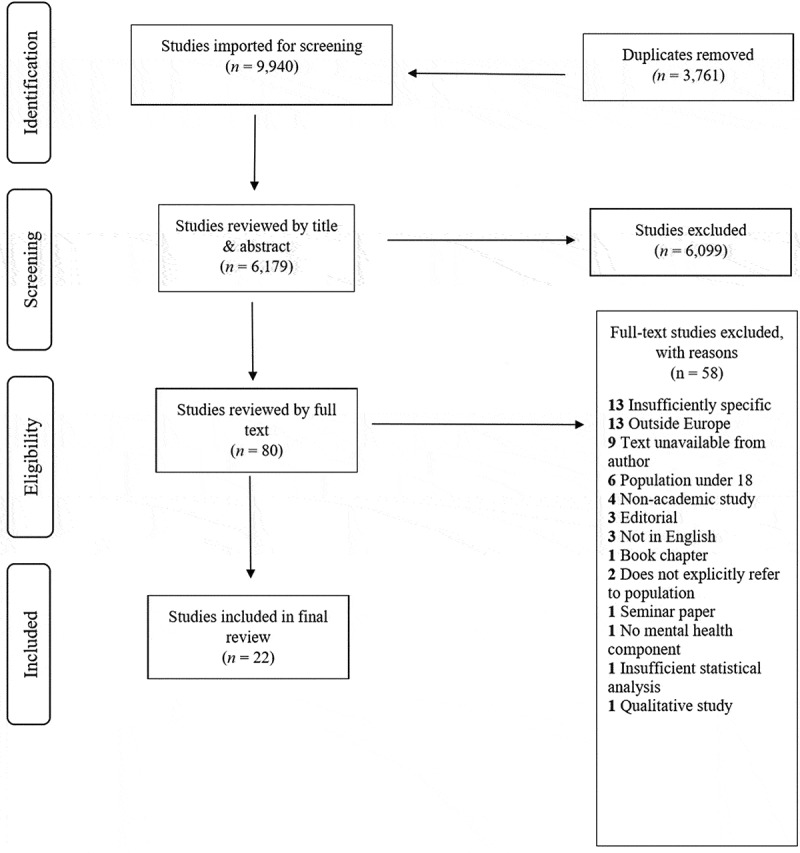
The present systematic review examined post-migration variables impacting upon mental health outcomes among asylum-seeking and refugee populations in Europe. It focuses on the effects of post-settlement stressors (including length of asylum process and duration of stay, residency status and social integration) and their impact upon post-traumatic stress disorder, anxiety and depression. Twenty-two studies were reviewed in this study. Length of asylum process and duration of stay was found to be the most frequently cited factor for mental health difficulties in 9 out of 22 studies. Contrary to expectation, residency or legal status was posited as a marker for other explanatory variables, including loneliness, discrimination and communication or language problems, rather than being an explanatory variable itself. However, in line with previous findings and as hypothesised in this review, there were statistically significant correlations found between family life, family separation and mental health outcomes.
本系统综述考察了影响欧洲寻求庇护者和难民群体心理健康结果的移民后变量。它聚焦于定居后压力源的影响(包括庇护程序时长和停留时间、居住身份和社会融合)及其对创伤后应激障碍、焦虑和抑郁的影响。本研究共综述了22项研究。在22项研究中的9项研究里,庇护程序时长和停留时间被发现是心理健康问题最常被提及的因素。与预期相反,居住或法律身份被认为是其他解释变量的标志,包括孤独、歧视以及沟通或语言问题,而不是其本身作为一个解释变量。然而,与之前的研究结果一致,并且正如本综述所假设的,家庭生活、家庭分离与心理健康结果之间存在统计学上的显著相关性。