Spatial Epidemiology Lab (SpELL), Université Libre de Bruxelles, Bruxelles, Belgium.
Laboratory of Clinical and Epidemiological Virology, Department of Microbiology, Immunology and Transplantation, Rega Institute for Medical Research, KU Leuven, Leuven, Belgium.
Mol Biol Evol. 2021 Apr 13;38(4):1608-1613. doi: 10.1093/molbev/msaa284.
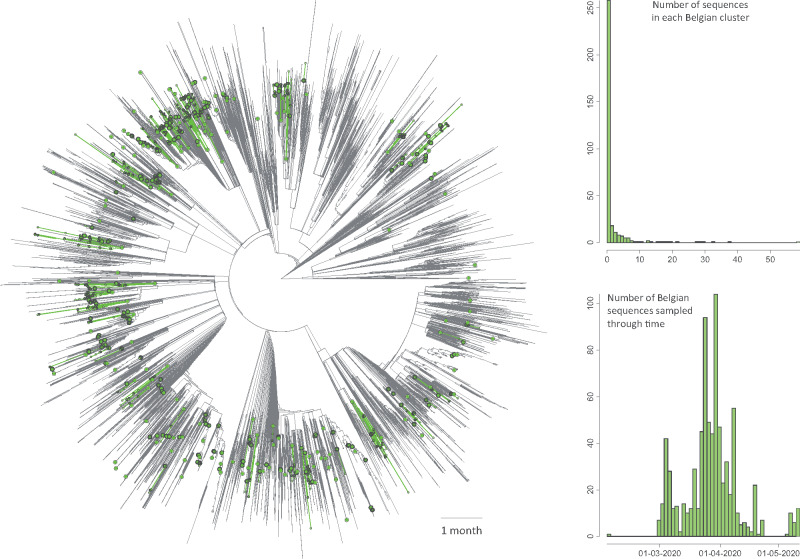
Since the start of the COVID-19 pandemic, an unprecedented number of genomic sequences of SARS-CoV-2 have been generated and shared with the scientific community. The unparalleled volume of available genetic data presents a unique opportunity to gain real-time insights into the virus transmission during the pandemic, but also a daunting computational hurdle if analyzed with gold-standard phylogeographic approaches. To tackle this practical limitation, we here describe and apply a rapid analytical pipeline to analyze the spatiotemporal dispersal history and dynamics of SARS-CoV-2 lineages. As a proof of concept, we focus on the Belgian epidemic, which has had one of the highest spatial densities of available SARS-CoV-2 genomes. Our pipeline has the potential to be quickly applied to other countries or regions, with key benefits in complementing epidemiological analyses in assessing the impact of intervention measures or their progressive easement.
自 COVID-19 大流行开始以来,已经生成了数量空前的 SARS-CoV-2 基因组序列,并与科学界共享。可用遗传数据的空前数量为实时了解大流行期间的病毒传播提供了独特的机会,但如果使用标准的系统地理学方法进行分析,也会带来令人生畏的计算障碍。为了解决这一实际限制,我们在这里描述并应用了一种快速分析管道来分析 SARS-CoV-2 谱系的时空扩散历史和动态。作为概念验证,我们专注于比利时的疫情,该疫情拥有最高密度的可用 SARS-CoV-2 基因组之一。我们的管道有可能快速应用于其他国家或地区,在评估干预措施的影响或逐步放宽这些措施方面,为补充流行病学分析具有重要意义。