Rahman M Shaminur, Hoque M Nazmul, Islam M Rafiul, Islam Israt, Mishu Israt Dilruba, Rahaman Md Mizanur, Sultana Munawar, Hossain M Anwar
Department of Microbiology, University of Dhaka, Dhaka 1000, Bangladesh.
Department of Gynecology, Obstetrics and Reproductive Health, Bangabandhu Sheikh Mujibur Rahman Agricultural University, Gazipur 1706, Bangladesh.
Gene Rep. 2021 Mar;22:100997. doi: 10.1016/j.genrep.2020.100997. Epub 2020 Dec 8.
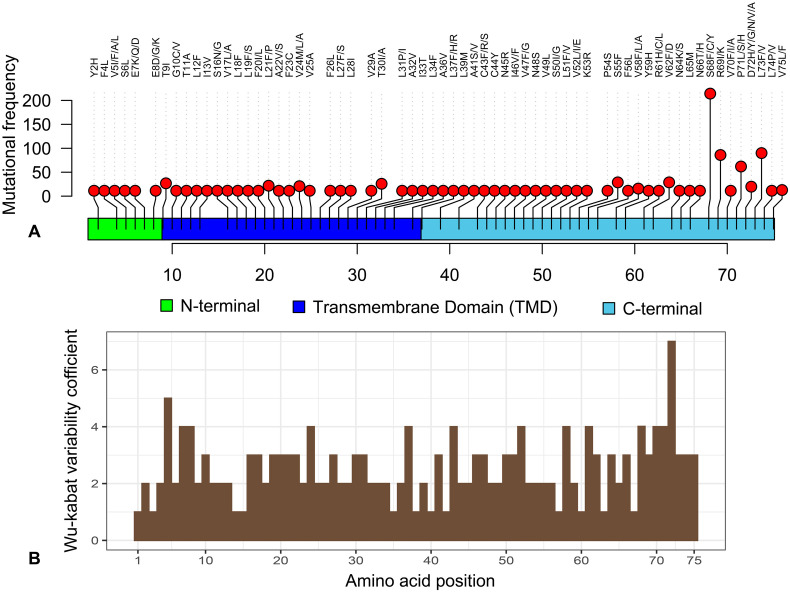
The ongoing mutations in the structural proteins of SARS-CoV-2 are the major impediment for prevention and control of the COVID-19 disease. Presently we focused on evolution of the envelope (E) protein, one of the most enigmatic and less studied protein among the four structural proteins (S, E, M and N) associated with multitude of immunopathological functions of SARS-CoV-2. In the present study, we comprehensively analyzed 81,818 high quality E protein sequences of SARS-CoV-2 globally available in the GISAID database as of 20 August 2020. Compared to Wuhan reference strain, our mutational analysis explored only 1.2 % (982/81818) mutant strains undergoing a total of 115 unique amino acid (aa) substitutions in the E protein, highlighting the fact that most (98.8 %) of the E protein of SARS-CoV-2 strains are highly conserved. Moreover, we found 58.77 % (134 of 228) nucleotides (nt) positions of SARS-CoV-2 gene encountering a total of 176 unique nt-level mutations globally, which may affect the efficacy of real time RT-PCR-based molecular detection of COVID-19. Importantly, higher aa variations observed in the C-terminal domain (CTD) of the E protein, particularly at Ser-Phe, Arg and the C-terminal end (DLLV: 72-75) may alter the binding of SARS-CoV-2 Envelope protein to tight junction-associated PALS1 and thus could play a key role in COVID-19 pathogenesis. Furthermore, this study revealed the V25A mutation in the transmembrane domain which is a key factor for the homopentameric conformation of E protein. Our analysis also observed a triple cysteine motif harboring mutation (L39M, A41S, A41V, C43F, C43R, C43S, C44Y, N45R) which may hinder the binding of E protein with spike glycoprotein. These results therefore suggest the continuous monitoring of the structural proteins including the envelope protein of SARS-CoV-2 since the number of genome sequences from across the world are continuously increasing.
严重急性呼吸综合征冠状病毒2(SARS-CoV-2)结构蛋白的持续突变是新冠病毒疾病防控的主要障碍。目前我们聚焦于包膜(E)蛋白的进化,E蛋白是与SARS-CoV-2多种免疫病理功能相关的四种结构蛋白(S、E、M和N)中最神秘且研究较少的蛋白之一。在本研究中,我们全面分析了截至2020年8月20日全球流感共享数据库(GISAID)中可获取的81818条高质量SARS-CoV-2的E蛋白序列。与武汉参考毒株相比,我们的突变分析仅发现1.2%(982/81818)的突变株,这些突变株的E蛋白总共发生了115个独特的氨基酸(aa)替换,这突出表明SARS-CoV-2毒株的大多数(98.8%)E蛋白高度保守。此外,我们发现SARS-CoV-2基因58.77%(228个中的134个)的核苷酸(nt)位置在全球范围内总共发生了176个独特的nt水平突变,这可能会影响基于实时逆转录聚合酶链反应(RT-PCR)的新冠病毒分子检测的有效性。重要的是,在E蛋白的C末端结构域(CTD)中观察到较高的氨基酸变异,特别是在丝氨酸 - 苯丙氨酸、精氨酸以及C末端(DLLV:72 - 75),这可能会改变SARS-CoV-2包膜蛋白与紧密连接相关的PALS1的结合,从而可能在新冠病毒发病机制中起关键作用。此外,本研究揭示了跨膜结构域中的V25A突变,这是E蛋白同源五聚体构象的关键因素。我们的分析还观察到一个含有突变的三聚体半胱氨酸基序(L39M、A41S、A41V、C43F、C43R、C43S、C44Y、N45R),这可能会阻碍E蛋白与刺突糖蛋白的结合。因此,这些结果表明,由于来自世界各地的基因组序列数量在不断增加,需要持续监测包括SARS-CoV-2包膜蛋白在内的结构蛋白。