Shah Abdullah, Rashid Farooq, Aziz Abdul, Jan Amin Ullah, Suleman Muhammad
Department of Biotechnology, Shaheed Benazir Bhutto University Sheringal, Dir, Pakistan.
School of Public Health, Department of Epidemiology, Southern Medical University, Dermatology Hospital, Guangzhou, China.
Gene Rep. 2020 Dec;21:100886. doi: 10.1016/j.genrep.2020.100886. Epub 2020 Sep 14.
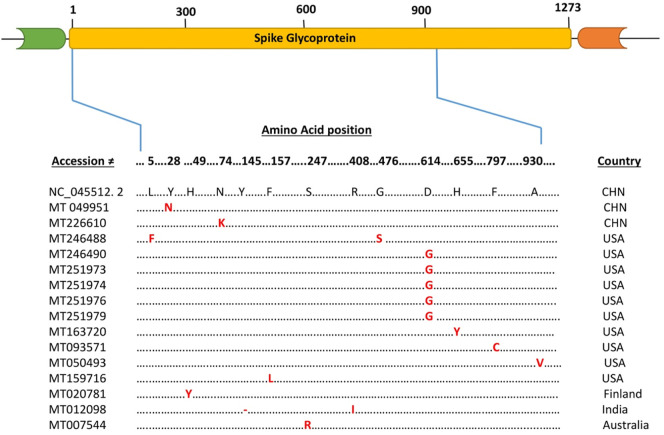
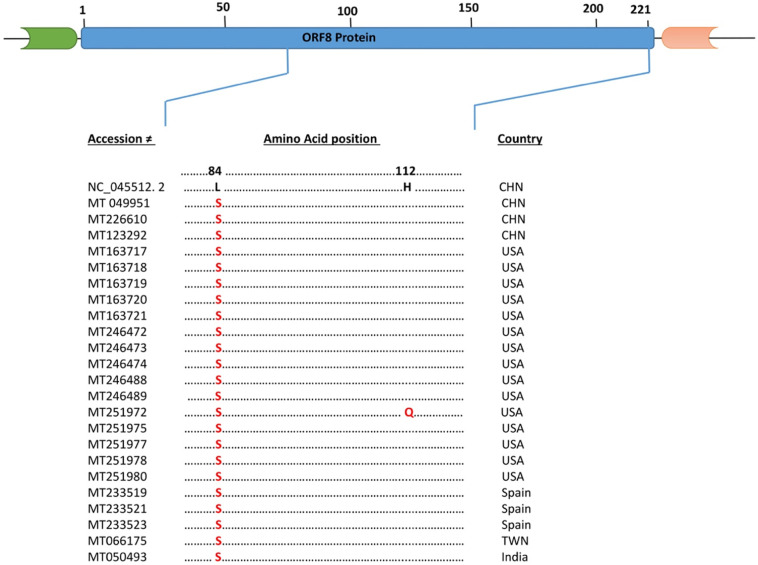
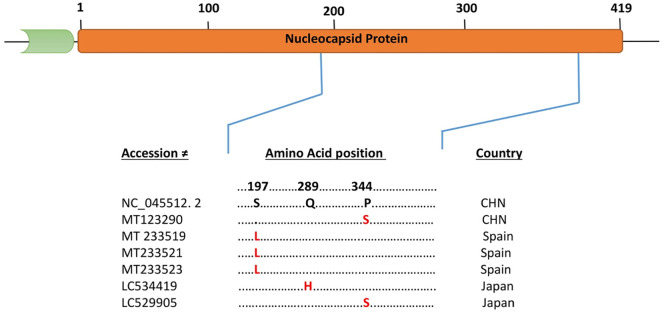
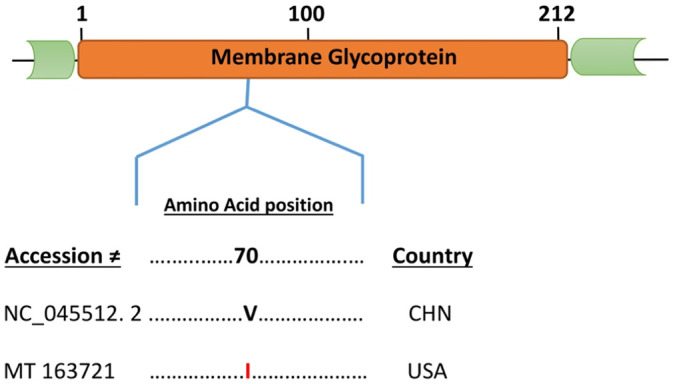
Since December 2019, a severe pandemic of pneumonia, COVID-19 associated with a novel coronavirus (SARS-CoV-2), have emerged in Wuhan, China and spreading throughout the world. As RNA viruses have a high mutation rate therefore we wanted to identify whether this virus is also prone to mutations. For this reason we selected four major structural (Spike protein (S), Envelope protein (E), Membrane glycoprotein (M), Nucleocapsid phosphoprotein (N)) and ORF8 protein of 100 different SARS-CoV-2 isolates of fifteen countries from NCBI database and compared these to the reference sequence, Wuhan NC_045512.2, which was the first isolate of SARS-CoV-2 that was sequenced. By multiple sequence alignment of amino acids, we observed substitutions and deletion in S protein at 13 different sites in the isolates of five countries (China, USA, Finland, India and Australia) as compared to the reference sequence. Similarly, alignment of N protein revealed substitutions at three different sites in isolates of China, Spain and Japan. M protein exhibits substitution only in one isolates from USA, however, no mutation was observed in E protein of any isolate. Interestingly, in ORF8 substitution of Leucine, a nonpolar to Serine a polar amino acid at same position (aa84 L to S) in 23 isolates of five countries i.e. China, USA, Spain, Taiwan and India were observed, which may affect the conformation of peptides. Thus, we observed several mutations in the isolates thereafter the first sequencing of SARS-CoV-2 isolate, NC_045512.2, which suggested that this virus might be a threat to the whole world and therefore further studies are needed to characterize how these mutations in different proteins affect the functionality and pathogenesis of SARS-CoV-2.
自2019年12月以来,一种与新型冠状病毒(SARS-CoV-2)相关的严重肺炎大流行疾病——COVID-19在中国武汉出现并蔓延至全球。由于RNA病毒具有较高的突变率,因此我们想确定这种病毒是否也易于发生突变。出于这个原因,我们从NCBI数据库中选取了来自15个国家的100种不同的SARS-CoV-2分离株的四种主要结构蛋白(刺突蛋白(S)、包膜蛋白(E)、膜糖蛋白(M)、核衣壳磷蛋白(N))和ORF8蛋白,并将它们与参考序列Wuhan NC_045512.2进行比较,该参考序列是首个测序的SARS-CoV-2分离株。通过氨基酸多序列比对,我们观察到与参考序列相比,五个国家(中国、美国、芬兰、印度和澳大利亚)的分离株中S蛋白在13个不同位点存在替换和缺失。同样,N蛋白的比对显示中国、西班牙和日本的分离株在三个不同位点存在替换。M蛋白仅在美国的一个分离株中出现替换,然而,在任何分离株的E蛋白中均未观察到突变。有趣的是,在五个国家(即中国、美国、西班牙、台湾和印度)的23个分离株中,观察到ORF8在相同位置(第84位氨基酸,从非极性的亮氨酸替换为极性的丝氨酸)发生替换,这可能会影响肽的构象。因此,在SARS-CoV-2分离株NC_045512.2首次测序之后,我们在分离株中观察到了几种突变,这表明这种病毒可能对全球构成威胁,因此需要进一步研究来表征不同蛋白质中的这些突变如何影响SARS-CoV-2的功能和发病机制。