Department of Clinical and Translational Research, University of Rochester Medical Center, Rochester, NY.
Nicotine Tob Res. 2020 Dec 15;22(Suppl 1):S85-S92. doi: 10.1093/ntr/ntaa195.
Electronic cigarette use (vaping) has been found to be associated with respiratory symptoms like wheezing or whistling in the chest. Whether or not lifetime vaping occurrences are associated with wheezing has not yet been investigated.
Population Assessment of Tobacco and Health (PATH) Study Wave 4 data with 22,233 adults collected from December 2016 to January 2018 were used. The cross-sectional association of lifetime vaping occurrences with wheezing and related respiratory symptoms was examined using multivariable weighted logistic regression models considering the complex sampling design.
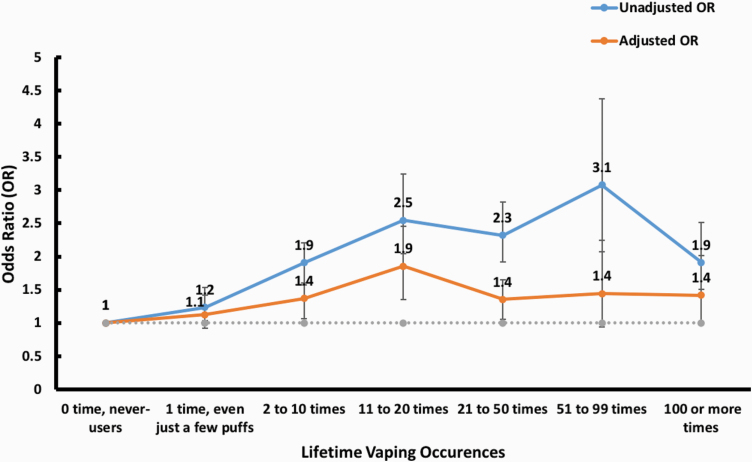
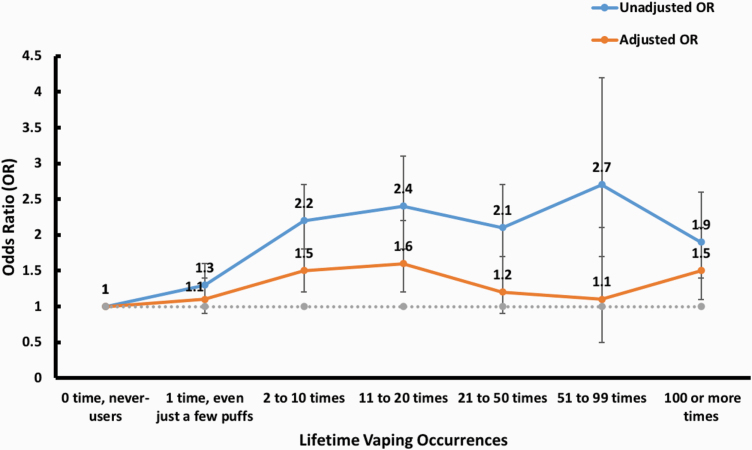
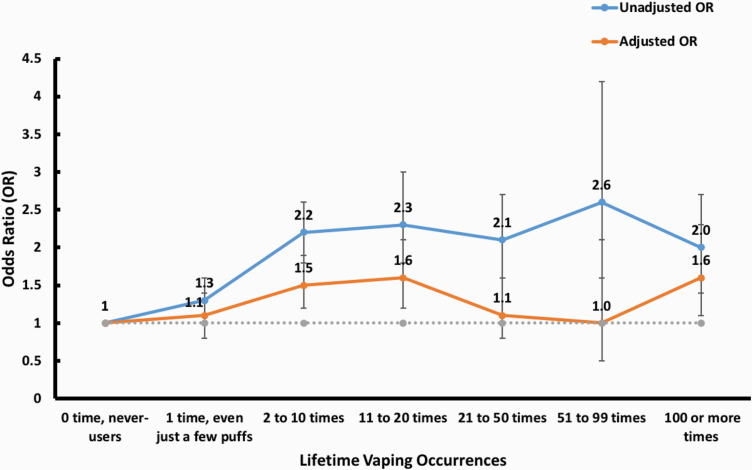
According to the weighted PATH Wave 4 data, about 89.9% adults never vaped, 3.2% adults vaped one time, 3.2% vaped 2-10 times, 1.3% vaped 11-20 times, 1.1% vaped 21-50 times, 0.4% vaped 51-99 times, and 0.9% vaped 100 or more times in their entire life. Compared to adults who never vaped, adults who vaped 2-10 times had a significantly higher association with ever wheezing (aOR = 1.4, 95% CI: 1.1 to 1.6), past 12-month wheezing (aOR = 1.5, 95% CI: 1.2 to 1.9) and the number of wheezing attacks in the past 12 months (aOR = 1.5, 95% CI: 1.2 to 1.8). Adults who vaped 11-20 times and 100 or more times had similar associations with wheezing as that for adults who vaped 2-10 times. Controlling other tobacco use attenuated the associations.
Lifetime vaping occurrences were found to be associated with some definitions of self-reported wheezing in cross-sectional analyses adjusted for other tobacco use.
Using the cross-sectional PATH Wave 4 data with 22,233 adults, we found significant associations between lifetime vaping occurrences and ever wheezing or whistling in the chest, past 12 months wheezing or whistling in the chest, as well as the number of wheezing attacks in the past 12 months. The study results suggest that larger studies with more precise time frames and measures are needed to further understand possible connections between vaping experimentation and wheezing symptoms that could inform our understanding of the health effects of electronic cigarettes and resultant policy decisions.
电子烟的使用( vaping )已被发现与喘息或胸部哨声等呼吸症状有关。尚未研究一生中电子烟的使用次数是否与喘息有关。
使用 2016 年 12 月至 2018 年 1 月期间收集的 22233 名成年人的人口评估烟草与健康( PATH )研究第四波数据。使用多变量加权逻辑回归模型,考虑到复杂的抽样设计,研究了一生中电子烟的使用次数与喘息和相关呼吸症状之间的横断面关联。
根据加权 PATH 波 4 数据,约 89.9%的成年人从未吸过电子烟,3.2%的成年人吸过一次,3.2%的成年人吸过 2-10 次,1.3%的成年人吸过 11-20 次,1.1%的成年人吸过 21-50 次,0.4%的成年人吸过 51-99 次,0.9%的成年人一生中吸过 100 次或更多次。与从未吸过电子烟的成年人相比,吸过 2-10 次电子烟的成年人与过去的喘息(aOR = 1.4,95%CI:1.1 至 1.6)、过去 12 个月的喘息(aOR = 1.5,95%CI:1.2 至 1.9)和过去 12 个月的喘息发作次数(aOR = 1.5,95%CI:1.2 至 1.8)有更高的关联性。吸过 11-20 次和 100 次或更多次电子烟的成年人与吸过 2-10 次电子烟的成年人的喘息关联相似。控制其他烟草使用会减弱这些关联。
在调整其他烟草使用的情况下,一生中电子烟的使用次数与横断面分析中自我报告的喘息某些定义有关。
使用 22233 名成年人的横断面 PATH 波 4 数据,我们发现一生中电子烟的使用次数与过去的喘息或胸部哨声、过去 12 个月的喘息或胸部哨声以及过去 12 个月的喘息发作次数之间存在显著关联。研究结果表明,需要进行更大规模、更精确时间框架和措施的研究,以进一步了解电子烟实验与喘息症状之间可能存在的联系,从而为我们理解电子烟的健康影响和由此产生的政策决策提供依据。