Department of Endocrinology and Metabolism, Amsterdam Gastroenterology Endocrinology and Metabolism, Amsterdam UMC, University of Amsterdam, Meibergdreef 9, 1105 AZ, Amsterdam, The Netherlands.
Endocrine Laboratory, Department of Clinical Chemistry, Amsterdam Gastroenterology Endocrinology and Metabolism, Amsterdam UMC, University of Amsterdam, 1105 AZ, Amsterdam, The Netherlands.
J Endocrinol Invest. 2021 Aug;44(8):1597-1607. doi: 10.1007/s40618-020-01482-4. Epub 2020 Dec 15.
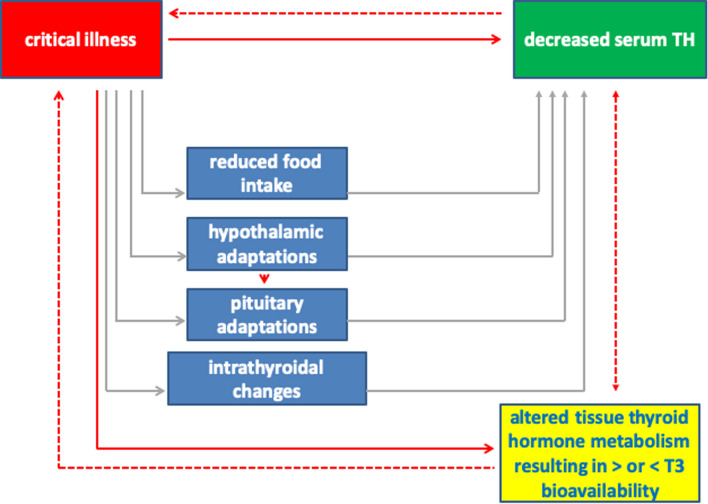
The non-thyroidal illness syndrome (NTIS) was first reported in the 1970s as a remarkable ensemble of changes in serum TH (TH) concentrations occurring in probably any severe illness. Ever since, NTIS has remained an intriguing phenomenon not only because of the robustness of the decrease in serum triiodothyronine (T3), but also by its clear correlation with morbidity and mortality. In recent years, it has become clear that (parenteral) feeding in patients with critical illness should be taken into account as a major determinant not only of NTIS but also of clinical outcome. Moreover, both experimental animal and clinical studies have shown that tissue TH concentrations during NTIS do not necessarily reflect serum low TH concentrations and may decrease, remain unaltered, or even increase according to the organ and type of illness studied. These differential changes now have a solid basis in molecular studies on organ-specific TH transporters, receptors and deiodinases. Finally, the role of inflammatory pathways in these non-systemic changes has begun to be clarified. A fascinating role for TH metabolism in innate immune cells, including neutrophils and monocytes/macrophages, was reported in recent years, but there is no evidence at this early stage that this may be a determinant of susceptibility to infections. Although endocrinologists have been tempted to correct NTIS by TH supplementation, there is at present insufficient evidence that this is beneficial. Thus, there is a clear need for adequately powered randomized clinical trials (RCT) with clinically relevant endpoints to fill this knowledge gap.
非甲状腺疾病综合征(NTIS)于 20 世纪 70 年代首次报道,是一种在任何严重疾病中都可能发生的血清 TH(TH)浓度显著变化的综合征。从那时起,NTIS 一直是一个有趣的现象,不仅因为血清三碘甲状腺原氨酸(T3)的降低显著,还因为它与发病率和死亡率有明确的相关性。近年来,很明显,在危重病患者中,(肠外)喂养应该被视为 NTIS 发生的主要决定因素,也是临床结局的主要决定因素。此外,动物实验和临床研究都表明,NTIS 期间组织 TH 浓度不一定反映血清低 TH 浓度,并且根据所研究的器官和疾病类型,可能会降低、保持不变或甚至增加。这些差异变化现在在器官特异性 TH 转运蛋白、受体和脱碘酶的分子研究中有了坚实的基础。最后,炎症途径在这些非系统性变化中的作用开始得到阐明。近年来,研究报道了 TH 代谢在先天免疫细胞(包括中性粒细胞和单核细胞/巨噬细胞)中的迷人作用,但在现阶段,没有证据表明这可能是易感染的决定因素。尽管内分泌学家试图通过 TH 补充来纠正 NTIS,但目前没有足够的证据表明这是有益的。因此,迫切需要进行具有临床相关终点的充分随机对照临床试验(RCT)来填补这一知识空白。