Department of Critical Care Medicine, Hospital Israelita Albert Einstein, São Paulo, Brazil.
Department of Laboratory Center, Hospital Israelita Albert Einstein, São Paulo, Brazil.
PLoS One. 2020 Dec 15;15(12):e0243604. doi: 10.1371/journal.pone.0243604. eCollection 2020.
Coagulation abnormalities in COVID-19 patients have not been addressed in depth.
To perform a longitudinal evaluation of coagulation profile of patients admitted to the ICU with COVID-19.
Conventional coagulation tests, rotational thromboelastometry (ROTEM), platelet function, fibrinolysis, antithrombin, protein C and S were measured at days 0, 1, 3, 7 and 14. Based on median total maximum SOFA score, patients were divided in two groups: SOFA ≤ 10 and SOFA > 10.
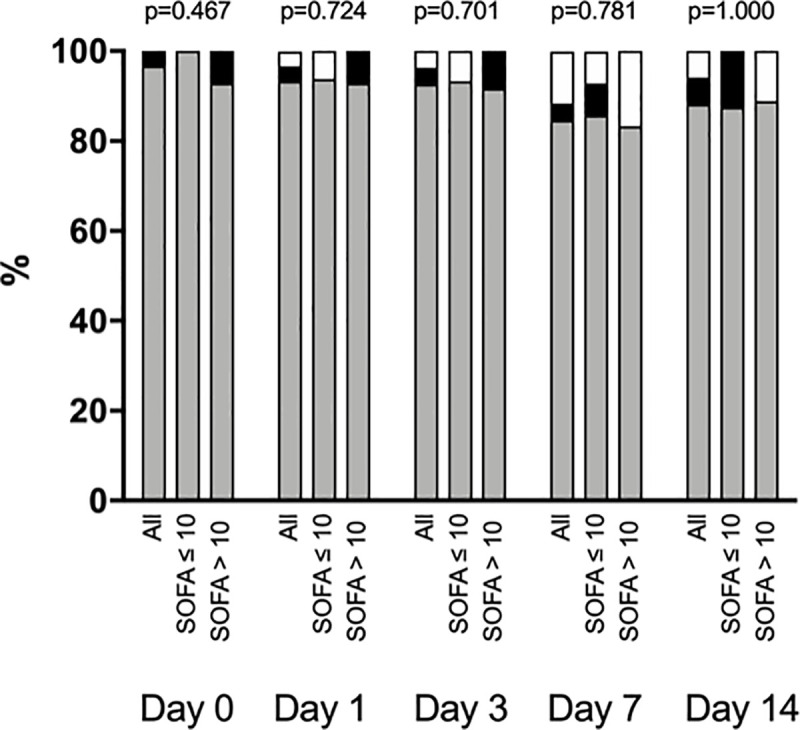
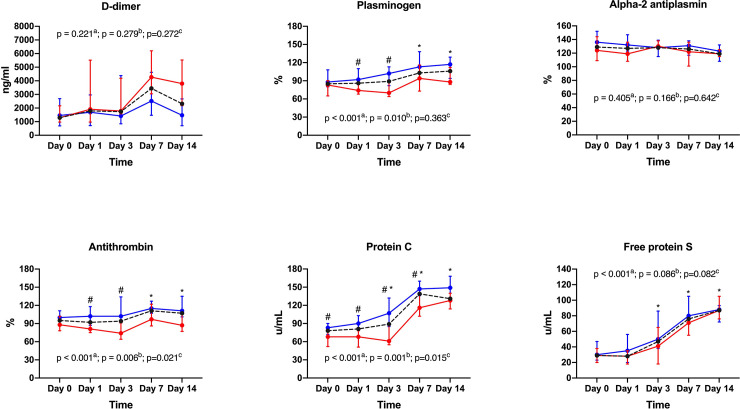
Thirty patients were studied. Some conventional coagulation tests, as aPTT, PT and INR remained unchanged during the study period, while alterations on others coagulation laboratory tests were detected. Fibrinogen levels were increased in both groups. ROTEM maximum clot firmness increased in both groups from Day 0 to Day 14. Moreover, ROTEM-FIBTEM maximum clot firmness was high in both groups, with a slight decrease from day 0 to day 14 in group SOFA ≤ 10 and a slight increase during the same period in group SOFA > 10. Fibrinolysis was low and decreased over time in all groups, with the most pronounced decrease observed in INTEM maximum lysis in group SOFA > 10. Also, D-dimer plasma levels were higher than normal reference range in both groups and free protein S plasma levels were low in both groups at baseline and increased over time, Finally, patients in group SOFA > 10 had lower plasminogen levels and Protein C than patients with SOFA <10, which may represent less fibrinolysis activity during a state of hypercoagulability.
COVID-19 patients have a pronounced hypercoagulability state, characterized by impaired endogenous anticoagulation and decreased fibrinolysis. The magnitude of coagulation abnormalities seems to correlate with the severity of organ dysfunction. The hypercoagulability state of COVID-19 patients was not only detected by ROTEM but it much more complex, where changes were observed on the fibrinolytic and endogenous anticoagulation system.
COVID-19 患者的凝血异常尚未得到深入研究。
对入住 ICU 的 COVID-19 患者的凝血谱进行纵向评估。
在第 0、1、3、7 和 14 天测量常规凝血试验、旋转血栓弹性测定法(ROTEM)、血小板功能、纤维蛋白溶解、抗凝血酶、蛋白 C 和 S。根据中位数总最大 SOFA 评分,患者分为两组:SOFA≤10 和 SOFA>10。
共 30 例患者入组。在研究期间,一些常规凝血试验,如 aPTT、PT 和 INR 保持不变,而其他凝血实验室试验则发生了变化。两组纤维蛋白原水平均升高。两组 ROTEM 最大凝块硬度从第 0 天到第 14 天增加。此外,两组 ROTEM-FIBTEM 最大凝块硬度均较高,SOFA≤10 组从第 0 天到第 14 天略有下降,SOFA>10 组在此期间略有增加。纤溶作用低且随时间推移逐渐下降,SOFA>10 组中 INTEM 最大溶解率下降最为明显。此外,两组患者的 D-二聚体血浆水平均高于正常参考范围,两组游离蛋白 S 血浆水平在基线时均较低,且随时间推移而升高。最后,SOFA>10 组的患者比 SOFA<10 组的患者具有较低的纤溶酶原水平和蛋白 C,这可能代表在高凝状态下的纤溶活性较低。
COVID-19 患者存在明显的高凝状态,表现为内源性抗凝受损和纤溶作用降低。凝血异常的严重程度似乎与器官功能障碍的严重程度相关。COVID-19 患者的高凝状态不仅通过 ROTEM 检测到,而且更为复杂,在纤维蛋白溶解和内源性抗凝系统中都观察到了变化。