Population, Policy and Practice Research and Teaching Department, UCL Great Ormond Street Institute of Child Health, London, United Kingdom.
NIHR Children and Families Policy Research Unit, UCL Great Ormond Street Institute of Child Health, London, United Kingdom.
PLoS One. 2020 Dec 15;15(12):e0243843. doi: 10.1371/journal.pone.0243843. eCollection 2020.
National birth cohorts derived from administrative health databases constitute unique resources for child health research due to whole country coverage, ongoing follow-up and linkage to other data sources. In England, a national birth cohort can be developed using Hospital Episode Statistics (HES), an administrative database covering details of all publicly funded hospital activity, including 97% of births, with longitudinal follow-up via linkage to hospital and mortality records. We present methods for developing a national birth cohort using HES and assess the impact of changes to data collection over time on coverage and completeness of linked follow-up records for children.
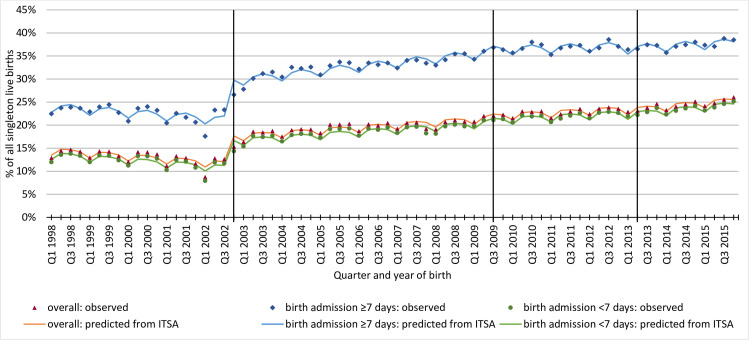
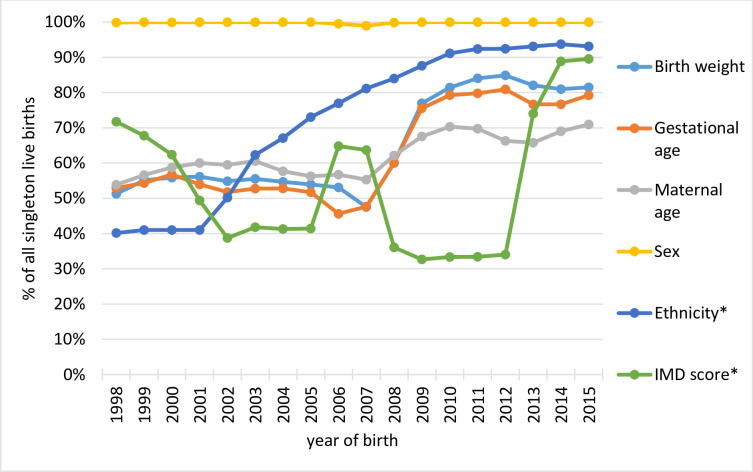
We developed a national cohort of singleton live births in 1998-2015, with information on key risk factors at birth (birth weight, gestational age, maternal age, ethnicity, area-level deprivation). We identified three changes to data collection, which could affect linkage of births to follow-up records: (1) the introduction of the "NHS Numbers for Babies (NN4B)", an on-line system which enabled maternity staff to request a unique healthcare patient identifier (NHS number) immediately at birth rather than at civil registration, in Q4 2002; (2) the introduction of additional data quality checks at civil registration in Q3 2009; and (3) correcting a postcode extraction error for births by the data provider in Q2 2013. We evaluated the impact of these changes on trends in two outcomes in infancy: hospital readmissions after birth (using interrupted time series analyses) and mortality rates (compared to published national statistics).
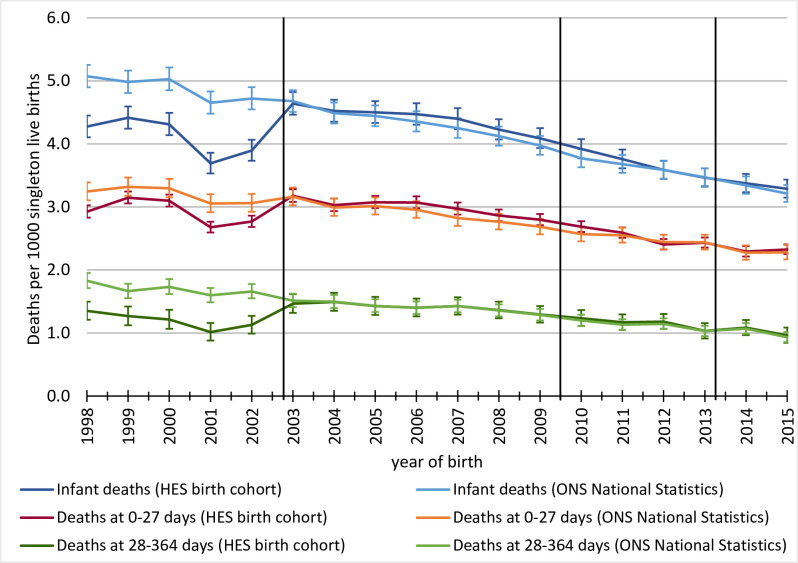
The cohort covered 10,653,998 babies, accounting for 96% of singleton live births in England in 1998-2015. Overall, 2,077,929 infants (19.5%) had at least one hospital readmission after birth. Readmission rates declined by 0.2% percentage points per annual quarter in Q1 1998 to Q3 2002, shifted up by 6.1% percentage points (compared to the expected value based on the trend before Q4 2002) to 17.7% in Q4 2002 when NN4B was introduced, and increased by 0.1% percentage points per annual quarter thereafter. Infant mortality rates were under-reported by 16% for births in 1998-2002 and similar to published national mortality statistics for births in 2003-2015. The trends in infant readmission were not affected by changes to data collection practices in Q3 2009 and Q2 2013, but the proportion of unlinked mortality records in HES and in ONS further declined after 2009.
HES can be used to develop a national birth cohort for child health research with follow-up via linkage to hospital and mortality records for children born from 2003 onwards. Re-linking births before 2003 to their follow-up records would maximise potential benefits of this rich resource, enabling studies of outcomes in adolescents with over 20 years of follow-up.
基于行政健康数据库的国家出生队列由于覆盖全国、持续随访以及与其他数据源的链接,构成了儿童健康研究的独特资源。在英国,可以使用医院入院统计(HES)开发国家出生队列,这是一个涵盖所有公共资助医院活动详细信息的行政数据库,包括 97%的出生记录,并通过与医院和死亡率记录的链接进行纵向随访。我们介绍了使用 HES 开发国家出生队列的方法,并评估了随着时间的推移数据收集的变化对儿童随访记录的覆盖范围和完整性的影响。
我们开发了一个 1998 年至 2015 年期间的单胎活产儿国家队列,其中包括出生时关键风险因素的信息(出生体重、胎龄、母亲年龄、种族、地区贫困程度)。我们确定了三个数据收集的变化,这些变化可能会影响出生与随访记录的链接:(1)在 2002 年第四季度引入了“NHS 婴儿编号(NN4B)”,这是一个在线系统,使产科工作人员能够在出生时立即请求唯一的医疗保健患者标识符(NHS 编号),而不是在民事登记时;(2)在 2009 年第三季度引入了更多的数据质量检查;(3)数据提供商在 2013 年第二季度纠正了邮政编码提取错误。我们评估了这些变化对婴儿期两个结果的趋势的影响:出生后的住院再入院(使用中断时间序列分析)和死亡率(与公布的国家统计数据进行比较)。
该队列涵盖了 10653998 名婴儿,占英格兰 1998 年至 2015 年期间单胎活产儿的 96%。总体而言,有 2077929 名婴儿(19.5%)在出生后至少有一次住院再入院。再入院率在 1998 年第一季度至 2002 年第三季度每季度下降 0.2%,在 2002 年第四季度 NN4B 引入时上升 6.1%(与 2002 年第四季度之前的趋势相比),达到 17.7%,此后每季度上升 0.1%。1998 年至 2002 年出生的婴儿死亡率报告偏低 16%,与 2003 年至 2015 年公布的国家死亡率统计数据相似。数据收集实践的变化在 2009 年第三季度和 2013 年第二季度并没有影响婴儿再入院的趋势,但 HES 和 ONS 中未链接的死亡率记录的比例在 2009 年之后进一步下降。
HES 可用于开发一个国家出生队列,用于儿童健康研究,通过与医院和死亡率记录的链接进行儿童随访。重新链接 2003 年前的出生记录与他们的随访记录,将最大限度地发挥这一丰富资源的潜在效益,使研究人员能够对 20 多年随访的青少年的结果进行研究。