Allen Foster Community Eye Health Research Centre, Gullapalli Pratibha Rao International Centre for Advancement of Rural Eyecare, L V Prasad Eye Institute, Hyderabad, Telangana, India.
Allen Foster Community Eye Health Research Centre, Gullapalli Pratibha Rao International Centre for Advancement of Rural Eyecare; Brien Holden Eye Research Centre, L V Prasad Eye Institute, Hyderabad, Telangana, India; School of Optometry and Vision Science, University of New South Wales, Sydney, Australia; University of Rochester, School of Medicine and Dentistry, Rochester, NY, USA.
Indian J Ophthalmol. 2021 Jan;69(1):117-121. doi: 10.4103/ijo.IJO_1740_19.
Screening preschool children for vision-related disorders poses a challenge. This study is designed to determine the agreement and diagnostic accuracy of the spot vision screener (SVS) in screening preschool children compared to screening procedure by vision technicians (VT).
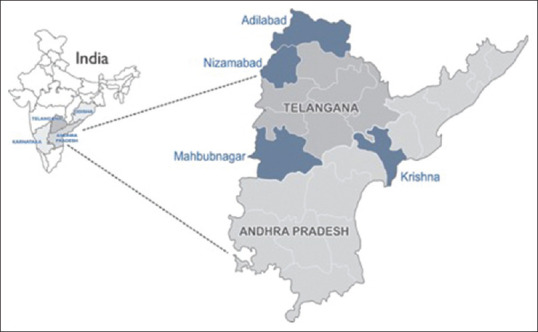
This study was conducted as a part of the ongoing study titled "Initiative for Screening Children for Refractive Errors and other Eye Health Needs (I-SCREEN)." Children from 33 Anganwadis (preschools) in two districts, Adilabad district of Telangana and Krishna district of Andhra Pradesh, in South India, underwent eye health screening by a VT and by a trained community eye health workers (CEHW) using the SVS. Findings were compared for agreement and diagnostic accuracy of assessment.
A total of 976 preschool children were screened by the VT and separately by the CEHW using the SVS in Adilabad (15 schools) and Krishna (18 schools) districts. The overall mean age of these children was 2.5 years (SD ± 1.3 years). There were 48 (4.9%) referrals by VT compared to 105 (10.8%) referrals by CEHW using SVS. The overall sensitivity of SVS was 91.7% (95% CI: 80%-97.7%) and the specificity was 93.4% (95% CI: 91.6%-94.9%). Positive predictive value was 41.9% (95% CI: 32.3%-51.9%) and negative predictive value was 99.5% (95% CI: 98.8%-99.9%) with a moderate agreement (0.54; 95% CI 0.49-0.64) between VT screening and screening with SVS.
The SVS showed good diagnostic accuracy and agreement in screening for possible vision-related disorders in preschool children.
对学龄前儿童进行视力相关障碍筛查具有挑战性。本研究旨在确定与视力技术人员(VT)的筛查程序相比,点状视力筛查仪(SVS)筛查学龄前儿童的一致性和诊断准确性。
本研究是正在进行的题为“儿童屈光不正和其他眼健康需求筛查倡议(I-SCREEN)”的一部分。来自印度南部泰伦加纳邦阿迪拉巴德区和安得拉邦克里希纳区的 33 个安加纳德(幼儿园)的儿童由 VT 和经过培训的社区眼保健工作者(CEHW)使用 SVS 进行眼健康筛查。对评估的一致性和诊断准确性进行比较。
共有 976 名学龄前儿童在阿迪拉巴德(15 所学校)和克里希纳(18 所学校)地区由 VT 单独筛查,由 CEHW 使用 SVS 筛查。这些儿童的平均年龄为 2.5 岁(标准差±1.3 岁)。VT 转诊 48 例(4.9%),CEHW 使用 SVS 转诊 105 例(10.8%)。SVS 的总体敏感性为 91.7%(95%置信区间:80%-97.7%),特异性为 93.4%(95%置信区间:91.6%-94.9%)。阳性预测值为 41.9%(95%置信区间:32.3%-51.9%),阴性预测值为 99.5%(95%置信区间:98.8%-99.9%),VT 筛查与 SVS 筛查之间存在中度一致性(0.54;95%置信区间 0.49-0.64)。
SVS 在筛查学龄前儿童可能存在的视力相关障碍方面具有良好的诊断准确性和一致性。