Department of Ophthalmology, The David J Apple Center for Vision Research, University Hospital Heidelberg, Heidelberg, Germany.
Department of Ophthalmology, Gavin Herbert Eye Institute, University of California, Irvine, CA.
Retina. 2021 Jun 1;41(6):1302-1308. doi: 10.1097/IAE.0000000000003032.
Human photoreceptors are sensitive to infrared light (IR). This sensitivity can be used as a novel indicator of retinal function. Diabetic retinopathy patients were assessed using in vivo two-photon excitation and compared their scotopic IR threshold with that of healthy patients.
Sixty-two participants, 28 healthy and 34 with diabetic retinopathy, underwent a comprehensive eye examination, where visual acuity and contrast sensitivity were assessed. Infrared thresholds were measured in the fovea and parafovea following 30-minute dark adaptation. A two-photon excitation device was used with integrated pulsed laser light (1,045 nm) for sensitivity testing and scanning laser ophthalmoscopy for fundus imaging.
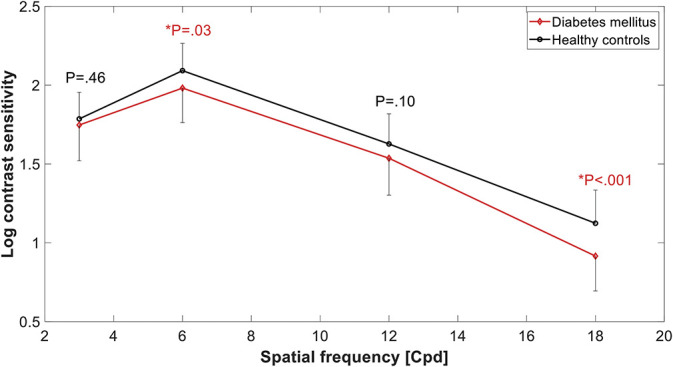
The mean Snellen visual acuity of diabetic patients (6/7.7) was worse than that of the healthy patients (6/5.5), which was significantly different (P < 0.001). Disease patients had decreased contrast sensitivity, especially at 6 and 18 cycles/degree. The mean retinal sensitivity to IR light in eyes with diabetic retinopathy (11.6 ± 2.0 dB) was significantly (P < 0.001) lower than that in normal eyes (15.5 ± 1.3 dB).
Compared with healthy control subjects, the IR light sensitivity of diabetic patients was significantly impaired. Two-photon measurements can be used in the assessment of retinal disease, but further studies are needed to validate IR light stimulation in various stages of diabetic retinopathy.
人类光感受器对红外光(IR)敏感。这种敏感性可以用作视网膜功能的新型指标。使用体内双光子激发评估糖尿病视网膜病变患者,并将其暗适应 IR 阈值与健康患者进行比较。
62 名参与者,28 名健康人和 34 名糖尿病视网膜病变患者接受了全面的眼科检查,评估了视力和对比敏感度。在 30 分钟暗适应后,在黄斑和旁黄斑处测量红外阈值。使用集成脉冲激光(1045nm)进行双光子激发设备进行灵敏度测试和扫描激光检眼镜眼底成像。
糖尿病患者的平均 Snellen 视力(6/7.7)比健康患者(6/5.5)差,差异有统计学意义(P<0.001)。患者的对比敏感度下降,尤其是在 6 和 18 个周期/度时。糖尿病视网膜病变眼的视网膜对 IR 光的平均敏感度(11.6±2.0dB)明显低于正常眼(15.5±1.3dB)(P<0.001)。
与健康对照组相比,糖尿病患者的 IR 光敏感度明显受损。双光子测量可用于评估视网膜疾病,但需要进一步研究来验证 IR 光刺激在糖尿病视网膜病变的各个阶段的效果。