Zhu Rongxin, Tian Shui, Wang Huan, Jiang Haiteng, Wang Xinyi, Shao Junneng, Wang Qiang, Yan Rui, Tao Shiwan, Liu Haiyan, Yao Zhijian, Lu Qing
Department of Psychiatry, The Affiliated Brain Hospital of Nanjing Medical University, Nanjing, China.
School of Biological Sciences and Medical Engineering, Southeast University, Nanjing, China.
Front Psychiatry. 2020 Nov 26;11:597770. doi: 10.3389/fpsyt.2020.597770. eCollection 2020.
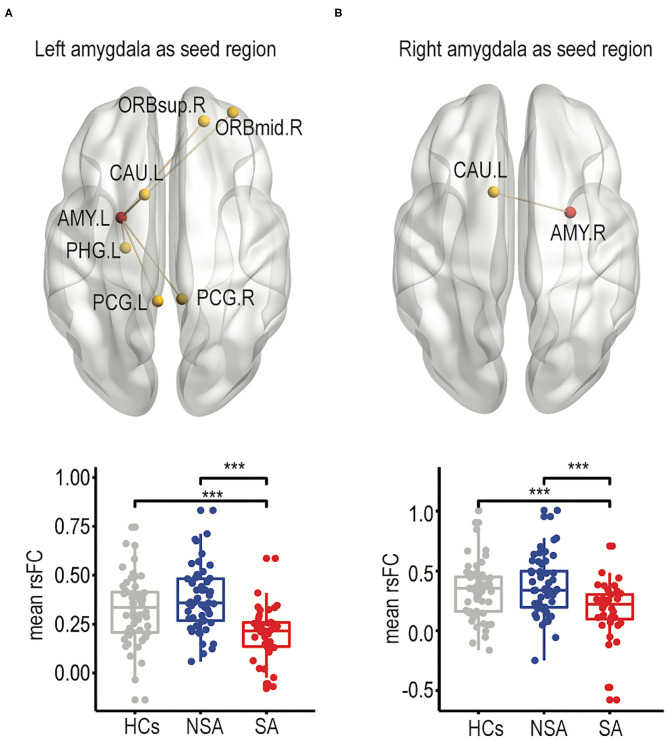
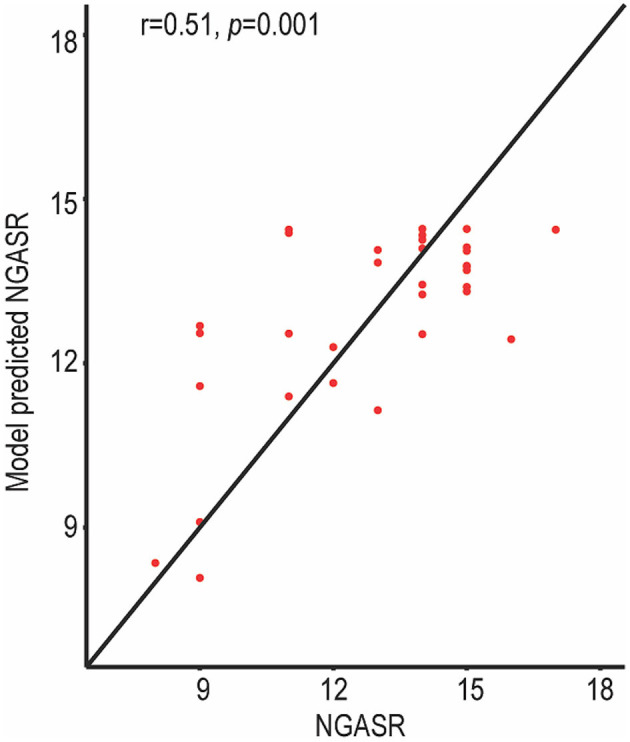
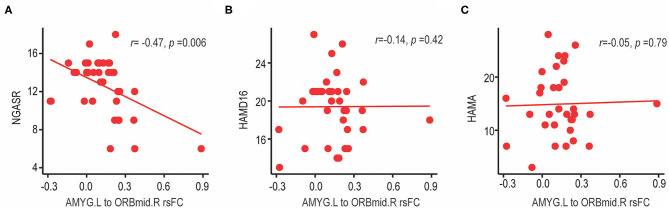
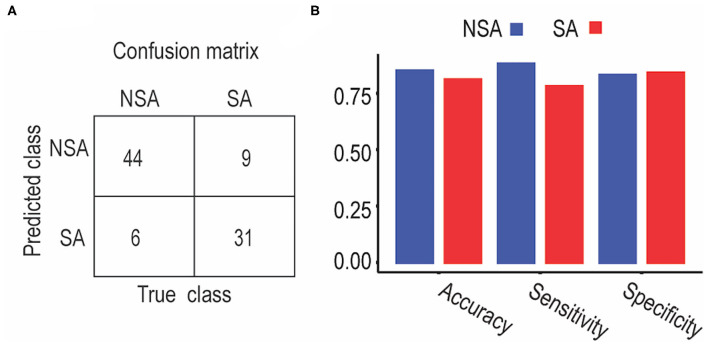
Bipolar II disorder (BD-II) major depression episode is highly associated with suicidality, and objective neural biomarkers could be key elements to assist in early prevention and intervention. This study aimed to integrate altered brain functionality in the frontolimbic system and machine learning techniques to classify suicidal BD-II patients and predict suicidality risk at the individual level. A cohort of 169 participants were enrolled, including 43 BD-II depression patients with at least one suicide attempt during a current depressive episode (SA), 62 BD-II depression patients without a history of attempted suicide (NSA), and 64 demographically matched healthy controls (HCs). We compared resting-state functional connectivity (rsFC) in the frontolimbic system among the three groups and explored the correlation between abnormal rsFCs and the level of suicide risk (assessed using the Nurses' Global Assessment of Suicide Risk, NGASR) in SA patients. Then, we applied support vector machines (SVMs) to classify SA vs. NSA in BD-II patients and predicted the risk of suicidality. SA patients showed significantly decreased frontolimbic rsFCs compared to NSA patients. The left amygdala-right middle frontal gyrus (orbital part) rsFC was negatively correlated with NGASR in the SA group, but not the severity of depressive or anxiety symptoms. Using frontolimbic rsFCs as features, the SVMs obtained an overall 84% classification accuracy in distinguishing SA and NSA. A significant correlation was observed between the SVMs-predicted NGASR and clinical assessed NGASR ( = 0.51, = 0.001). Our results demonstrated that decreased rsFCs in the frontolimbic system might be critical objective features of suicidality in BD-II patients, and could be useful for objective prediction of suicidality risk in individuals.
双相II型障碍(BD-II)的重度抑郁发作与自杀行为高度相关,客观的神经生物标志物可能是协助早期预防和干预的关键因素。本研究旨在整合额边缘系统中改变的脑功能和机器学习技术,以对有自杀行为的BD-II患者进行分类,并在个体水平上预测自杀风险。招募了169名参与者,包括43名在当前抑郁发作期间至少有一次自杀未遂的BD-II抑郁患者(SA)、62名无自杀未遂史的BD-II抑郁患者(NSA)和64名人口统计学匹配的健康对照者(HC)。我们比较了三组之间额边缘系统的静息态功能连接(rsFC),并探讨了SA患者中异常rsFC与自杀风险水平(使用护士全球自杀风险评估量表NGASR进行评估)之间的相关性。然后,我们应用支持向量机(SVM)对BD-II患者中的SA与NSA进行分类,并预测自杀风险。与NSA患者相比,SA患者的额边缘rsFC显著降低。SA组中左侧杏仁核-右侧额中回(眶部)的rsFC与NGASR呈负相关,但与抑郁或焦虑症状严重程度无关。以额边缘rsFC为特征,SVM在区分SA和NSA方面的总体分类准确率为84%。观察到SVM预测的NGASR与临床评估的NGASR之间存在显著相关性(r = 0.51,p = 0.001)。我们的结果表明,额边缘系统中rsFC降低可能是BD-II患者自杀行为的关键客观特征,并且可用于个体自杀风险的客观预测。