Singh Udisha, Morya Vinod, Rajwar Anjali, Chandrasekaran Arun Richard, Datta Bhaskar, Ghoroi Chinmay, Bhatia Dhiraj
Biological Engineering Discipline, Indian Institute of Technology Gandhinagar, Palaj, Gujarat 382355, India.
The RNA Institute, University at Albany, State University of New York, Albany, New York 12222, United States.
ACS Omega. 2020 Nov 28;5(48):30767-30774. doi: 10.1021/acsomega.0c03656. eCollection 2020 Dec 8.
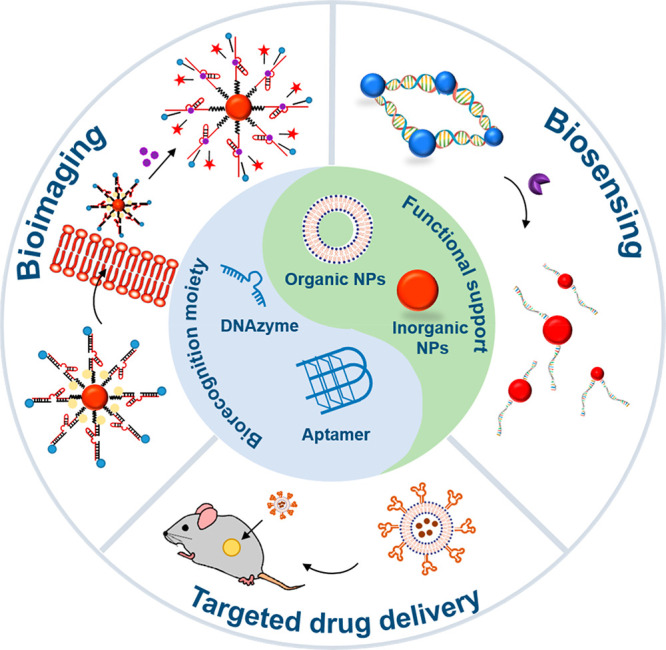
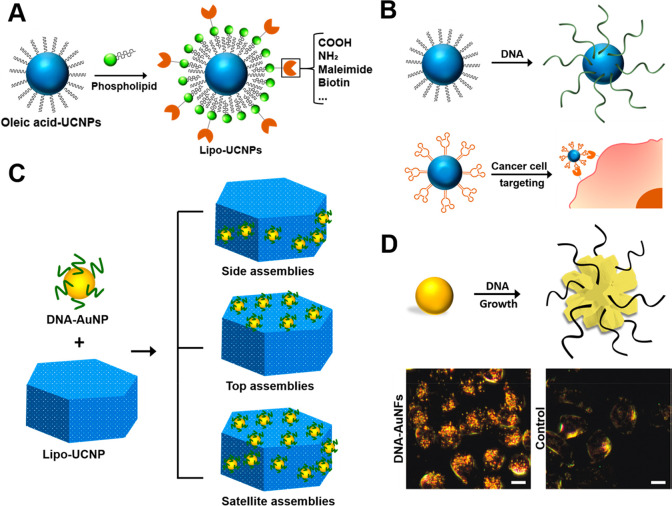
Nanoscale systems have increasingly been used in biomedical applications, enhancing the demand for the development of biomolecule-functionalized nanoparticles for targeted applications. Such designer nanosystems hold great prospective to refine disease diagnosis and treatment. To completely investigate their potential for bioapplications, nanoparticles must be biocompatible and targetable toward explicit receptors to guarantee particular detecting, imaging, and medication conveyance in complex organic milieus, for example, living cells, tissues, and organisms. We present recent works that explore enhanced biocompatibility and biorecognition of nanoparticles functionalized with DNA and different DNA entities such as aptamers, DNAzymes, and aptazymes. We sum up the methods utilized in the amalgamation of complex nanostructures, survey the significant types of multifunctional nanoparticles that have been developed in the course of recent years, and give a perceptual vision of the significant field of nanomedicine. The field of DNA-functionalized nanoparticles holds an incredible guarantee in rising biomedical zones, for example, multimodal imaging, theranostics, and picture-guided treatments.
纳米级系统在生物医学应用中越来越多地被使用,这增加了对用于靶向应用的生物分子功能化纳米颗粒开发的需求。这种定制的纳米系统在改进疾病诊断和治疗方面具有巨大的前景。为了全面研究它们在生物应用中的潜力,纳米颗粒必须具有生物相容性并且能够靶向特定的受体,以确保在复杂的有机环境(例如活细胞、组织和生物体)中进行特定的检测、成像和药物输送。我们展示了最近的研究成果,这些研究探索了用DNA和不同的DNA实体(如适体、脱氧核酶和适体酶)功能化的纳米颗粒的增强生物相容性和生物识别能力。我们总结了用于合成复杂纳米结构的方法,综述了近年来开发的多功能纳米颗粒的主要类型,并对纳米医学的重要领域给出了一个直观的展望。DNA功能化纳米颗粒领域在新兴的生物医学领域(如多模态成像、治疗诊断学和图像引导治疗)有着令人难以置信的前景。