Department of Pharmacy Practice and Pharmaceutical Sciences, College of Pharmacy, University of Minnesota Duluth, Duluth, Minnesota, USA.
Department of Pediatrics, University of Cincinnati College of Medicine, Cincinnati, Ohio, USA.
Clin Transl Sci. 2021 Mar;14(2):692-701. doi: 10.1111/cts.12931. Epub 2020 Dec 16.
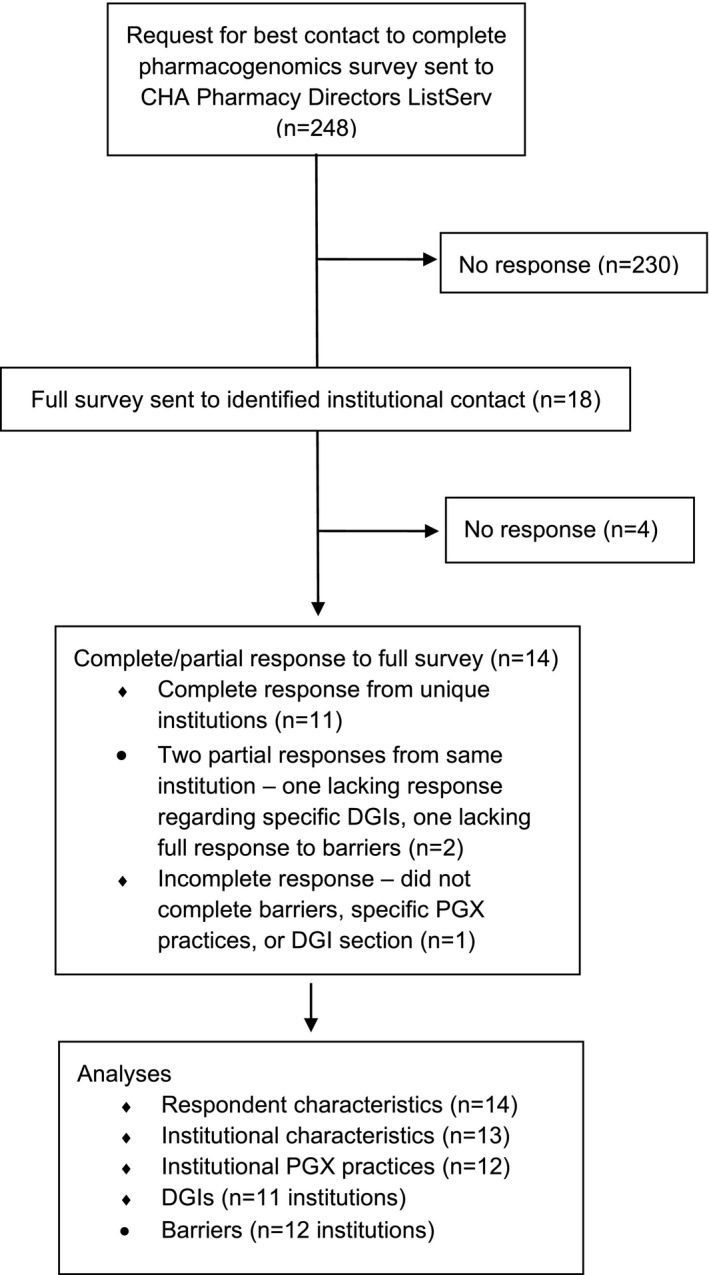
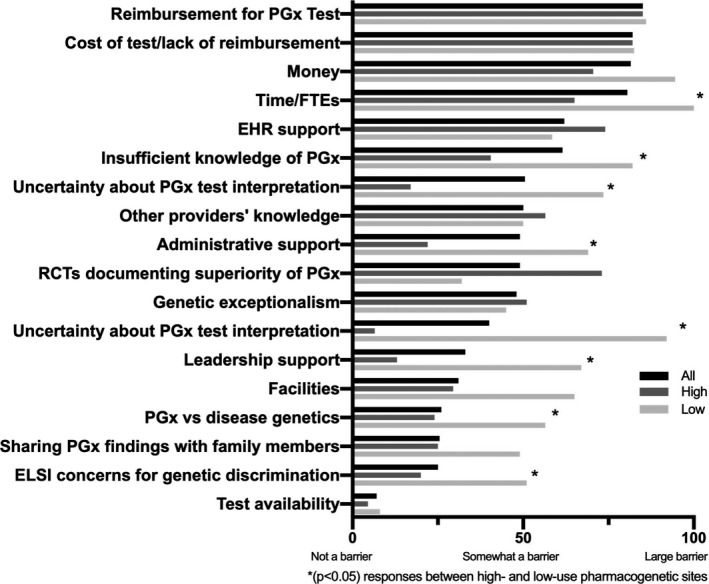
Although pharmacogenetic testing is becoming increasingly common across medical subspecialties, a broad range of utilization and implementation exists across pediatric centers. Large pediatric institutions that routinely use pharmacogenetics in their patient care have published their practices and experiences; however, minimal data exist regarding the full spectrum of pharmacogenetic implementation among children's hospitals. The primary objective of this nationwide survey was to characterize the availability, concerns, and barriers to pharmacogenetic testing in children's hospitals in the Children's Hospital Association. Initial responses identifying a contact person were received from 18 institutions. Of those 18 institutions, 14 responses (11 complete and 3 partial) to a more detailed survey regarding pharmacogenetic practices were received. The majority of respondents were from urban institutions (72%) and held a Doctor of Pharmacy degree (67%). Among all respondents, the three primary barriers to implementing pharmacogenetic testing identified were test reimbursement, test cost, and money. Conversely, the three least concerning barriers were potential for genetic discrimination, sharing results with family members, and availability of tests in certified laboratories. Low-use sites rated several barriers significantly higher than the high-use sites, including knowledge of pharmacogenetics (P = 0.03), pharmacogenetic interpretations (P = 0.04), and pharmacogenetic-based changes to therapy (P = 0.03). In spite of decreasing costs of pharmacogenetic testing, financial barriers are one of the main barriers perceived by pediatric institutions attempting clinical implementation. Low-use sites may also benefit from education/outreach in order to reduce perceived barriers to implementation.
虽然遗传药理学检测在医学各专业领域的应用越来越普遍,但儿科中心的检测应用和实施情况却存在很大差异。一些大型儿科机构在患者治疗中常规使用遗传药理学,但关于儿童医院遗传药理学实施的全面情况数据很少。这项全国性调查的主要目的是描述儿童医疗协会儿童医院遗传药理学检测的可用性、关注点和障碍。最初从 18 家机构收到了识别联系人的回复。在这 18 家机构中,有 14 家(11 家完整,3 家部分)对遗传药理学实践的更详细调查做出了回应。大多数受访者来自城市机构(72%),并拥有药学博士学位(67%)。在所有受访者中,实施遗传药理学检测的三个主要障碍是检测报销、检测成本和资金。相反,最不令人担忧的三个障碍是遗传歧视的可能性、与家庭成员分享结果以及认证实验室中测试的可用性。低使用率的站点对几个障碍的评价明显高于高使用率的站点,包括对遗传药理学的了解(P = 0.03)、遗传药理学解释(P = 0.04)和基于遗传药理学的治疗改变(P = 0.03)。尽管遗传药理学检测的成本在降低,但财务障碍仍然是儿科机构尝试临床实施的主要障碍之一。使用率低的站点也可能受益于教育/外展,以减少实施的感知障碍。