International Food Policy Research Institute (IFPRI), Washington, DC, USA.
Independent consultant for IFPRI, Dakar, Senegal.
J Nutr. 2021 Feb 1;151(2):412-422. doi: 10.1093/jn/nxaa360.
Simple proxy indicators are needed to assess and monitor micronutrient intake adequacy of vulnerable populations. Standard dichotomous indicators exist for nonpregnant women of reproductive age and 6-23-mo-old children in low-income countries, but not for 24-59-mo-old children or pregnant or breastfeeding women.
This study aimed to evaluate the performance of 2 standard food group scores (FGSs) and related dichotomous indicators to predict micronutrient adequacy of the diet of rural Burkinabe 24-59-mo-old children and women of reproductive age by physiological status.
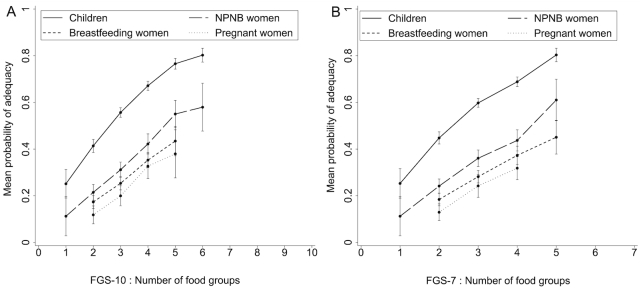
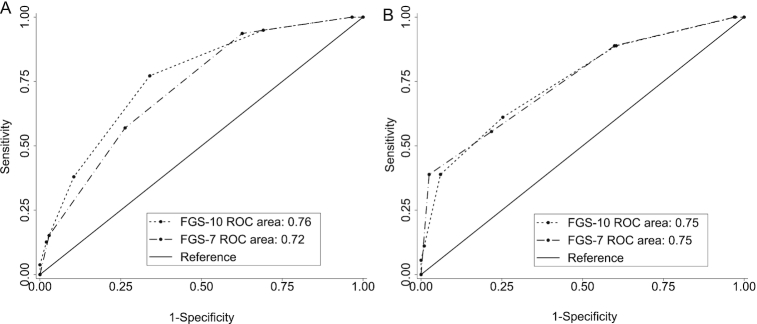
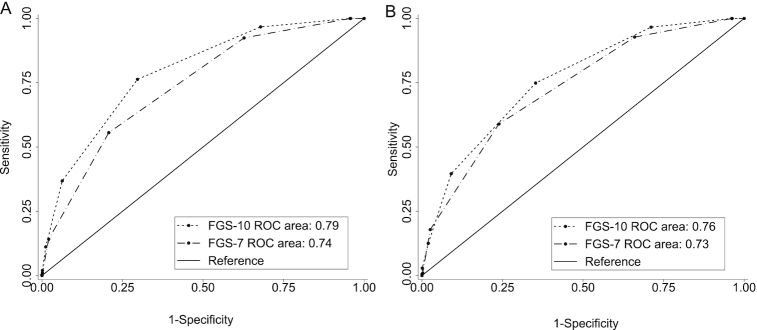
A 24-h recall survey was conducted at dry season among 1066 pairs of children and caregivers. Micronutrient adequacy was evaluated by the mean probability of adequacy (MPA) of intake over 11 micronutrients. Proxy indicators were FGS-10 [10 food groups based on the FAO/FHI360 minimum dietary diversity for women (MDD-W) guidelines] and related MDD-W (FGS-10 ≥5); and FGS-7 [7 groups based on the WHO infant and young child (IYC) feeding MDD guidelines] and related MDD-IYC (FGS-7 ≥4).
FGS-10 and FGS-7 were similar across children and women (∼3 groups). FGS-10 performed better than FGS-7 to predict MPA in children (Spearman rank correlation = 0.59 compared with 0.50) and women of all 3 physiological statuses (Spearman rank correlation = 0.53-0.55 compared with 0.42-0.52). MDD-W and MDD-IYC performed well in predicting MPA >0.75 in children and MPA >0.6 in nonpregnant nonbreastfeeding (NPNB) women, but a 4-group cutoff for FGS-10 allowed a better balance between sensitivity, specificity, and proportion of correct classification. MPA levels for pregnant and breastfeeding women were too low to assess best cutoff points.
MDD-IYC or an adapted MDD-W (FGS-10 ≥4 instead of FGS-10 ≥5) can be extended to 24-59-mo-old children and NPNB women in similar-diet settings. The inadequacy of micronutrient intakes in pregnant and breastfeeding women warrants urgent action. Micronutrient adequacy predictors should be validated in populations where a higher proportion of these women do meet dietary requirements.
需要简单的代理指标来评估和监测弱势人群的微量营养素摄入充足情况。低收入国家有针对生育年龄的非孕妇和 6-23 月龄儿童的标准二分法指标,但针对 24-59 月龄儿童或孕妇及哺乳期妇女则没有。
本研究旨在评估 2 种标准食物组得分(FGS)和相关二分法指标在预测布基纳法索农村地区 24-59 月龄儿童和生育年龄妇女的饮食中多种微量营养素充足情况时的表现,其依据是生理状态。
在旱季对 1066 对儿童及其照顾者进行了 24 小时膳食回顾调查。通过 11 种微量营养素摄入量的平均充足概率(MPA)评估微量营养素充足情况。代理指标为基于粮农组织/妇发基金妇女最低饮食多样性指南(MDD-W)的 10 种食物组得分(FGS-10)和相关 MDD-W(FGS-10≥5);以及基于世卫组织婴幼儿喂养 MDD 指南的 7 种食物组得分(FGS-7)和相关 MDD-IYC(FGS-7≥4)。
FGS-10 和 FGS-7 在儿童和妇女中表现相似(约 3 组)。FGS-10 在预测儿童(Spearman 秩相关系数=0.59 比 0.50)和所有 3 种生理状态的妇女(Spearman 秩相关系数=0.53-0.55 比 0.42-0.52)的 MPA 方面优于 FGS-7。MDD-W 和 MDD-IYC 在预测儿童的 MPA>0.75 和非哺乳期非孕妇(NPNB)妇女的 MPA>0.6 方面表现良好,但 4 分组 FGS-10 切点可在敏感性、特异性和正确分类比例之间取得更好的平衡。孕妇和哺乳期妇女的 MPA 水平太低,无法评估最佳切点。
MDD-IYC 或改良的 MDD-W(FGS-10≥4 而非 FGS-10≥5)可扩展至类似饮食环境中的 24-59 月龄儿童和 NPNB 妇女。孕妇和哺乳期妇女微量营养素摄入不足的情况亟待解决。应在摄入这些营养素能满足需求的妇女比例较高的人群中验证微量营养素充足情况预测指标。