Departamento de Bioquimica, Escuela de Medicina, Universidad de Costa Rica, San Jose 94088, Costa Rica.
Faculdade de Ciencias Biologicas e da Saude, Universidade Sao Judas Tadeu, Sao Paulo 01000, Brazil.
Nutrients. 2020 Jul 4;12(7):1994. doi: 10.3390/nu12071994.
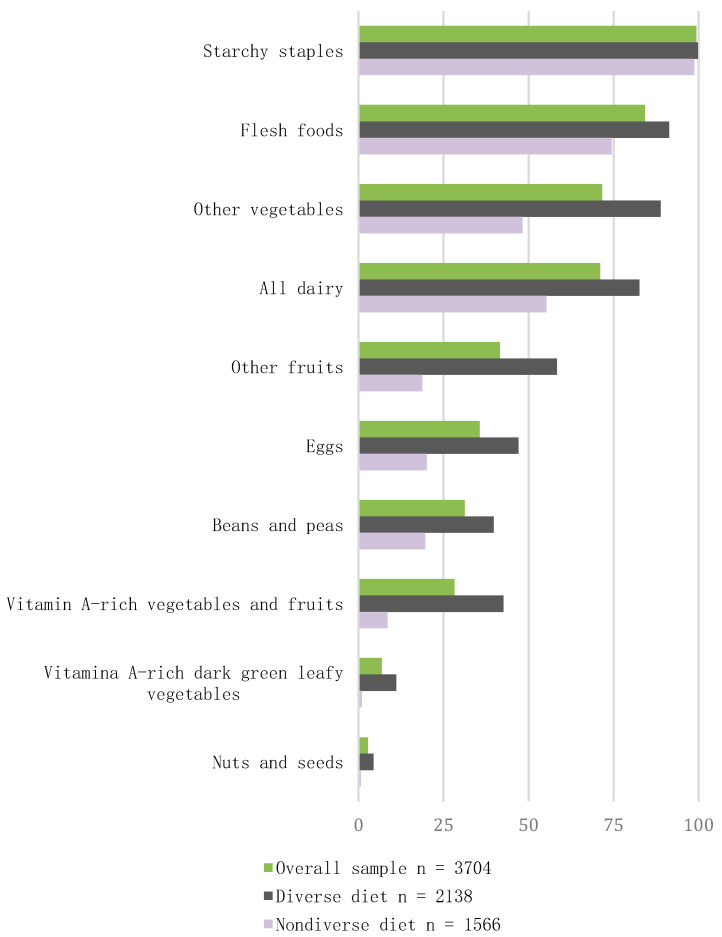
Dietary diversity, an important component of diet quality, is associated with an increased probability of adequate micronutrient intake. Women of childbearing age (WCA) are particularly vulnerable to micronutrient inadequacy. The Minimum Dietary Diversity for Women (MDD-W) has been used widely as a proxy measurement of micronutrient adequacy. This study aimed to assess the association between MDD-W and nutrients adequacy among WCA of eight Latin American countries. Nutrient intakes from 3704 WCA were analyzed with two 24-hour dietary recalls. Dietary diversity was calculated based on ten food groups with a cut-off point of intake ≥5 groups. The mean dietary diversity score was 4.72 points, and 57.7% of WCA achieved MDD-W. Vitamin D and E showed a mean Nutrient Adequacy Ratio (NAR) of 0.03 and 0.38, respectively. WCA with a diverse diet (MDD-W > 5) reported a significantly higher intake of most micronutrients and healthy food groups with less consumption of red and processed meats and sugar-sweetened beverages. MDD-W was significantly associated with the mean adequacy ratio (MAR) of 18 micronutrients evaluated. Nevertheless, even those women with a diverse diet fell short of meeting the Estimated Average Requirements (EAR) for vitamins D and E. MDD-W is an appropriate tool to evaluate micronutrients adequacy in WCA from Latin America, showing that women who achieved the MDD-W reported higher adequacy ratios for most micronutrients and an overall healthier diet.
膳食多样性是饮食质量的重要组成部分,与增加获得足够微量营养素的可能性有关。育龄妇女(WCA)特别容易出现微量营养素不足的情况。最低膳食多样性女性(MDD-W)已被广泛用作衡量微量营养素充足的替代指标。本研究旨在评估 MDD-W 与 8 个拉丁美洲国家育龄妇女营养充足率之间的关系。对 3704 名育龄妇女的 2 份 24 小时膳食回忆进行了营养素摄入量分析。根据 10 种食物组计算了膳食多样性,摄入≥5 组为截止点。平均膳食多样性评分得分为 4.72 分,57.7%的育龄妇女达到了 MDD-W。维生素 D 和 E 的平均营养充足率(NAR)分别为 0.03 和 0.38。饮食多样化(MDD-W>5)的育龄妇女报告说,她们摄入了更多的大多数微量营养素和健康食品组,而红肉类和加工肉类以及含糖饮料的摄入量则较少。MDD-W 与评估的 18 种微量营养素的平均充足率(MAR)显著相关。然而,即使是那些饮食多样化的女性也未能满足维生素 D 和 E 的估计平均需求量(EAR)。MDD-W 是评估拉丁美洲育龄妇女微量营养素充足性的合适工具,表明达到 MDD-W 的女性报告说,她们对大多数微量营养素的充足率更高,并且整体饮食更健康。