Spalletta Gianfranco, Porcari Desirée Estela, Banaj Nerisa, Ciullo Valentina, Palmer Katie
Laboratory of Neuropsychiatry, Department of Clinical and Behavioral Neurology, IRCCS Santa Lucia Foundation, Rome, Italy.
Menninger Department of Psychiatry and Behavioral Sciences, Baylor College of Medicine, Houston, TX, United States.
Front Psychiatry. 2020 Nov 30;11:599844. doi: 10.3389/fpsyt.2020.599844. eCollection 2020.
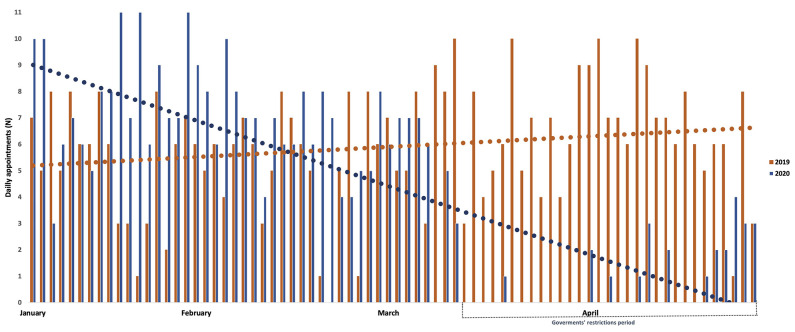
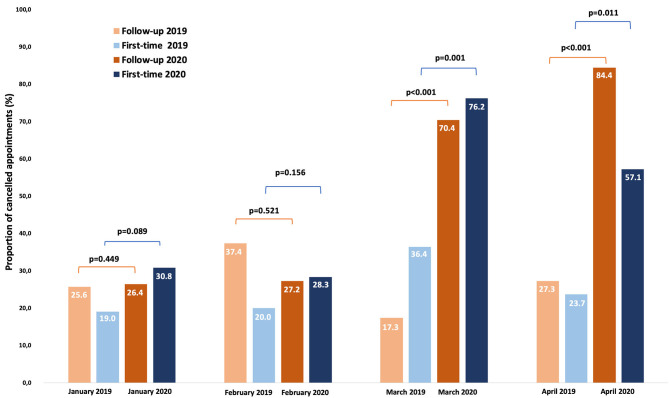
In the first wave of the COVID-19 pandemic in 2020, many countries made changes to the routine management of patients with non-communicable diseases, including neurocognitive disorders. Therefore, many "so-called" non-urgent elective procedures and outpatient appointments have been canceled or postponed, possibly impacting negatively on health and well-being of patients in the short- and long-term. Here, we aimed at describing numbers and types of outpatient appointments canceled as a result of government's restrictive measures in our memory clinic. The scheduled appointments at the memory clinic of the Santa Lucia Foundation IRCCS, Rome, Italy, are recorded in a comprehensive dataset under strict administrative control. Here, we compared appointments (first-time and follow-up) that were canceled from January to April 2020 with those of the corresponding months in 2019. We observed a substantial decrease in appointments during 2020. The majority of scheduled appointments were follow-up, and about a quarter were first-time appointments. We estimated that 66.7% and 77.4% of patients missed out respectively their first and follow-up appointments in our memory clinic due to government's restrictive measures in March-April 2020. A large number of patients with neurocognitive disorders missed crucial appointments due to government's restrictive measures, and many experienced a delay in initial diagnosis and initiation of treatment. This has relevant impact on their treatment and consequently has (is still having and potentially will have) an increase on the healthcare service burden of clinics. Furthermore, as a second wave of COVID-19 affects Europe, and with winter approaching, it is a compelling priority to ensure easy and rapid access to appropriate assessment, care and treatment in the event of a new outbreak and potential subsequent lockdowns, with particular attention to the development of specific healthcare technologies customized to older persons with cognitive impairment.
在2020年新冠疫情的第一波冲击中,许多国家对包括神经认知障碍在内的非传染性疾病患者的常规管理做出了改变。因此,许多“所谓”的非紧急择期手术和门诊预约被取消或推迟,这可能在短期和长期内对患者的健康和福祉产生负面影响。在此,我们旨在描述因政府限制措施而在我们记忆门诊取消的门诊预约的数量和类型。意大利罗马圣卢西亚基金会IRCCS记忆门诊的预约安排记录在一个严格行政管控下的综合数据集中。在这里,我们将2020年1月至4月取消的预约(首次预约和随访预约)与2019年相应月份的预约进行了比较。我们观察到2020年预约数量大幅下降。大多数预约安排是随访预约,约四分之一是首次预约。我们估计,由于2020年3月至4月政府的限制措施,我们记忆门诊分别有66.7%和77.4%的患者错过了首次和随访预约。大量神经认知障碍患者因政府的限制措施错过了关键预约,许多患者在初始诊断和治疗开始方面出现延迟。这对他们的治疗产生了相关影响,因此已经(仍在产生且可能会产生)增加诊所的医疗服务负担。此外,随着新冠疫情第二波影响欧洲,且冬季临近,在新的疫情爆发及随后可能的封锁情况下,确保能够轻松、快速地获得适当的评估、护理和治疗成为当务之急,尤其要关注为认知障碍老年人定制的特定医疗技术的开发。