Kim Jeehyun, Hua Gordon, Zhang Han, Chan Teffran J, Xie Michael, Levin Marc, Farrokhyar Forough, Archibald Stuart D, Jackson Bernard, Young James E, Gupta Michael
Otolaryngology - Head and Neck Surgery, McMaster University, Hamilton, CAN.
Otolaryngology - Head and Neck Surgery, University of British Columbia, Hamilton, CAN.
Cureus. 2020 Nov 14;12(11):e11483. doi: 10.7759/cureus.11483.
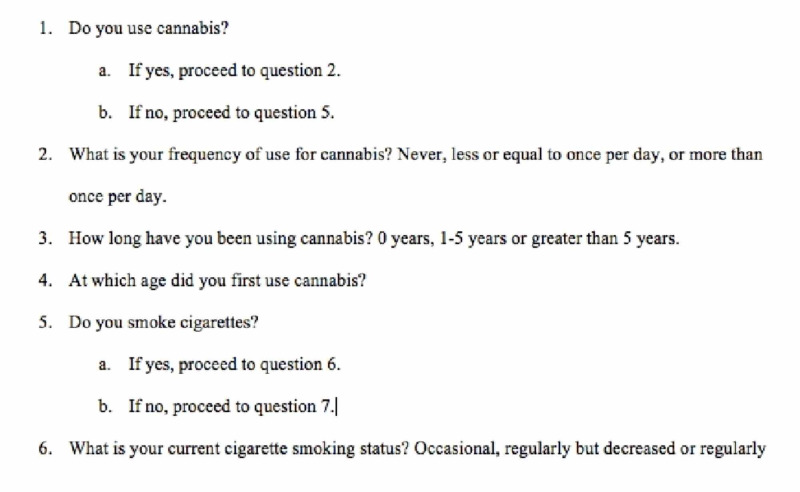
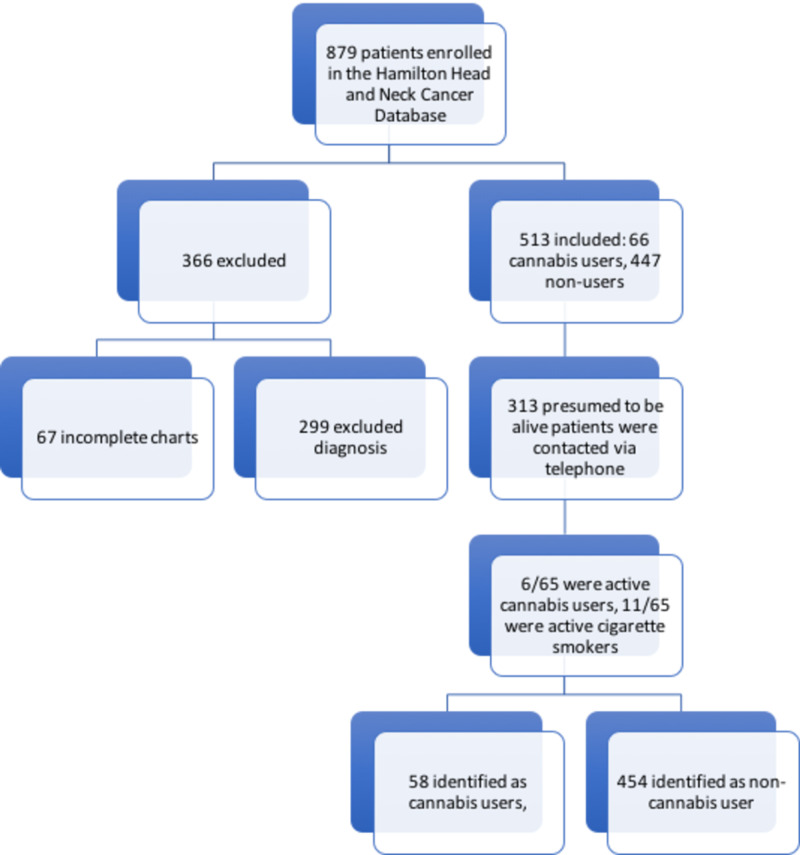
Objective To determine whether there is an association between cannabis use and developing a second primary cancer in head and neck cancer patients, as well as determining the prevalence of cannabis use amongst head and neck cancer patients. Study design This retrospective cohort study investigated patients from the Hamilton Region Head and Neck Cancer Database who were enrolled prospectively between 2011 and 2015, with follow-up data up to November 2018. Patients were contacted to confirm current cannabis and tobacco smoking status. Setting All patients were enrolled from a single tertiary cancer center in Hamilton, Ontario. Subjects and methods Consecutive patients with a newly diagnosed head and neck cancer were prospectively enrolled between 2011 to 2015. Cannabis users and controls were compared using standard modes of comparison. The odds ratio from a multivariable logistic regression model was then determined. Results A total of 513 patients were included in this study: 59 in the cannabis group and 454 in the control group. In terms of baseline characteristics, there was no significant difference between cannabis users and controls except that cannabis users were more likely to develop primary oropharyngeal cancer (p=0.0046). Two of 59 (3.4%) cannabis users developed a second primary cancer, in comparison to 23 of 454 (5.1%) non-cannabis users. The odds ratio for cannabis use on the second primary cancer was 0.19 (95% CI [0.01-3.20], p=0.25). Conclusion This study suggests that cannabis use behaves differently than tobacco smoking, as the former may not be associated with field cancerization.
目的 确定大麻使用与头颈癌患者发生第二原发性癌症之间是否存在关联,并确定头颈癌患者中大麻使用的流行率。研究设计 这项回顾性队列研究调查了汉密尔顿地区头颈癌数据库中2011年至2015年期间前瞻性入组的患者,随访数据截至2018年11月。联系患者以确认当前大麻和烟草吸烟状况。研究地点 所有患者均来自安大略省汉密尔顿的一家单一三级癌症中心。研究对象和方法 2011年至2015年期间前瞻性纳入新诊断的头颈癌连续患者。使用标准比较模式比较大麻使用者和对照组。然后确定多变量逻辑回归模型的比值比。结果 本研究共纳入513例患者:大麻组59例,对照组454例。在基线特征方面,大麻使用者和对照组之间无显著差异,只是大麻使用者更易患原发性口咽癌(p=0.0046)。59例大麻使用者中有2例(3.4%)发生了第二原发性癌症,相比之下,454例非大麻使用者中有23例(5.1%)发生了第二原发性癌症。大麻使用与第二原发性癌症的比值比为0.19(95%CI[0.01-3.20],p=0.25)。结论 本研究表明,大麻使用的行为与吸烟不同,因为前者可能与场癌化无关。