Division of Otolaryngology - Head & Neck Surgery, Department of Surgery, University of Alberta Hospital, 1E4.34 Walter C. Mackenzie Centre, Edmonton, Alberta, T6G 2B7, Canada.
Division of Otolaryngology - Head & Neck Surgery, Department of Surgery, University of Calgary Cumming School of Medicine, Calgary, Alberta, Canada.
J Otolaryngol Head Neck Surg. 2019 Jul 23;48(1):33. doi: 10.1186/s40463-019-0357-4.
Active tobacco smoking is a well-known risk factor for head and neck malignancy, and strong evidence has associated tobacco as the main carcinogenic factor in squamous cell cancers of this region. Evidence supporting a carcinogenic effect of second-hand smoke (SHS) on head and neck organs in non-smokers was also demonstrated with results consistent with those for active smokers. There is little data on the effects of SHS in patients previously treated for squamous cell carcinomas of the head and neck.
The purpose of this study was to prospectively evaluate the role of SHS on recurrence and survival in treated head and neck cancer patients.
We conducted a prospective cohort study to examine the association between self-reported SHS exposure and the risk of recurrence and mortality in patients treated for squamous cell cancers of the head and neck in a longitudinal fashion. Patients filled out an exhaustive smoking questionnaire on presentation and abbreviated questionnaires at each follow-up visit, which occurred every 6 months. Primary outcome measures were recurrence, development of a second primary malignancy, and recurrence-free survival. Chi square analysis was used to assess the association between SHS and the primary outcomes. A multivariate binary logistic regression analysis was applied to determine the independent predictors of recurrence. Cox proportional hazards and Kaplan Meier modeling were employed to assess the possible relationships between SHS exposure and time to develop the primary outcomes.
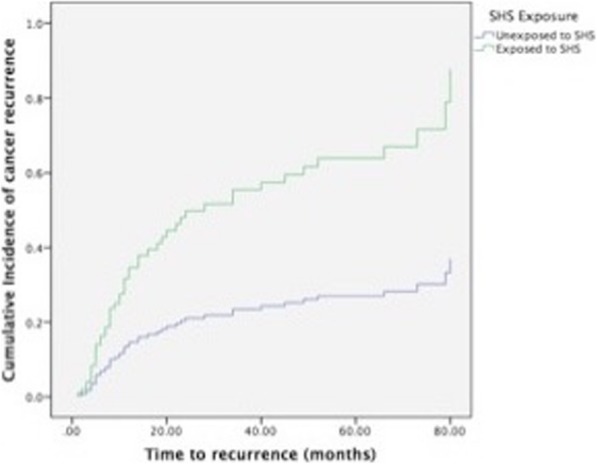
Untreated new patients with a histologically confirmed diagnosis of first primary SCC of the UADT (defined as cancer of the oral cavity, the oropharynx, the hypopharynx, and the larynx) were recruited. Patients seen at The University of Texas Medical Branch (UTMB) Head and Neck oncology clinic from 1988 to 1996 were considered as cases in this study. One hundred and thirty-five patients were enrolled in the study. The median follow-up time for the sample was 54 months (3.92 years). Complete records were achieved for 92% of patients, thus 124 patients were included in the final analysis. SHS significantly correlated with recurrence and recurrence-free survival. The rate of recurrence was 46% in the group exposed to SHS and 22% in the non-exposed group. Based on multivariate binary logistic regression analysis, SHS exposure was detected as a significant independent predictor for recurrence (HR = 3.00 [95% CI 1.18-7.63]). Kaplan-Meier analysis demonstrated that patients who were not exposed to SHS had a statistically significant longer recurrence-free survival (log-rank P = 0.029). The mean survival for non SHS-exposed patients was 76 [63-89] months versus 54 [45-63] months for those exposed to SHS.
SHS exposure is an independent predictor of recurrence and survival after head and neck cancer treatment. These results support the importance and efforts of reducing smoking at home in in the work-place.

主动吸烟是头颈部恶性肿瘤的一个众所周知的危险因素,有强有力的证据表明烟草是该区域鳞状细胞癌的主要致癌因素。二手烟(SHS)对非吸烟者头颈部器官的致癌作用也得到了证实,结果与主动吸烟者一致。关于 SHS 在头颈部鳞状细胞癌经治患者中的影响的数据较少。
本研究旨在前瞻性评估 SHS 对经治头颈部癌症患者复发和生存的影响。
我们进行了一项前瞻性队列研究,以纵向方式检查自我报告的 SHS 暴露与头颈部鳞状细胞癌患者复发和死亡率之间的关系。患者在就诊时填写了一份详尽的吸烟问卷,并在每次随访时填写了一份简短的问卷,随访每 6 个月进行一次。主要结局指标是复发、第二原发恶性肿瘤的发生和无复发生存率。卡方分析用于评估 SHS 与主要结局之间的关系。应用多变量二项逻辑回归分析确定复发的独立预测因素。Cox 比例风险和 Kaplan-Meier 建模用于评估 SHS 暴露与主要结局发生时间之间的可能关系。
招募了经组织学证实的头颈部上呼吸消化道(UADT)首次原发性 SCC 患者(定义为口腔、口咽、下咽和喉的癌症)。本研究的病例为 1988 年至 1996 年间在德克萨斯大学医学分部(UTMB)头颈肿瘤诊所就诊的患者。该研究共纳入 135 例患者。该样本的中位随访时间为 54 个月(3.92 年)。92%的患者完成了完整的记录,因此最终有 124 例患者纳入最终分析。SHS 与复发和无复发生存显著相关。在暴露于 SHS 的组中,复发率为 46%,而在未暴露于 SHS 的组中为 22%。基于多变量二项逻辑回归分析,SHS 暴露被检测为复发的显著独立预测因素(HR=3.00[95%CI 1.18-7.63])。Kaplan-Meier 分析表明,未暴露于 SHS 的患者无复发生存时间显著延长(对数秩 P=0.029)。未暴露于 SHS 的患者的平均生存时间为 76 [63-89] 个月,而暴露于 SHS 的患者为 54 [45-63] 个月。
SHS 暴露是头颈部癌症治疗后复发和生存的独立预测因素。这些结果支持减少家庭和工作场所吸烟的重要性和努力。