Busetto Gian Maria, Del Giudice Francesco, Mari Andrea, Sperduti Isabella, Longo Nicola, Antonelli Alessandro, Cerruto Maria Angela, Costantini Elisabetta, Carini Marco, Minervini Andrea, Rocco Bernardo, Artibani Walter, Porreca Angelo, Porpiglia Francesco, Damiano Rocco, De Sio Marco, Arcaniolo Davide, Cimino Sebastiano, Russo Giorgio Ivan, Lucarelli Giuseppe, Di Tonno Pasquale, Gontero Paolo, Soria Francesco, Trombetta Carlo, Liguori Giovanni, Scarpa Roberto Mario, Papalia Rocco, Terrone Carlo, Borghesi Marco, Verze Paolo, Madonia Massimo, De Lisa Antonello, Bove Pierluigi, Guazzoni Giorgio, Lughezzani Giovanni, Racioppi Marco, Di Gianfrancesco Luca, Brunocilla Eugenio, Schiavina Riccardo, Simeone Claudio, Veccia Alessandro, Montorsi Francesco, Briganti Alberto, Dal Moro Fabrizio, Pavone Carlo, Serretta Vincenzo, Di Stasi Savino Mauro, Galosi Andrea Benedetto, Schips Luigi, Marchioni Michele, Montanari Emanuele, Carrieri Giuseppe, Cormio Luigi, Greco Francesco, Musi Gennaro, Maggi Martina, Conti Simon L, Tubaro Andrea, De Berardinis Ettore, Sciarra Alessandro, Gallucci Michele, Mirone Vincenzo, de Cobelli Ottavio, Ferro Matteo
Sapienza Rome University Policlinico Umberto I, Rome, Italy.
Stanford University, Palo Alto, CA, United States.
Front Surg. 2020 Nov 24;7:563006. doi: 10.3389/fsurg.2020.563006. eCollection 2020.
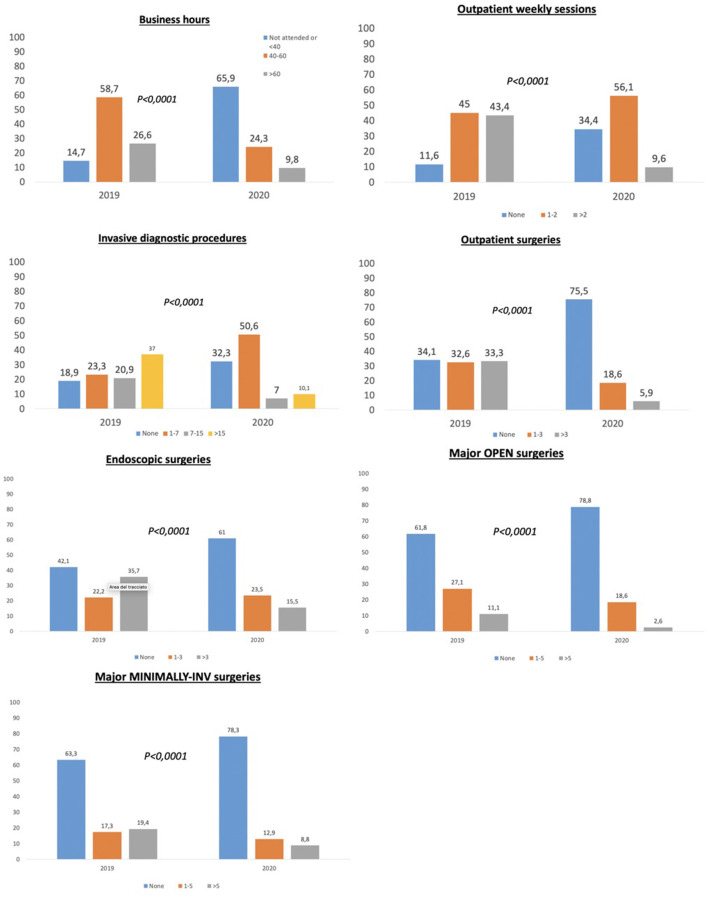
The COVID-19 outbreak, in a few weeks, overloaded Italian hospitals, and the majority of medical procedures were postponed. During the pandemic, with hospital reorganization, clinical and learning activities performed by residents suffered a forced remodulation. The objective of this study is to investigate how urology training in Italy has been affected during the COVID-19 era. In this multi-academic study, we compared residents' training during the highest outbreak level with their previous activity. Overall 387 (67.1%) of the 577 Italian Urology residents participated in a 72-h anonymous online survey with 36 items sent via email. The main outcomes were clinical/surgical activities, social distancing, distance learning, and telemedicine. Clinical and learning activity was significantly reduced for the overall group, and after categorizing residents as those working only in COVID hospitals, both "junior" and "senior" residents, and those working in any of three geographical areas created (Italian regions were clustered in three major zones according to the prevalence of COVID-19). A significant decrease in outpatient activity, invasive diagnostic procedures, and endoscopic and major surgeries was reported. Through multivariate analysis, the specific year of residency has been found to be an independent predictor for all response modification. Being in zone 3 and zone 2 and having "senior" resident status were independent predictors associated with a lower reduction of the clinical and learning activity. Working in a COVID hospital and having "senior" resident status were independent predictors associated with higher reduction of the outpatient activity. Working in zone 3 and having "senior" resident status were independent predictors of lower and higher outpatient surgical activity, respectively. Working in a COVID hospital was an independent predictor associated with robotic surgical activity. The majority of residents reported that distance teaching and multidisciplinary virtual meetings are still not used, and 44.8% reported that their relationships with colleagues decreased. The COVID-19 pandemic presents an unprecedented challenge, including changes in the training and education of urology residents. The COVID era can offer an opportunity to balance and implement innovative solutions that can bridge the educational gap and can be part of future urology training.
在短短几周内,新冠疫情就使意大利的医院不堪重负,大部分医疗程序都被推迟。在疫情期间,随着医院的重组,住院医生开展的临床和学习活动被迫进行了调整。本研究的目的是调查在新冠疫情时代,意大利的泌尿外科培训受到了怎样的影响。在这项多学术机构参与的研究中,我们将疫情爆发高峰期住院医生的培训情况与其之前的活动进行了比较。意大利577名泌尿外科住院医生中,共有387名(67.1%)参与了一项为期72小时的匿名在线调查,通过电子邮件发送了36个问题。主要结果包括临床/手术活动、社交距离、远程学习和远程医疗。总体而言,整个群体的临床和学习活动显著减少,在将住院医生分为仅在新冠医院工作的医生、“初级”和“高级”住院医生,以及在划分出的三个地理区域(根据新冠疫情的流行情况,意大利各地区被划分为三个主要区域)中任何一个区域工作的医生后,情况也是如此。门诊活动、侵入性诊断程序以及内镜手术和大型手术均有显著减少。通过多变量分析发现,住院医生的具体年份是所有反应变化的独立预测因素。身处3区和2区以及具有“高级”住院医生身份是与临床和学习活动减少程度较低相关的独立预测因素。在新冠医院工作且具有“高级”住院医生身份是与门诊活动减少程度较高相关的独立预测因素。身处3区且具有“高级”住院医生身份分别是门诊手术活动减少程度较低和较高的独立预测因素。在新冠医院工作是与机器人手术活动相关的独立预测因素。大多数住院医生表示,远程教学和多学科虚拟会议仍未得到应用,44.8%的住院医生表示他们与同事的关系有所减少。新冠疫情带来了前所未有的挑战,包括泌尿外科住院医生培训和教育方面的变化。新冠时代可以提供一个机会,来平衡并实施创新解决方案,这些方案能够弥合教育差距,并成为未来泌尿外科培训的一部分。