Department of Radiology, Cochin Hospital, APHP, Paris, France.
Department of Radiology, Ambroise Paré Hospital, APHP, Boulogne, France.
PLoS One. 2020 Dec 17;15(12):e0243342. doi: 10.1371/journal.pone.0243342. eCollection 2020.
In numerous countries, large population testing is impossible due to the limited availability of RT-PCR kits and CT-scans. This study aimed to determine a pre-test probability score for SARS-CoV-2 infection.
This multicenter retrospective study (4 University Hospitals) included patients with clinical suspicion of SARS-CoV-2 infection. Demographic characteristics, clinical symptoms, and results of blood tests (complete white blood cell count, serum electrolytes and CRP) were collected. A pre-test probability score was derived from univariate analyses of clinical and biological variables between patients and controls, followed by multivariate binary logistic analysis to determine the independent variables associated with SARS-CoV-2 infection.
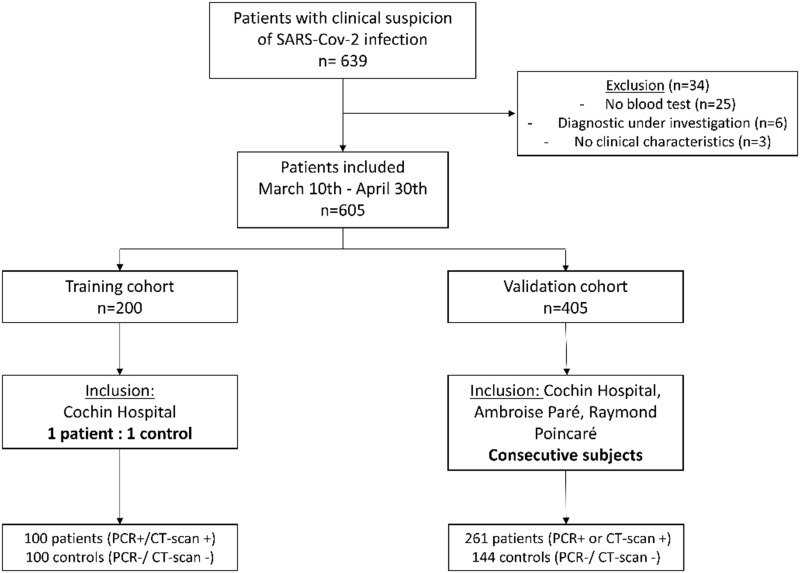
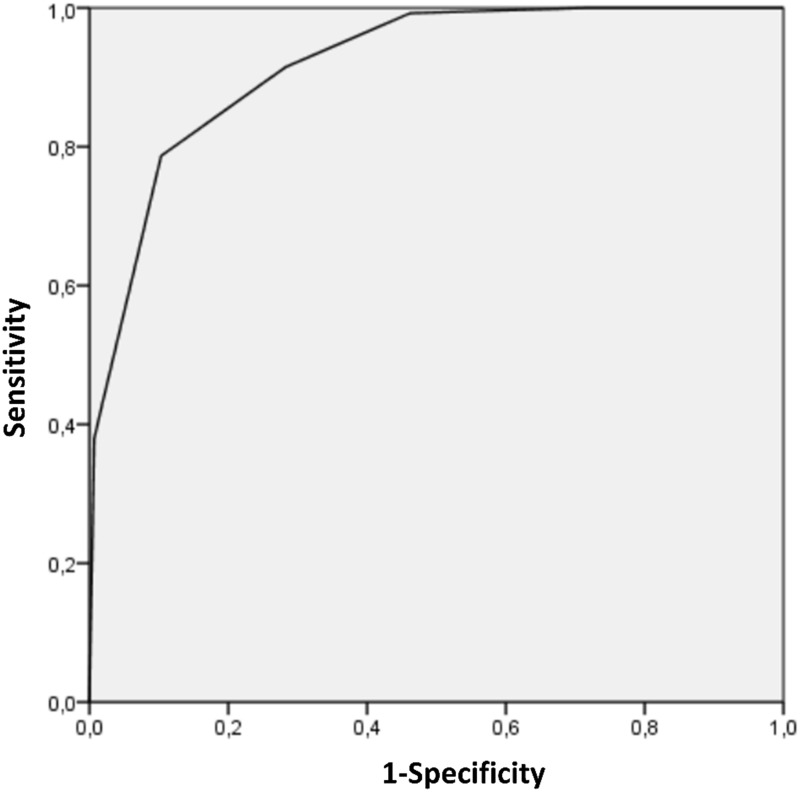
605 patients were included between March 10th and April 30th, 2020 (200 patients for the training cohort, 405 consecutive patients for the validation cohort). In the multivariate analysis, lymphocyte (<1.3 G/L), eosinophil (<0.06 G/L), basophil (<0.04 G/L) and neutrophil counts (<5 G/L) were associated with high probability of SARS-CoV-2 infection but no clinical variable was statistically significant. The score had a good performance in the validation cohort (AUC = 0.918 (CI: [0.891-0.946]; STD = 0.014) with a Positive Predictive Value of high-probability score of 93% (95%CI: [0.89-0.96]). Furthermore, a low-probability score excluded SARS-CoV-2 infection with a Negative Predictive Value of 98% (95%CI: [0.93-0.99]). The performance of the score was stable even during the last period of the study (15-30th April) with more controls than infected patients.
The PARIS score has a good performance to categorize the pre-test probability of SARS-CoV-2 infection based on complete white blood cell count. It could help clinicians adapt testing and for rapid triage of patients before test results.
在许多国家,由于实时聚合酶链反应(RT-PCR)试剂盒和计算机断层扫描(CT)的数量有限,大规模人群检测是不可能的。本研究旨在确定 SARS-CoV-2 感染的预测概率评分。
这是一项多中心回顾性研究(4 所大学医院),纳入了临床疑似 SARS-CoV-2 感染的患者。收集了人口统计学特征、临床症状以及血液检查结果(白细胞总数、血清电解质和 C 反应蛋白)。通过对患者和对照组之间的临床和生物学变量进行单因素分析,得出预测概率评分,然后进行多变量二元逻辑分析,确定与 SARS-CoV-2 感染相关的独立变量。
2020 年 3 月 10 日至 4 月 30 日期间共纳入 605 例患者(训练队列 200 例,验证队列连续 405 例)。多变量分析显示,淋巴细胞(<1.3 G/L)、嗜酸性粒细胞(<0.06 G/L)、嗜碱性粒细胞(<0.04 G/L)和中性粒细胞计数(<5 G/L)与 SARS-CoV-2 感染的高概率相关,但无临床变量具有统计学意义。该评分在验证队列中的表现良好(AUC = 0.918(CI:[0.891-0.946];STD = 0.014),高概率评分的阳性预测值为 93%(95%CI:[0.89-0.96])。此外,低概率评分可排除 SARS-CoV-2 感染,阴性预测值为 98%(95%CI:[0.93-0.99])。即使在研究的最后阶段(4 月 15 日至 30 日),感染患者数量少于对照组,该评分的性能也保持稳定。
PARIS 评分可根据白细胞总数对 SARS-CoV-2 感染的预测概率进行分类,有助于临床医生调整检测,并在检测结果出来之前对患者进行快速分诊。