Institute of Anesthesiology, University and University Hospital Zurich, Zurich, Switzerland.
Division of Medical Oncology and Hematology, University and University Hospital Zurich, Zurich, Switzerland.
PLoS One. 2020 Dec 17;15(12):e0243409. doi: 10.1371/journal.pone.0243409. eCollection 2020.
A significant proportion of patients with coronavirus disease 19 (COVID-19) suffer from excessive coagulation activation and coagulopathy which is associated with an increased risk of venous and arterial thromboembolism and adverse outcome. Our study investigates coagulation markers and the incidence of thromboembolic events in COVID-19 patients receiving recommended anticoagulation strategies.
In a retrospective single-center analysis at the University Hospital Zurich, Switzerland, we investigated 31 adult COVID-19 patients between April 6th and May 13th, 2020 and with at least one laboratory assessment of the coagulation markers prothrombin time/Quick, thrombin time, fibrinogen and D-dimers. For antithrombotic prophylaxis low-molecular-weight-heparin or unfractionated heparin was administered and two patients with heparin-induced thrombocytopenia received argatroban.
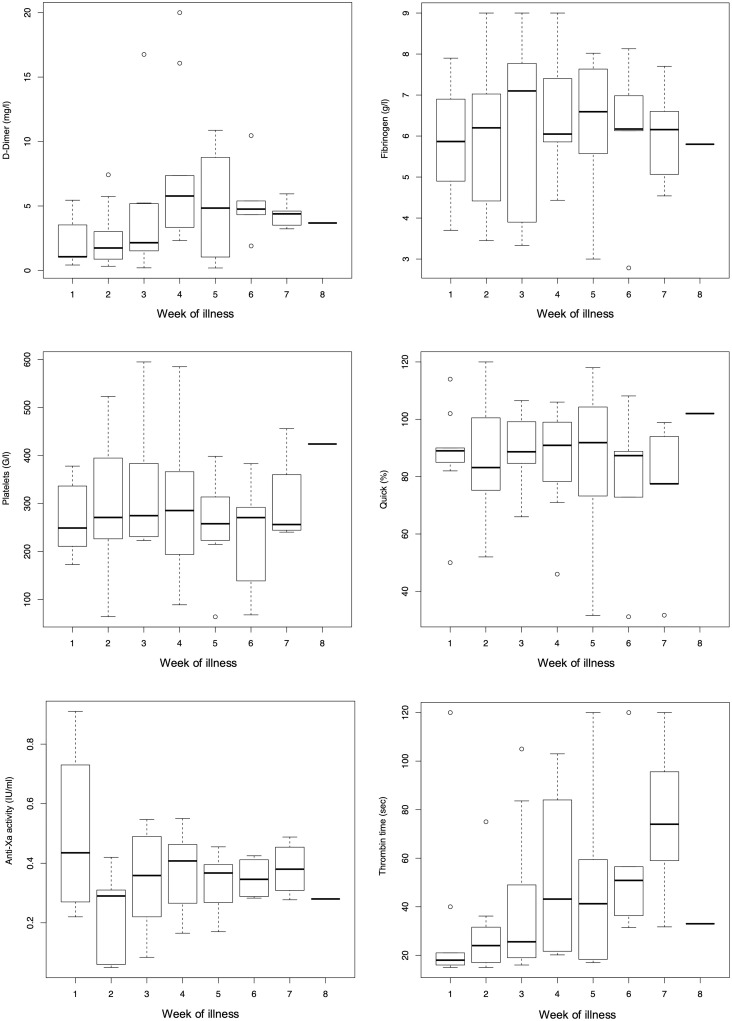
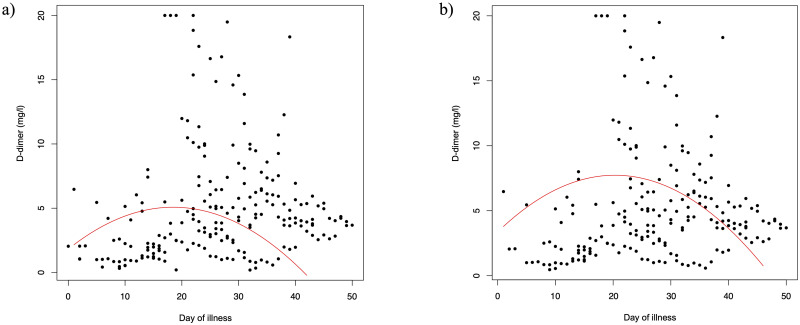
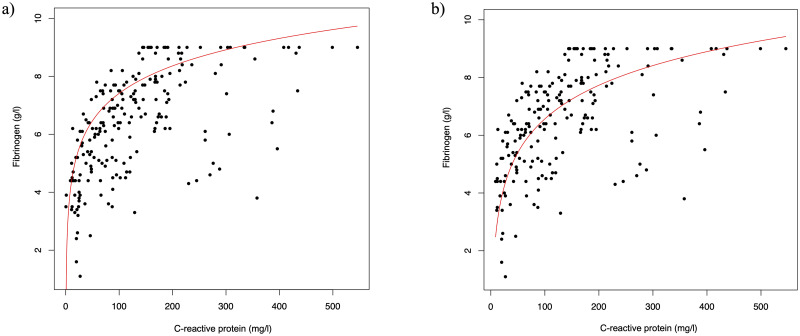
We analyzed 31 patients (68% male, mean age 60± SD 15 years). 22 (71%) of these required intensive care unit treatment, 5 (16%) were hospitalized in a ward, and 4 (13%) were outpatients. Mean fibrinogen levels were markedly elevated to 6.4± SD 1.8g/l, with a peak in the third week of the disease and no significant decrease over time. D-dimers were elevated to a mean value of 5.1±4.4mg/l with peak levels of 6.8±5.3mg/l in the fourth week of disease, and a subsequent decrease. Platelet count (308±136G/l) and PT/Quick (85±22%) showed no significant changes over time. Sensitivity analyses for patients treated in the ICU showed that D-dimer levels were higher in this group. The results of other sensitivity analyses were comparable. Thromboembolic events were diagnosed in 4 (13%) patients and 5 (16%) patients died during the observation period.
We find coagulation alterations in COVID-19 patients indicating significant hypercoagulability. These alterations are visible despite antithrombotic treatment, and peak around week 3-4 of the disease.
相当比例的新型冠状病毒病 19 (COVID-19)患者存在明显的凝血激活和凝血异常,这与静脉和动脉血栓栓塞事件风险增加以及不良预后相关。我们的研究旨在调查接受推荐抗凝策略的 COVID-19 患者的凝血标志物和血栓栓塞事件的发生率。
在瑞士苏黎世大学医院的一项回顾性单中心分析中,我们调查了 2020 年 4 月 6 日至 5 月 13 日期间的 31 例成年 COVID-19 患者,这些患者至少进行了一次凝血标志物凝血酶原时间/快速、凝血酶时间、纤维蛋白原和 D-二聚体的实验室评估。对于抗血栓预防,给予低分子肝素或未分馏肝素,2 例肝素诱导的血小板减少症患者接受了阿加曲班。
我们分析了 31 例患者(68%为男性,平均年龄 60±15 岁)。其中 22 例(71%)需要重症监护治疗,5 例(16%)住院治疗,4 例(13%)为门诊患者。纤维蛋白原水平明显升高至 6.4±1.8g/l,疾病第 3 周达峰值,且随时间无明显下降。D-二聚体升高至平均 5.1±4.4mg/l,疾病第 4 周达峰值 6.8±5.3mg/l,随后下降。血小板计数(308±136G/l)和 PT/Quick(85±22%)随时间无明显变化。对 ICU 治疗患者的敏感性分析显示,该组 D-二聚体水平较高。其他敏感性分析的结果相似。4 例(13%)患者诊断为血栓栓塞事件,5 例(16%)患者在观察期间死亡。
我们发现 COVID-19 患者存在凝血异常,表明存在明显的高凝状态。这些改变尽管进行了抗凝治疗,但仍可见于疾病的第 3-4 周。