Moranguinho Ines, Valente Susana T
Department of Immunology and Microbiology, The Scripps Research Institute, 130 Scripps Way, Jupiter, FL 33458, USA.
Viruses. 2020 Dec 15;12(12):1443. doi: 10.3390/v12121443.
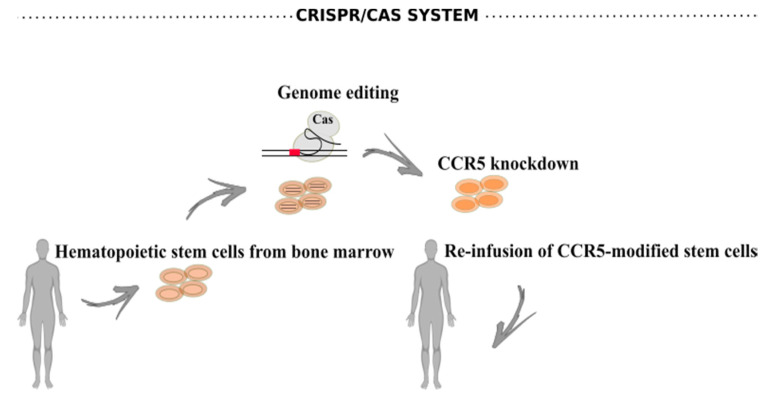
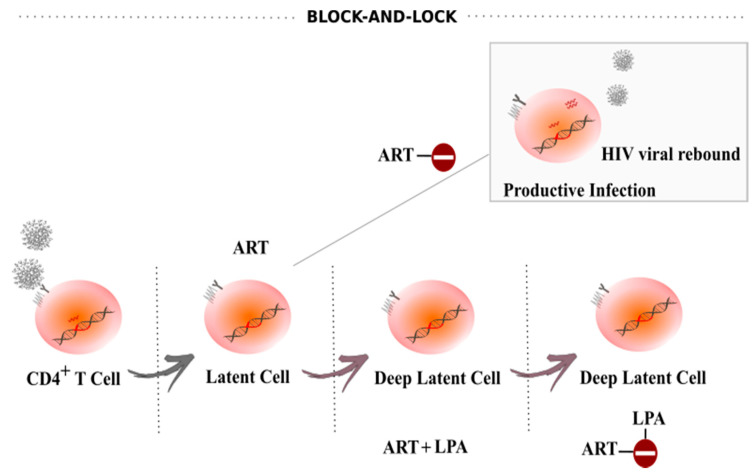
HIV-1/AIDS remains a global public health problem. The world health organization (WHO) reported at the end of 2019 that 38 million people were living with HIV-1 worldwide, of which only 67% were accessing antiretroviral therapy (ART). Despite great success in the clinical management of HIV-1 infection, ART does not eliminate the virus from the host genome. Instead, HIV-1 remains latent as a viral reservoir in any tissue containing resting memory CD4 T cells. The elimination of these residual proviruses that can reseed full-blown infection upon treatment interruption remains the major barrier towards curing HIV-1. Novel approaches have recently been developed to excise or disrupt the virus from the host cells (e.g., gene editing with the CRISPR-Cas system) to permanently shut off transcription of the virus (block-and-lock and RNA interference strategies), or to reactivate the virus from cell reservoirs so that it can be eliminated by the immune system or cytopathic effects (shock-and-kill strategy). Here, we will review each of these approaches, with the major focus placed on the block-and-lock strategy.
人类免疫缺陷病毒1型/艾滋病(HIV-1/AIDS)仍然是一个全球公共卫生问题。世界卫生组织(WHO)在2019年底报告称,全球有3800万人感染了HIV-1,其中只有67%的人正在接受抗逆转录病毒疗法(ART)。尽管在HIV-1感染的临床管理方面取得了巨大成功,但抗逆转录病毒疗法并不能从宿主基因组中清除病毒。相反,HIV-1作为病毒储存库潜伏在任何含有静止记忆CD4 T细胞的组织中。消除这些在治疗中断时能够重新引发全面感染的残留前病毒,仍然是治愈HIV-1的主要障碍。最近已经开发出了新的方法,用于从宿主细胞中切除或破坏病毒(例如,使用CRISPR-Cas系统进行基因编辑),以永久关闭病毒的转录(阻断并锁定和RNA干扰策略),或者从细胞储存库中重新激活病毒,以便它能够被免疫系统或细胞病变效应清除(激活并清除策略)。在此,我们将对这些方法逐一进行综述,主要重点放在阻断并锁定策略上。