Pfister Joachim, Bata Roland, Hubmann Isabella, Hörmann Anton Amadeus, Gsaller Fabio, Haas Hubertus, Decristoforo Clemens
Department of Nuclear Medicine, Medical University Innsbruck, 6020 Innsbruck, Austria.
Institute of Molecular Biology, Medical University Innsbruck, 6020 Innsbruck, Austria.
J Fungi (Basel). 2020 Dec 15;6(4):367. doi: 10.3390/jof6040367.
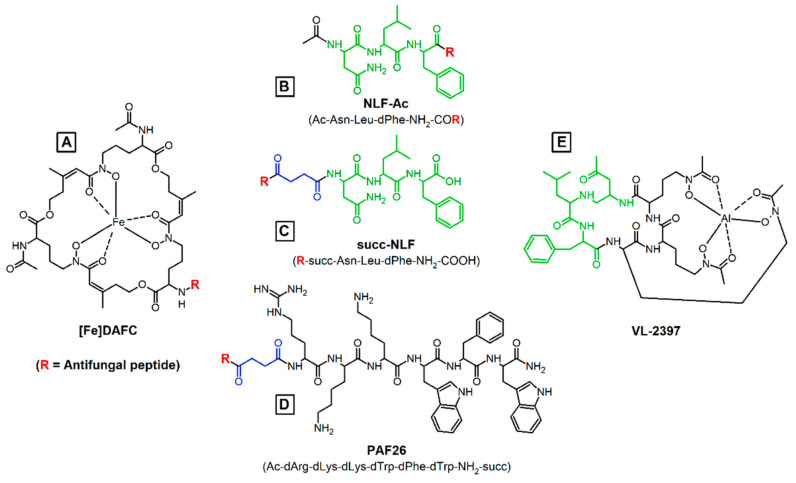
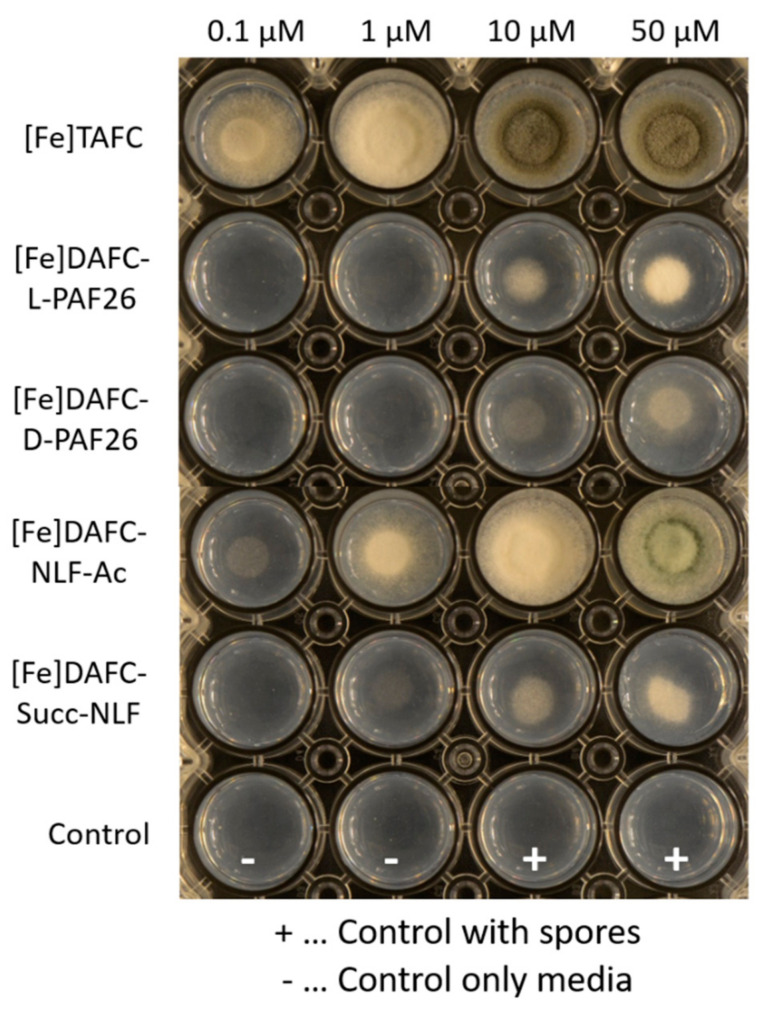
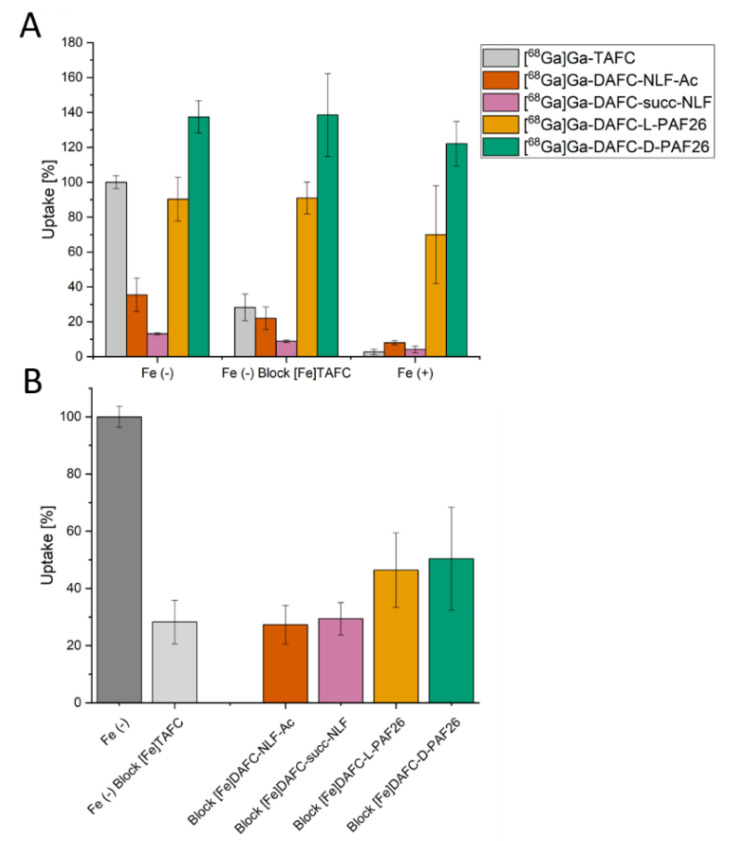
Antifungal resistance of human fungal pathogens represents an increasing challenge in modern medicine. Short antimicrobial peptides (AMP) display a promising class of antifungals with a different mode of action, but lack target specificity and metabolic stability. In this study the hexapeptide PAF26 (Ac-dArg-dLys-dLys-dTrp-dPhe-dTrp-NH2) and the three amino acid long peptide NLF (H2N-Asn-Leu-dPhe-COOH) were coupled to diacetylfusarinine C (DAFC), a derivative of the siderophore triacetylfusarinine C (TAFC) of , to achieve targeted delivery for treatment of invasive aspergillosis. Conjugated compounds in various modifications were labelled with radioactive gallium-68 to perform in vitro and in vivo characterizations. LogD, serum stability, uptake- growth promotion- and minimal inhibitory concentration assays were performed, as well as in vivo stability tests and biodistribution in BALB/c mice. Uptake and growth assays revealed specific internalization of the siderophore conjugates by . They showed a high stability in human serum and also in the blood of BALB/c mice but metabolites in urine, probably due to degradation in the kidneys. Only PAF26 showed growth inhibition at 8 µg/ml which was lost after conjugation to DAFC. Despite their lacking antifungal activity conjugates based on a siderophore scaffold have a potential to provide the basis for a new class of antifungals, which allow the combination of imaging by using PET/CT with targeted treatment, thereby opening a theranostic approach for personalized therapy.
人类真菌病原体的抗真菌耐药性在现代医学中构成了日益严峻的挑战。短抗菌肽(AMP)是一类具有不同作用模式的有前景的抗真菌药物,但缺乏靶标特异性和代谢稳定性。在本研究中,六肽PAF26(Ac-dArg-dLys-dLys-dTrp-dPhe-dTrp-NH2)和三氨基酸长肽NLF(H2N-Asn-Leu-dPhe-COOH)与二乙酰fusarinine C(DAFC)偶联,DAFC是铁载体三乙酰fusarinine C(TAFC)的衍生物,以实现靶向递送用于治疗侵袭性曲霉病。对各种修饰的共轭化合物用放射性镓-68进行标记,以进行体外和体内表征。进行了LogD、血清稳定性、摄取-生长促进-和最小抑菌浓度测定,以及体内稳定性测试和在BALB/c小鼠中的生物分布研究。摄取和生长测定揭示了铁载体共轭物被[具体细胞或组织]特异性内化。它们在人血清以及BALB/c小鼠血液中显示出高稳定性,但在尿液中有代谢产物,可能是由于在肾脏中降解。只有PAF26在8μg/ml时显示出生长抑制,但与DAFC偶联后这种抑制作用消失。尽管基于铁载体支架的共轭物缺乏抗真菌活性,但它们有潜力为一类新型抗真菌药物提供基础,这类药物允许将PET/CT成像与靶向治疗相结合,从而开启个性化治疗的诊疗一体化方法。