APC Microbiome Ireland, University College Cork, Cork, Ireland.
Food Bioscience Department, Teagasc Food Research Centre, Fermoy, Ireland.
Front Cell Infect Microbiol. 2020 Mar 17;10:105. doi: 10.3389/fcimb.2020.00105. eCollection 2020.
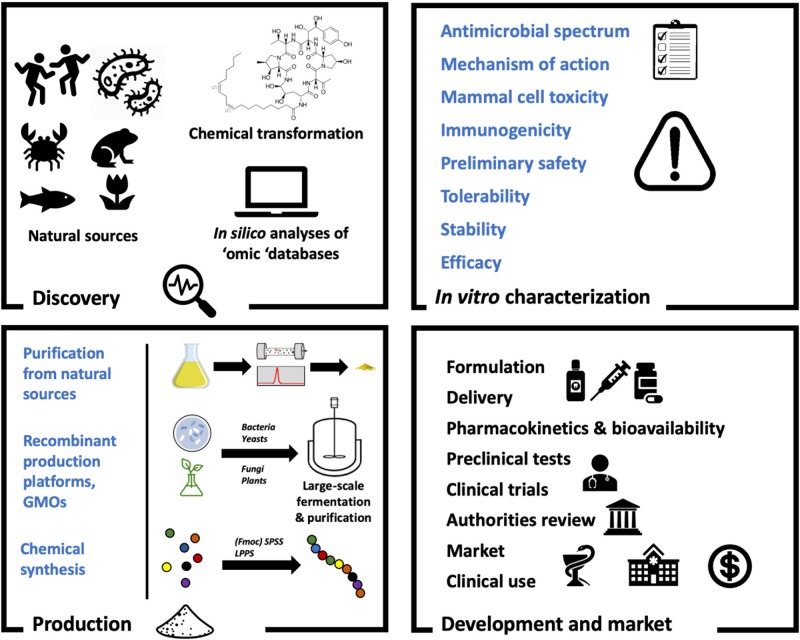
Fungi have been used since ancient times in food and beverage-making processes and, more recently, have been harnessed for the production of antibiotics and in processes of relevance to the bioeconomy. Moreover, they are starting to gain attention as a key component of the human microbiome. However, fungi are also responsible for human infections. The incidence of community-acquired and nosocomial fungal infections has increased considerably in recent decades. Antibiotic resistance development, the increasing number of immunodeficiency- and/or immunosuppression-related diseases and limited therapeutic options available are triggering the search for novel alternatives. These new antifungals should be less toxic for the host, with targeted or broader antimicrobial spectra (for diseases of known and unknown etiology, respectively) and modes of actions that limit the potential for the emergence of resistance among pathogenic fungi. Given these criteria, antimicrobial peptides with antifungal properties, i.e., antifungal peptides (AFPs), have emerged as powerful candidates due to their efficacy and high selectivity. In this review, we provide an overview of the bioactivity and classification of AFPs (natural and synthetic) as well as their mode of action and advantages over current antifungal drugs. Additionally, natural, heterologous and synthetic production of AFPs with a view to greater levels of exploitation is discussed. Finally, we evaluate the current and potential applications of these peptides, along with the future challenges relating to antifungal treatments.
真菌在食品和饮料制造过程中自古就被使用,而近年来,它们又被用于生产抗生素,并在与生物经济相关的过程中得到利用。此外,它们开始作为人类微生物组的一个关键组成部分引起关注。然而,真菌也会导致人类感染。在最近几十年中,社区获得性和医院获得性真菌感染的发病率大大增加。抗生素耐药性的发展、免疫缺陷和/或免疫抑制相关疾病的增多以及可用的治疗选择有限,促使人们寻找新的替代品。这些新的抗真菌药物对宿主的毒性应较低,具有靶向或更广泛的抗菌谱(分别针对已知和未知病因的疾病),并且作用方式限制了致病真菌产生耐药性的潜力。鉴于这些标准,具有抗真菌特性的抗菌肽,即抗真菌肽 (AFP),由于其功效和高选择性而成为有力的候选药物。在这篇综述中,我们概述了 AFP(天然和合成)的生物活性和分类,以及它们的作用模式和相对于现有抗真菌药物的优势。此外,还讨论了 AFP 的天然、异源和合成生产,以期实现更高水平的利用。最后,我们评估了这些肽的当前和潜在应用,以及与抗真菌治疗相关的未来挑战。