Pan Xiaohui, Xu Shishi, Li Juan, Tong Nanwei
Department of Endocrinology and Metabolism, West China Hospital of Sichuan University, Chengdu, China.
Front Endocrinol (Lausanne). 2020 Dec 1;11:599355. doi: 10.3389/fendo.2020.599355. eCollection 2020.
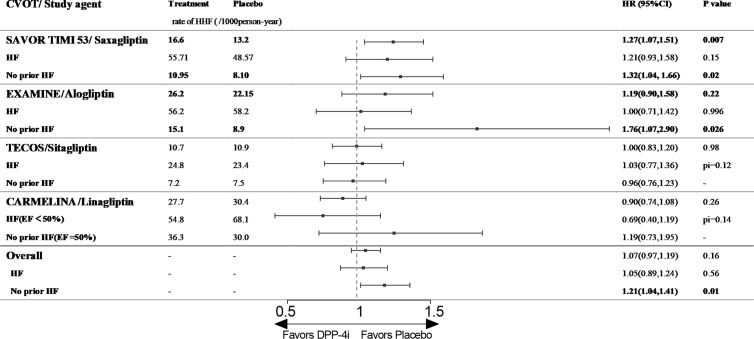
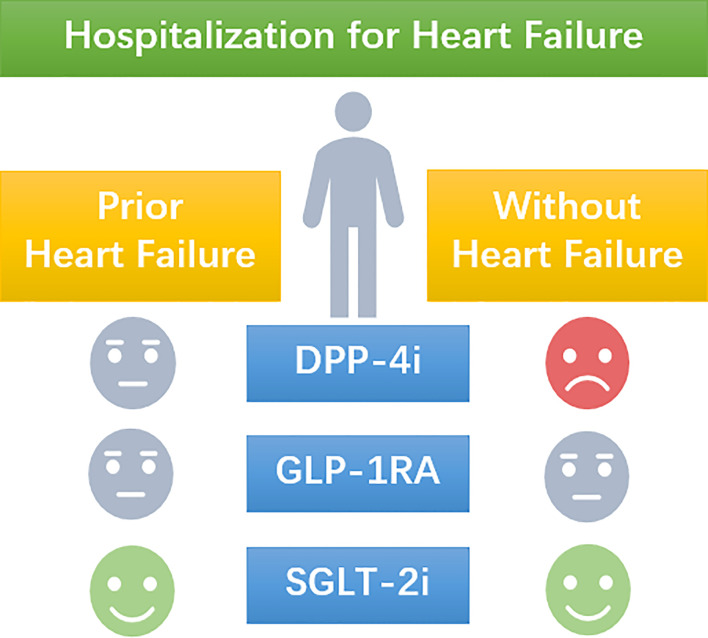
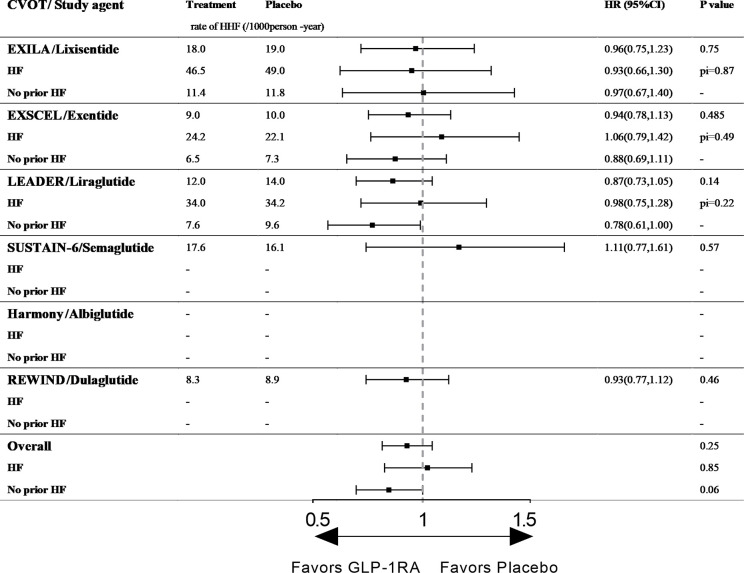
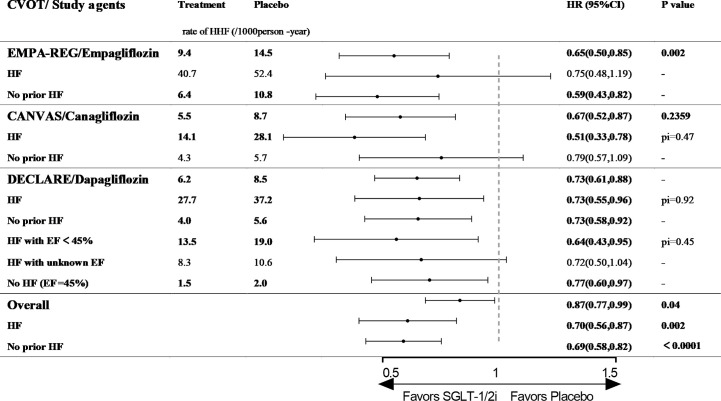
Patients with type 2 diabetes (T2D) have a higher risk of heart failure (HF) than healthy people, and the prognosis of patients with diabetes and current or previous HF is worse than that of patients with only diabetes. We reviewed the HF outcomes in recently published cardiovascular outcome trials (CVOTs) of three new classes of anti-diabetic agents, namely, dipeptidyl peptidase-4 inhibitors (DPP-4is), glucagon-like-peptide 1 receptor agonists (GLP-1RAs), and sodium glucose cotransporter-2 inhibitors (SGLT-2is) or SGLT-2 and SGLT-1 dual inhibitors and divided the patients into two groups based on the history of HF (with or without) and analyzed their risks of HHF based on the receipt of the aforementioned anti-diabetes drug types. Since the follow-up period differed among the trials, we expressed the rate of HHF as events/1,000 person-years to describe the HF outcome. At last we pooled the data and analyzed their different effects and mechanisms on heart failure outcomes. Although DPP-4is did not increase the risk of HHF in T2D patients with a history of HF, they were associated with a significantly higher risk of HHF among patients without history of HF. Some GLP-1RAs reduced the risk of macrovascular events, but none of these drugs reduced the risk of HHF in patients with T2D irrespective of their HF history. It was not clarified whether SGLT-1/2is can improve the prognosis of macrovascular events in patients with T2D, but these drugs reduced the risk of HHF regardless of patients' histories of HF. This information may be useful or referential for the "precise" selection of hyperglycemic medications. Further researches still needed to clarify the mechanisms of these anti-diabetic medications.
2型糖尿病(T2D)患者发生心力衰竭(HF)的风险高于健康人,糖尿病合并当前或既往HF患者的预后比仅患糖尿病的患者更差。我们回顾了最近发表的三类新型抗糖尿病药物的心血管结局试验(CVOTs)中的HF结局,这三类药物分别是二肽基肽酶-4抑制剂(DPP-4is)、胰高血糖素样肽-1受体激动剂(GLP-1RAs)以及钠-葡萄糖协同转运蛋白-2抑制剂(SGLT-2is)或SGLT-2和SGLT-1双重抑制剂,并根据HF病史(有或无)将患者分为两组,基于接受上述抗糖尿病药物类型分析他们发生HHF的风险。由于各试验的随访期不同,我们将HHF发生率表示为事件/1000人年以描述HF结局。最后我们汇总数据并分析它们对心力衰竭结局的不同影响及机制。尽管DPP-4is在有HF病史的T2D患者中未增加HHF风险,但在无HF病史的患者中,它们与显著更高的HHF风险相关。一些GLP-1RAs降低了大血管事件风险,但无论HF病史如何,这些药物均未降低T2D患者的HHF风险。目前尚不清楚SGLT-1/2is是否能改善T2D患者大血管事件的预后,但这些药物无论患者HF病史如何均降低了HHF风险。该信息可能有助于或可用于高血糖药物的“精准”选择。仍需进一步研究以阐明这些抗糖尿病药物的作用机制。