Ren Guoling, Wang Jinlong, Qu Lina, Li Wei, Hu Min, Bian Lihong, Zhang Yiting, Le Jianjun, Dou Xumou, Chen Xinhong, Bai Lulu, Li Yue
Heilongjiang Provincial Key Laboratory of Oilfield Applied Chemistry and Technology, Daqing, China.
College of Bioengineering, Daqing Normal University, Daqing, China.
Front Microbiol. 2020 Dec 1;11:580363. doi: 10.3389/fmicb.2020.580363. eCollection 2020.
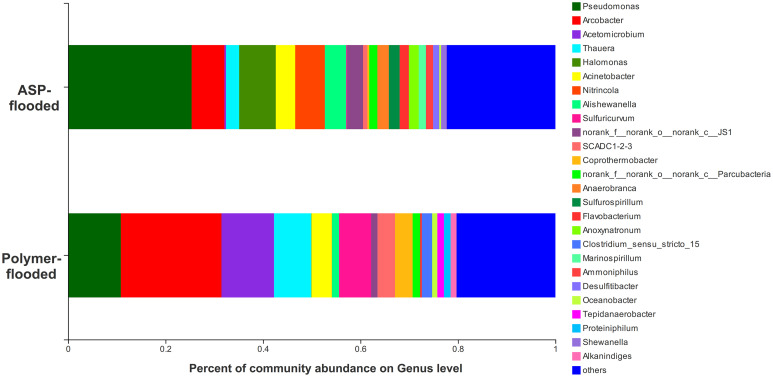
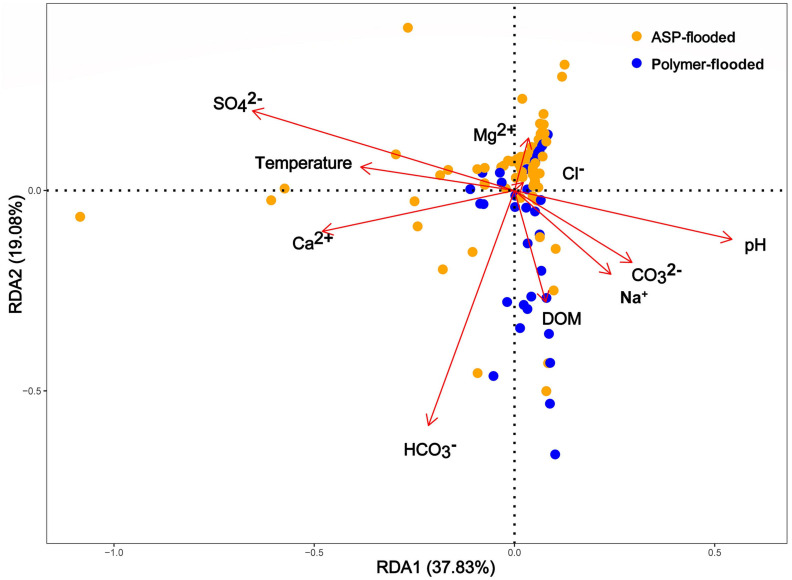
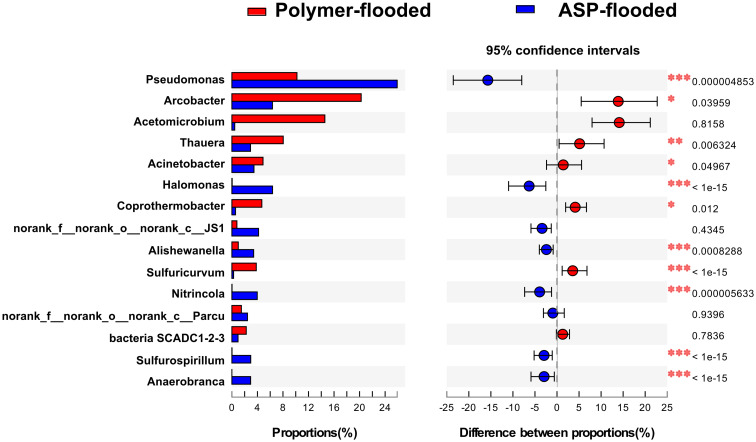
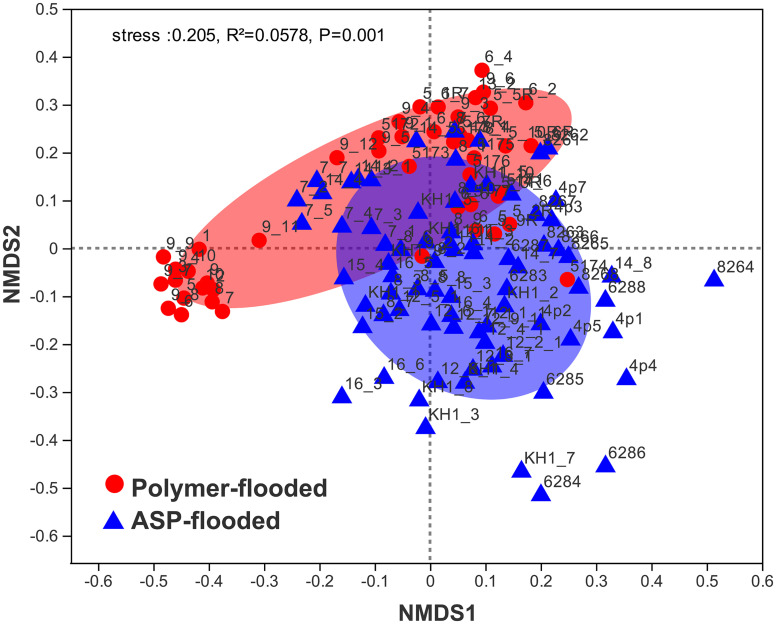
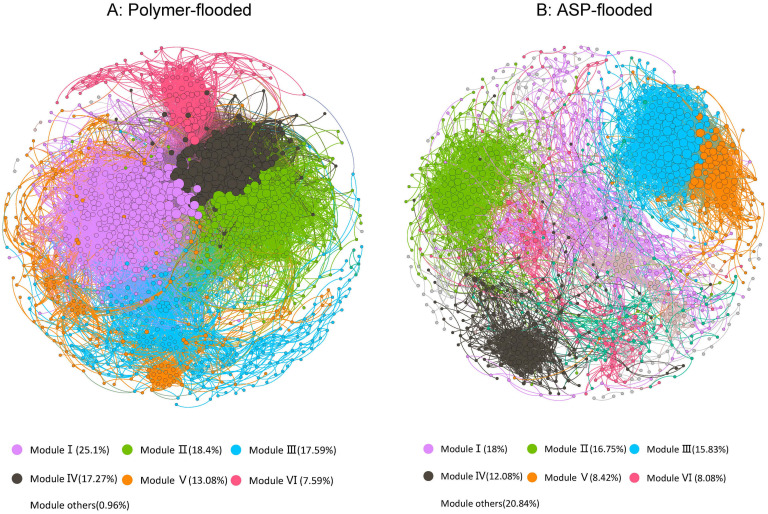
Polymer flooding technology and alkaline-surfactant-polymer (ASP) flooding technology have been widely used in some oil reservoirs. About 50% of remaining oil is trapped, however, in polymer-flooded and ASP-flooded reservoirs. How to further improve oil recovery of these reservoirs after chemical flooding is technically challenging. Microbial enhanced oil recovery (MEOR) technology is a promising alternative technology. However, the bacterial communities in the polymer-flooded and ASP-flooded reservoirs have rarely been investigated. We investigated the distribution and co-occurrence patterns of bacterial communities in ASP-flooded and polymer-flooded oil production wells. We found that and were dominant both in the polymer-flooded and ASP-flooded production wells. accounted for a large amount of the bacterial communities inhabiting in the ASP-flooded blocks, whereas they were hardly detected in the polymer-flooded blocks, and the trends for were the opposite. RDA analysis indicated that bacterial communities in ASP-flooded and polymer-flooded oil production wells are closely related to the physical and chemical properties, such as high salinity and strong alkaline, which together accounted for 56.91% of total variance. Co-occurrence network analysis revealed non-random combination patterns of bacterial composition from production wells of ASP-flooded and polymer-flooded blocks, and the ASP-flooded treatment decreased bacterial network complexity, suggesting that the application of ASP flooding technology reduced the tightness of bacterial interactions.
聚合物驱油技术和碱-表面活性剂-聚合物(ASP)驱油技术已在一些油藏中得到广泛应用。然而,在聚合物驱油和ASP驱油的油藏中,约50%的剩余油被困住。如何在化学驱油后进一步提高这些油藏的采收率在技术上具有挑战性。微生物强化采油(MEOR)技术是一种很有前景的替代技术。然而,聚合物驱油和ASP驱油油藏中的细菌群落很少被研究。我们调查了ASP驱油和聚合物驱油生产井中细菌群落的分布和共生模式。我们发现,[具体细菌名称1]和[具体细菌名称2]在聚合物驱油和ASP驱油生产井中均占主导地位。[具体细菌名称3]在ASP驱油区块中的细菌群落中占很大比例,而在聚合物驱油区块中几乎检测不到,[具体细菌名称4]的情况则相反。冗余分析(RDA)表明,ASP驱油和聚合物驱油生产井中的细菌群落与高盐度和强碱性等物理化学性质密切相关,这些性质共同占总变异的56.91%。共生网络分析揭示了ASP驱油和聚合物驱油区块生产井中细菌组成的非随机组合模式,并且ASP驱油处理降低了细菌网络的复杂性,这表明ASP驱油技术的应用降低了细菌相互作用的紧密程度。