Brachtlova Tereza, van Ginkel Jan-Willem, Luinenburg Mark J, de Menezes Renée X, Koppers-Lalic Danijela, Pegtel D Michiel, Dong Wenliang, de Gruijl Tanja D, van Beusechem Victor W
Department of Medical Oncology, Amsterdam UMC, Vrije Universiteit Amsterdam, Cancer Center Amsterdam, Amsterdam Infection & Immunity Institute, De Boelelaan 1117, 1081 HV Amsterdam, the Netherlands.
ORCA Therapeutics B.V., 1081 HV Amsterdam, the Netherlands.
Mol Ther Oncolytics. 2020 Oct 27;19:332-343. doi: 10.1016/j.omto.2020.10.012. eCollection 2020 Dec 16.
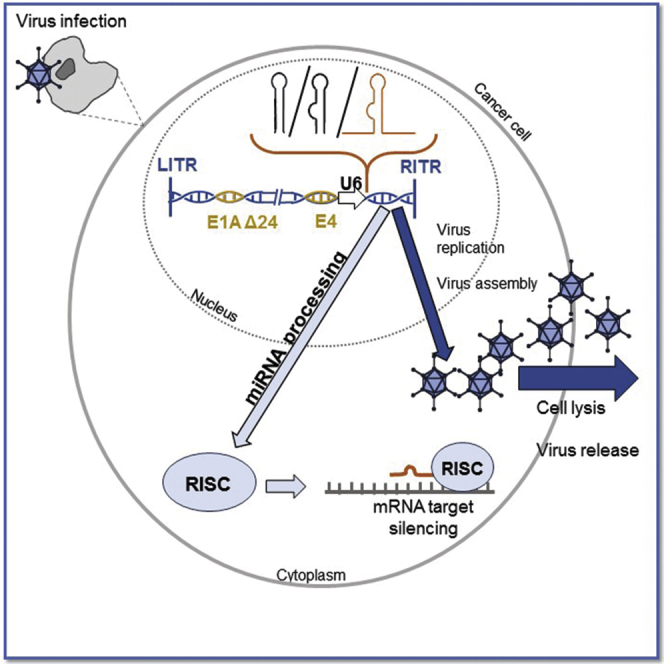
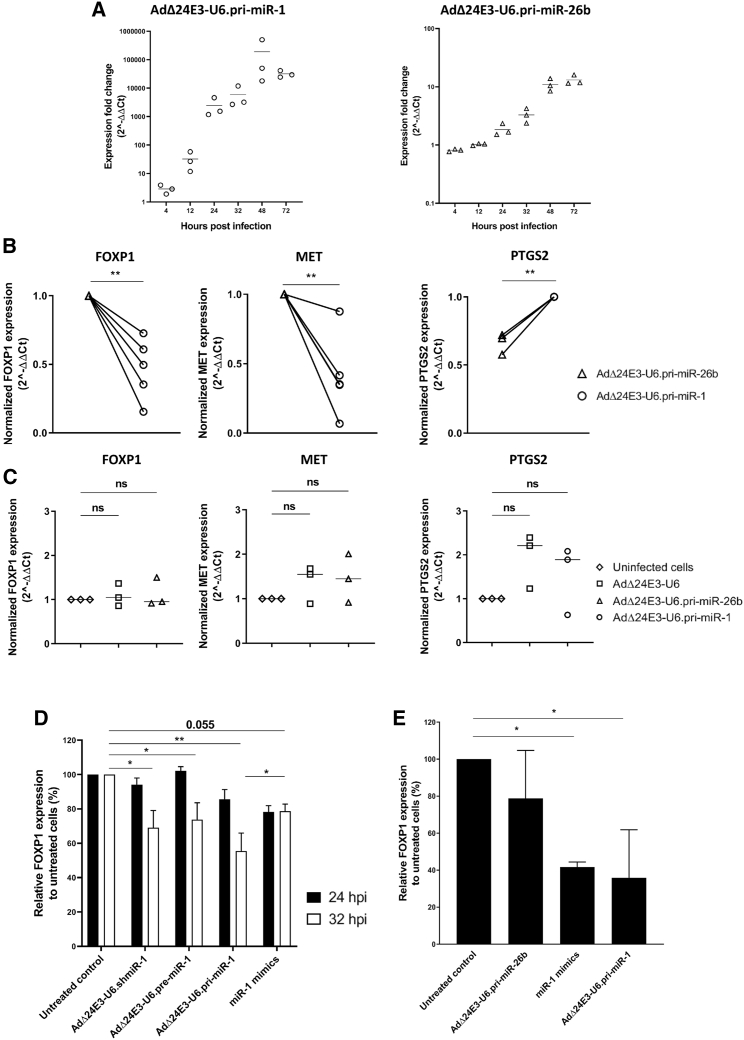
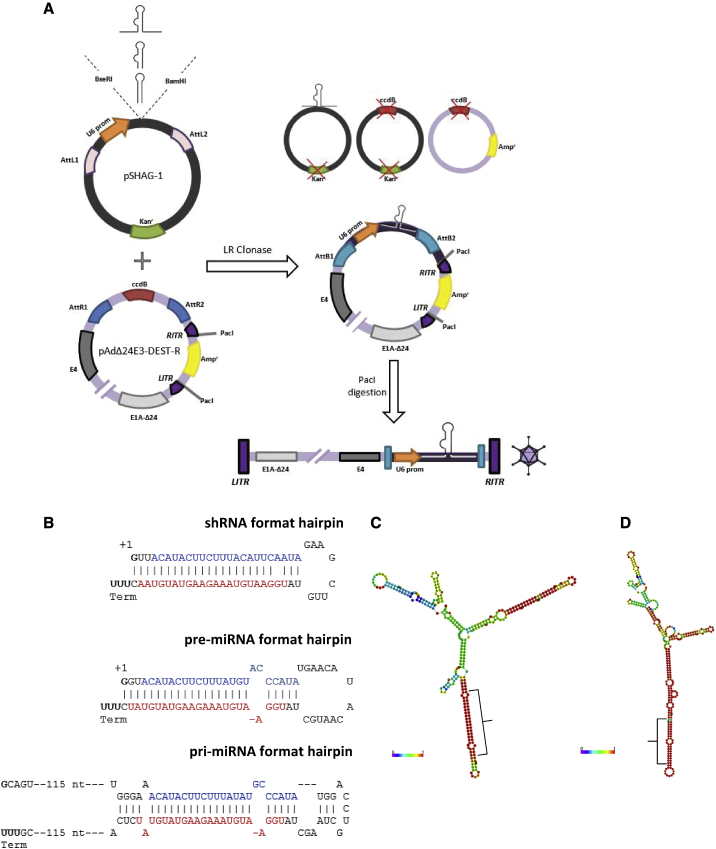
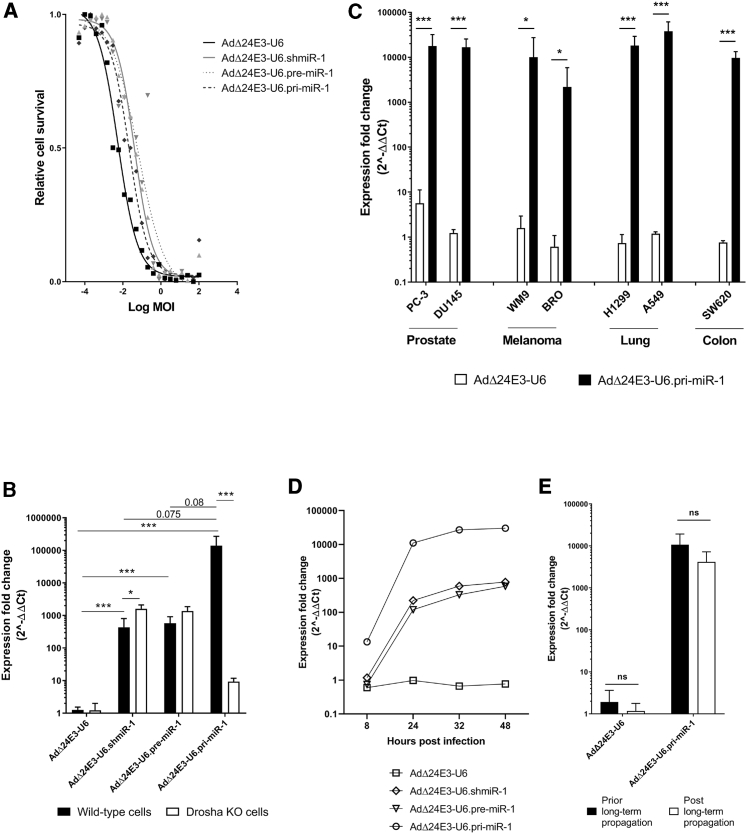
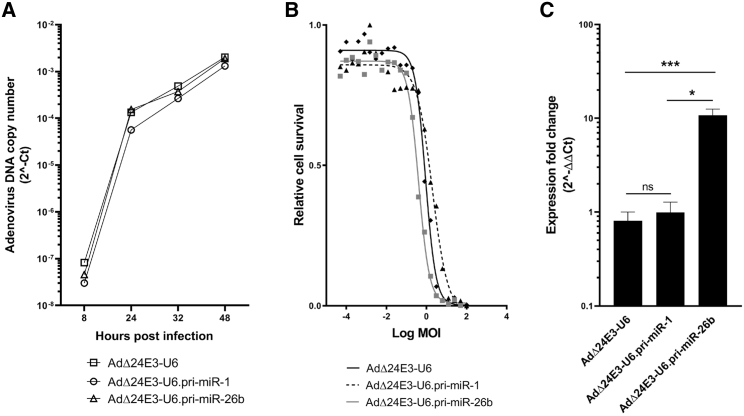
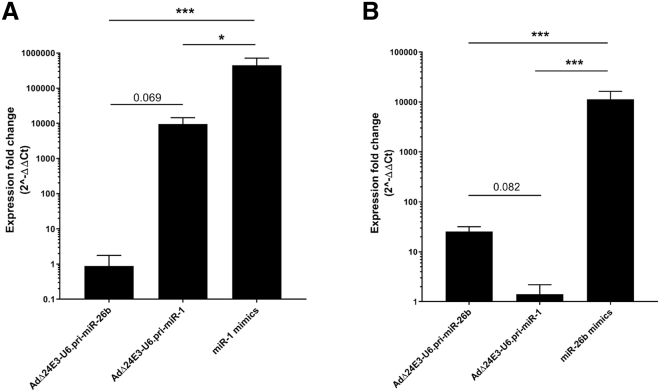
Oncolytic adenoviruses are being developed as new anti-cancer agents. Their efficacy can be improved by incorporating RNA interference (RNAi) molecules. RNAi molecules can be expressed in various precursor formats. The aim of this study was to determine the most effective format. To this end, we constructed three Δ24-type oncolytic adenoviruses, with human microRNA-1 (miR-1) expression cassettes in short hairpin RNA (shRNA), precursor microRNA (pre-miRNA), and primary miRNA (pri-miRNA) format, respectively. The viruses were compared for virus replication, mature miR-1 expression, and target gene silencing in cancer cells. Incorporation of the cassettes had only minor effects on virus replication. Mature miR-1 expression from the pri-miRNA format reached on average 100-fold higher levels than from the other two formats. This expression remained stable upon long-term virus propagation. Infection with the pri-miR-1-expressing virus silenced the validated miR-1 targets FOXP1 and MET. knockout almost completely abrogated mature miR-1 expression, confirming that processing of adenovirus-encoded pri-miR-1 was dependent on the host cell miRNA machinery. Using simple recombination cloning, a similar virus expressing miR-26b was made and shown to silence the validated miR-26b target PTGS2. We thus provide a platform for construction of oncolytic adenoviruses with high expression of RNAi molecules of choice.
溶瘤腺病毒正被开发为新型抗癌药物。通过整合RNA干扰(RNAi)分子可提高其疗效。RNAi分子可以多种前体形式表达。本研究的目的是确定最有效的形式。为此,我们构建了三种Δ24型溶瘤腺病毒,分别带有短发夹RNA(shRNA)、前体微小RNA(pre-miRNA)和初级微小RNA(pri-miRNA)形式的人微小RNA-1(miR-1)表达盒。比较了这些病毒在癌细胞中的病毒复制、成熟miR-1表达和靶基因沉默情况。表达盒的整合对病毒复制只有轻微影响。pri-miRNA形式的成熟miR-1表达平均比其他两种形式高100倍。在长期病毒传代过程中,这种表达保持稳定。用表达pri-miR-1的病毒感染可使已验证的miR-1靶标FOXP1和MET沉默。敲除几乎完全消除了成熟miR-1表达,证实腺病毒编码的pri-miR-1的加工依赖于宿主细胞的miRNA机制。通过简单的重组克隆,制备了一种表达miR-26b的类似病毒,并证明其可使已验证的miR-26b靶标PTGS2沉默。因此,我们提供了一个构建可高表达所选RNAi分子的溶瘤腺病毒的平台。