Cheedalla Aneesha, Moreau Caroline, Burke Anne E
Department of Gynecology and Obstetrics, Johns Hopkins University School of Medicine, Baltimore, MD.
Department of Population, Family and Reproductive Health, Johns Hopkins Bloomberg School of Public Health, Baltimore, MD.
Contracept X. 2020 Nov 20;2:100048. doi: 10.1016/j.conx.2020.100048. eCollection 2020.
The effects of the comprehensiveness of sex education on sexual health measures have not been well-studied. We compared trends in comprehensive sex education and its relation to contraceptive use at first intercourse and current contraceptive use for women ages 15-24 in the United States between 2011 and 2017.
Analyses included females ages 15-24 from the 2011-2017 National Survey of Family Growth. We defined comprehensive sex education as including 6 topics queried in the NSFG (how to say no to sex, birth control methods, where to get birth control, how to use condoms, sexually transmitted infections, HIV/AIDS), and non-comprehensive sex education as including less than 6 topics. Multivariable regression models investigated associations with contraceptive indicators.
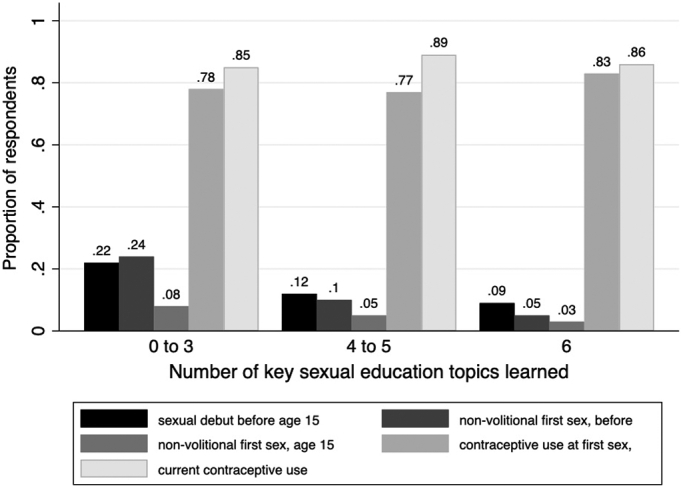
Among 5445 respondents, percentages of women receiving comprehensive sex education in 2011-2013, 2013-2015, and 2015-2017 were 35%, 40%, and 34%. Across all periods, respondents reporting comprehensive sex education before first sex were less likely to report first sexual intercourse before age 15 (aOR 0.55; 95% CI: 0.40-0.74) and non-volitional first intercourse (aOR 0.42, 95% CI: 0.26-0.72) compared to those with non-comprehensive sex education. At first intercourse, those with comprehensive sex education were more likely to have used any (aOR = 1.63; 95% CI: 1.18-2.25) and very effective (aOR = 1.35; 95% CI: 1.04-1.75) contraception. Comprehensive sex education was unrelated to current contraceptive use (aOR = 0.87; 95% CI: 0.63-1.21).
Comprehensive sex education was associated with increased odds of contraceptive use at first intercourse, but not current contraceptive use.
Programs that promote comprehensive sex education may have a positive impact on preventive behaviors at sexual debut.
性教育的全面性对性健康指标的影响尚未得到充分研究。我们比较了2011年至2017年美国15至24岁女性全面性教育的趋势及其与首次性交时避孕措施使用和当前避孕措施使用的关系。
分析纳入了2011 - 2017年全国家庭成长调查中15至24岁的女性。我们将全面性教育定义为包括全国家庭成长调查中询问的6个主题(如何拒绝性行为、避孕方法、何处获取避孕措施、如何使用避孕套、性传播感染、艾滋病毒/艾滋病),非全面性教育定义为包括少于6个主题。多变量回归模型研究了与避孕指标的关联。
在5445名受访者中,2011 - 2013年、2013 - 2015年和2015 - 2017年接受全面性教育的女性比例分别为35%、40%和34%。在所有时期,报告在首次性交前接受全面性教育的受访者与接受非全面性教育的受访者相比,在15岁之前进行首次性交的可能性较小(调整后比值比[aOR]为0.55;95%置信区间[CI]:0.40 - 0.74),非自愿首次性交的可能性也较小(aOR为0.42,95% CI:0.26 - 0.72)。在首次性交时,接受全面性教育的人更有可能使用任何避孕措施(aOR = 1.63;95% CI:1.18 - 2.25)和非常有效的避孕措施(aOR = 1.35;95% CI:1.04 - 1.75)。全面性教育与当前避孕措施的使用无关(aOR = 0.87;95% CI:0.63 - 1.21)。
全面性教育与首次性交时避孕措施使用几率的增加有关,但与当前避孕措施的使用无关。
推广全面性教育的项目可能对首次性行为时的预防行为产生积极影响。