Follmann Dean, Fintzi Jonathan, Fay Michael P, Janes Holly E, Baden Lindsey, Sahly Hana El, Fleming Thomas R, Mehrotra Devan V, Carpp Lindsay N, Juraska Michal, Benkeser David, Donnell Deborah, Fong Youyi, Han Shu, Hirsch Ian, Huang Ying, Huang Yunda, Hyrien Ollivier, Luedtke Alex, Carone Marco, Nason Martha, Vandebosch An, Zhou Honghong, Cho Iksung, Gabriel Erin, Kublin James G, Cohen Myron S, Corey Lawrence, Gilbert Peter B, Neuzil Kathleen M
Biostatistics Research Branch, National Institute of Allergy and Infectious Diseases, Bethesda, MD, USA.
Vaccine and Infectious Disease Division, Fred Hutchinson Cancer Research Center, Seattle, WA, USA.
medRxiv. 2020 Dec 14:2020.12.14.20248137. doi: 10.1101/2020.12.14.20248137.
Several candidate vaccines to prevent COVID-19 disease have entered large-scale phase 3 placebo-controlled randomized clinical trials and some have demonstrated substantial short-term efficacy. Efficacious vaccines should, at some point, be offered to placebo participants, which will occur before long-term efficacy and safety are known.
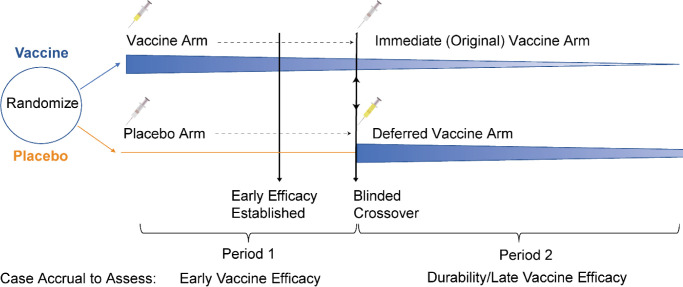
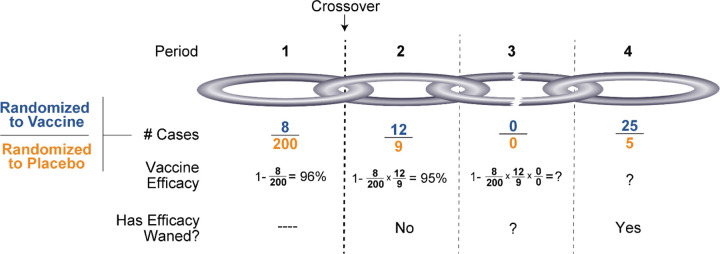
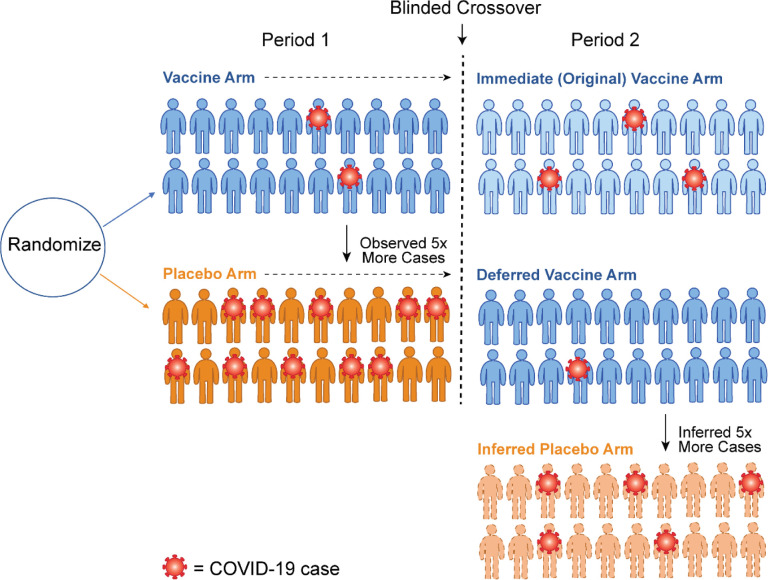
Following vaccination of the placebo group, we show that placebo-controlled vaccine efficacy can be derived by assuming the benefit of vaccination over time has the same profile for the original vaccine recipients and the placebo crossovers. This reconstruction allows estimation of both vaccine durability and potential vaccine-associated enhanced disease.
Post-crossover estimates of vaccine efficacy can provide insights about durability, identify waning efficacy, and identify late enhancement of disease, but are less reliable estimates than those obtained by a standard trial where the placebo cohort is maintained. As vaccine efficacy estimates for post-crossover periods depend on prior vaccine efficacy estimates, longer pre-crossover periods with higher case counts provide better estimates of late vaccine efficacy. Further, open-label crossover may lead to riskier behavior in the immediate crossover period for the unblinded vaccine arm, confounding vaccine efficacy estimates for all post-crossover periods.
We advocate blinded crossover and continued follow-up of trial participants to best assess vaccine durability and potential delayed enhancement of disease. This approach allows placebo recipients timely access to the vaccine when it would no longer be proper to maintain participants on placebo, yet still allows important insights about immunological and clinical effectiveness over time.
几种预防新冠病毒疾病的候选疫苗已进入大规模3期安慰剂对照随机临床试验,一些疫苗已显示出显著的短期疗效。在知晓长期疗效和安全性之前的某个时候,应向安慰剂组参与者提供有效的疫苗。
在安慰剂组接种疫苗后,我们表明,通过假设疫苗接种随时间的益处对于原始疫苗接种者和安慰剂交叉者具有相同的特征,可以得出安慰剂对照的疫苗效力。这种重建方法可以估计疫苗的持久性以及潜在的疫苗相关疾病增强情况。
交叉后疫苗效力的估计可以提供有关持久性的见解,识别效力下降情况,并识别疾病的后期增强情况,但与维持安慰剂队列的标准试验所获得的估计相比,可靠性较低。由于交叉后期的疫苗效力估计取决于先前的疫苗效力估计,病例数较多的较长交叉前期能更好地估计后期疫苗效力。此外,开放标签交叉可能会导致未设盲的疫苗组在直接交叉期出现更具风险的行为,从而混淆所有交叉后期的疫苗效力估计。
我们提倡对试验参与者进行设盲交叉和持续随访,以最佳地评估疫苗的持久性和潜在的疾病延迟增强情况。这种方法允许安慰剂接受者在继续让参与者使用安慰剂不再合适时及时获得疫苗,但仍能随着时间推移提供有关免疫和临床效果的重要见解。