Laboratoire Evolution & Diversité Biologique (EDB, UMR 5174), CNRS/IRD/Université Toulouse III, 118 Route de Narbonne, 31062 Toulouse, France.
Claude E. Phillips Herbarium, Delaware State University, 1200 N. Dupont Hwy, Dover, DE 19901-2277, USA.
Genes (Basel). 2020 Dec 16;11(12):1508. doi: 10.3390/genes11121508.
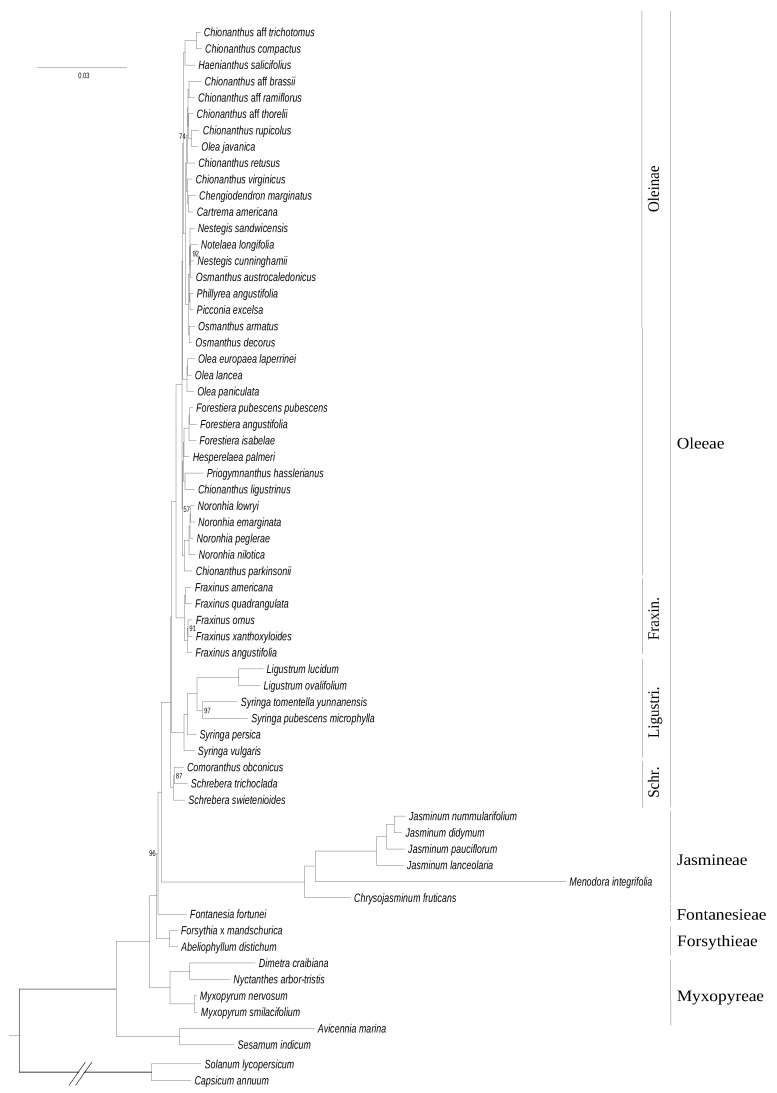
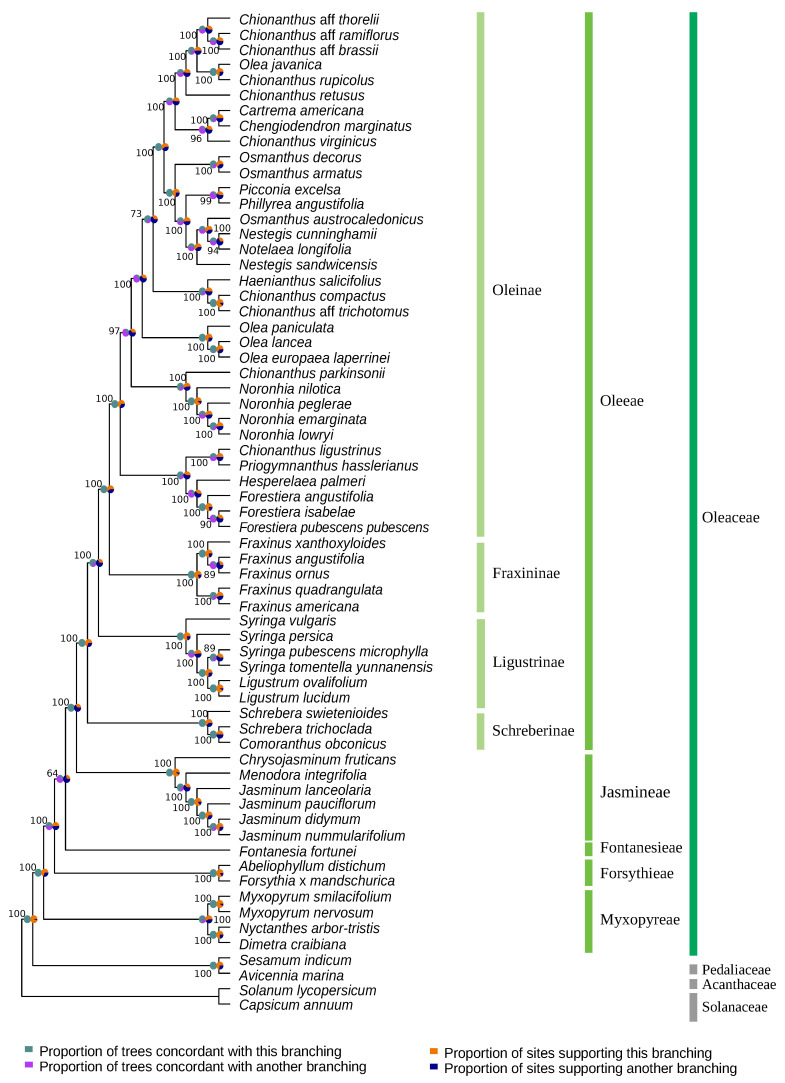
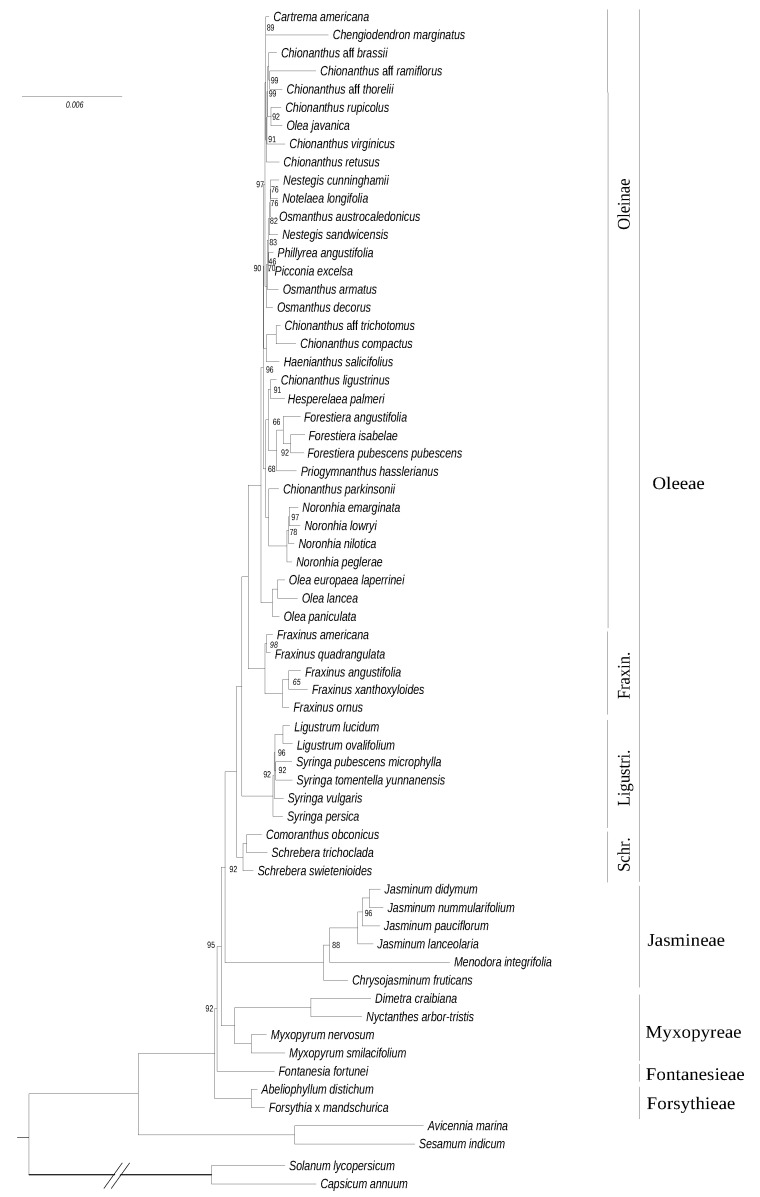
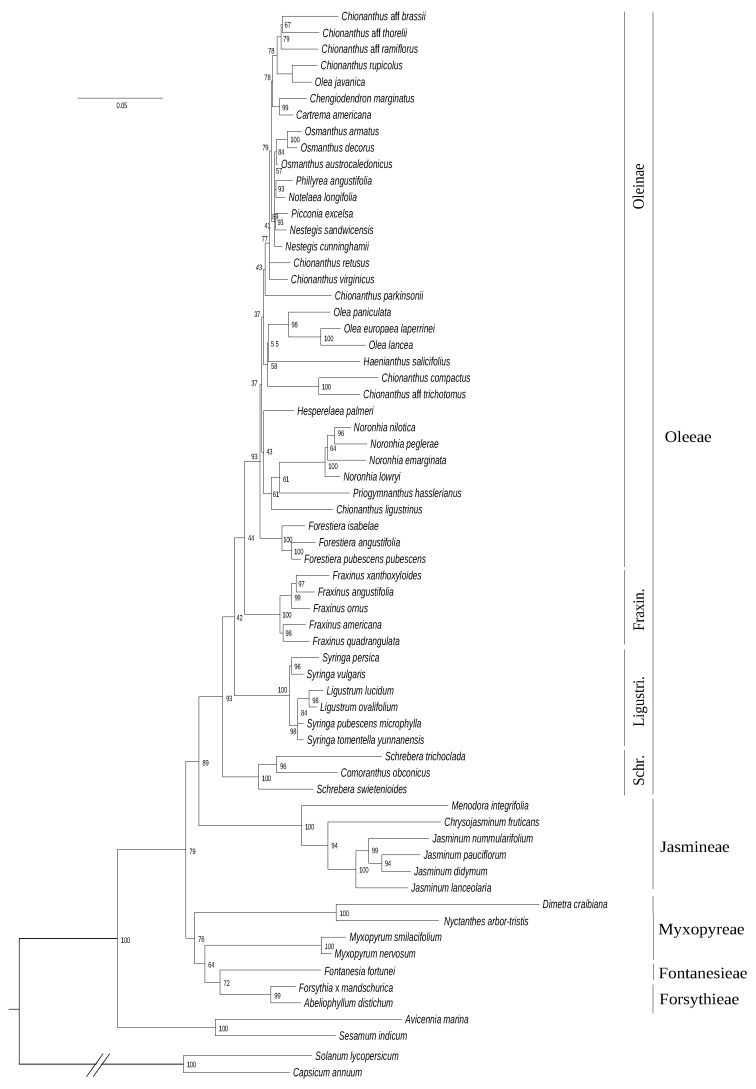
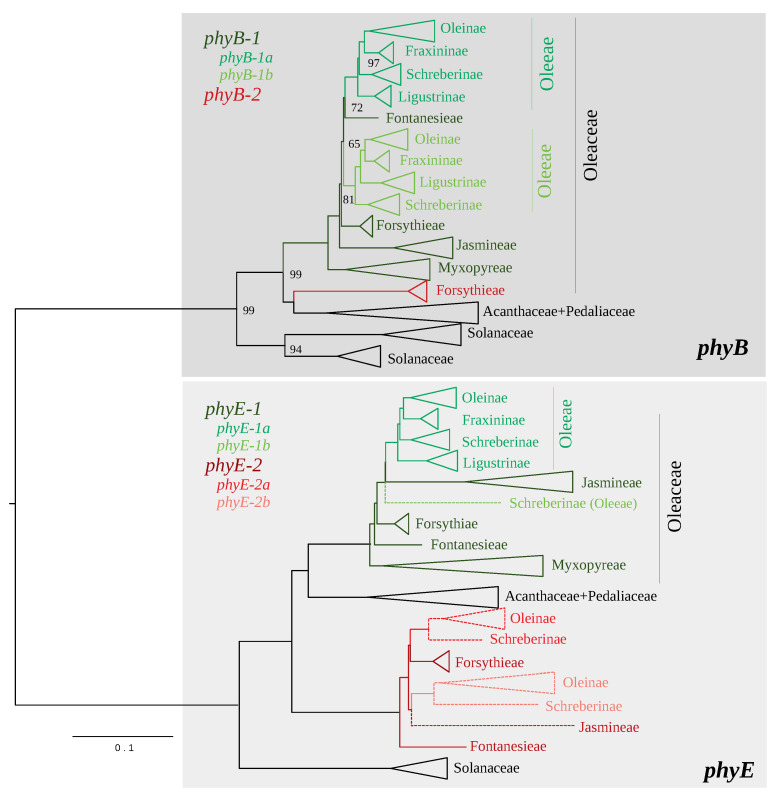
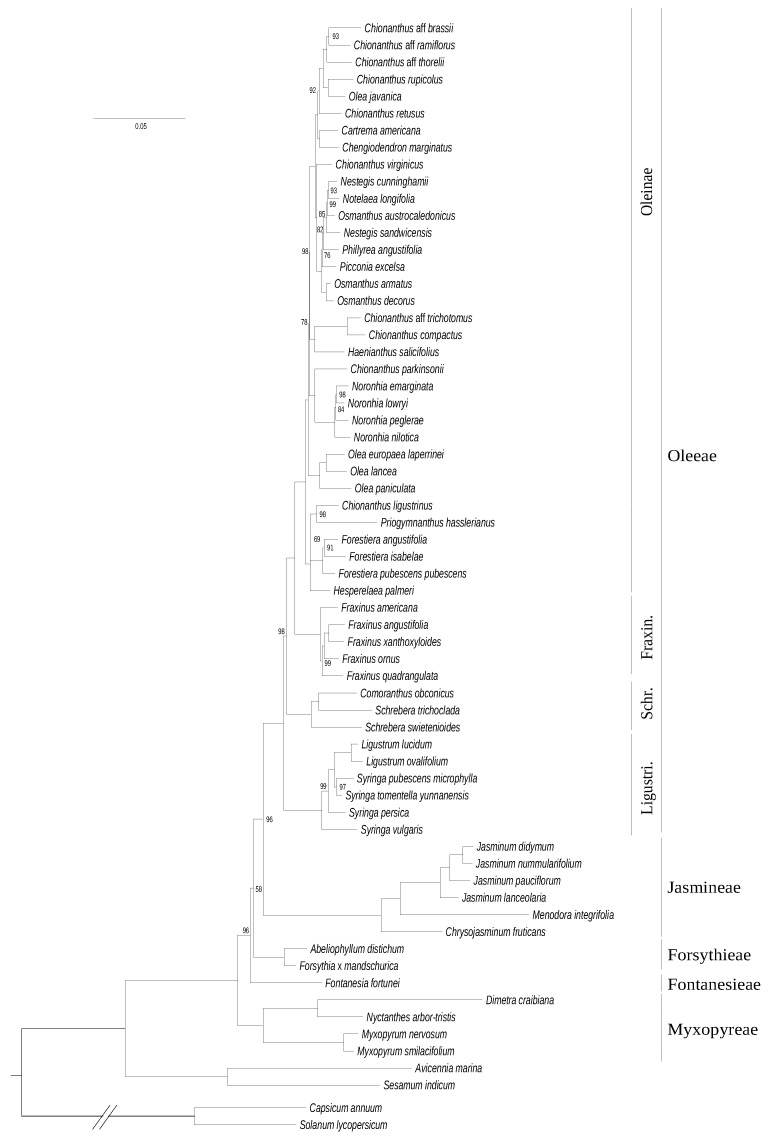
The olive family, Oleaceae, is a group of woody plants comprising 28 genera and ca. 700 species, distributed on all continents (except Antarctica) in both temperate and tropical environments. It includes several genera of major economic and ecological importance such as olives, ash trees, jasmines, forsythias, osmanthuses, privets and lilacs. The natural history of the group is not completely understood yet, but its diversification seems to be associated with polyploidisation events and the evolution of various reproductive and dispersal strategies. In addition, some taxonomical issues still need to be resolved, particularly in the paleopolyploid tribe Oleeae. Reconstructing a robust phylogenetic hypothesis is thus an important step toward a better comprehension of Oleaceae's diversity. Here, we reconstructed phylogenies of the olive family using 80 plastid coding sequences, 37 mitochondrial genes, the complete nuclear ribosomal cluster and a small multigene family encoding phytochromes ( and ) of 61 representative species. Tribes and subtribes were strongly supported by all phylogenetic reconstructions, while a few Oleeae genera are still polyphyletic () or paraphyletic (, ). Some phylogenetic relationships among tribes remain poorly resolved with conflicts between topologies reconstructed from different genomic regions. The use of nuclear data remains an important challenge especially in a group with ploidy changes (both paleo- and neo-polyploids). This work provides new genomic datasets that will assist the study of the biogeography and taxonomy of the whole Oleaceae.
木樨科,又名橄榄科,是木本植物的一个科,包含 28 属约 700 种,分布于各大洲(南极洲除外)的温带和热带环境中。该科包括一些具有重要经济和生态意义的属,如橄榄属、榆属、茉莉属、连翘属、桂花属、女贞属和丁香属。该科的自然历史尚未完全了解,但它的多样化似乎与多倍体化事件和各种生殖与传播策略的进化有关。此外,一些分类学问题仍需解决,特别是在古多倍体族 Oleeae 中。因此,构建一个稳健的系统发育假说对于更好地理解木樨科的多样性是一个重要的步骤。在这里,我们使用 80 个质体编码序列、37 个线粒体基因、完整的核核糖体簇和一个包含编码光敏色素的小多基因家族(和)的 61 个代表物种的数据集来重建橄榄科的系统发育。所有的系统发育重建都强烈支持族和亚族的分类,而一些 Oleeae 属仍然是多系的()或并系的(,)。一些族之间的系统发育关系仍然没有得到很好的解决,不同基因组区域重建的拓扑结构之间存在冲突。核数据的使用仍然是一个重要的挑战,特别是在一个具有倍性变化(古多倍体和新多倍体)的群体中。这项工作提供了新的基因组数据集,将有助于研究整个木樨科的生物地理学和分类学。