School of Public Health, Graduate School of Medicine, The University of Tokyo, Bunkyo-ku, Japan.
Division of Cancer Statistics Integration, Center for Cancer Control and Information Services, National Cancer Center, Chuo-ku, Japan.
Cancer Med. 2021 Jan;10(2):757-771. doi: 10.1002/cam4.3677. Epub 2020 Dec 19.
Although preclinical studies suggest that fermented soy foods may have a protective effect against breast cancer, no prospective cohort studies have examined this association.
Our study examined the association between fermented and nonfermented soy food intake and breast cancer risk using a population-based prospective cohort study in Japan.
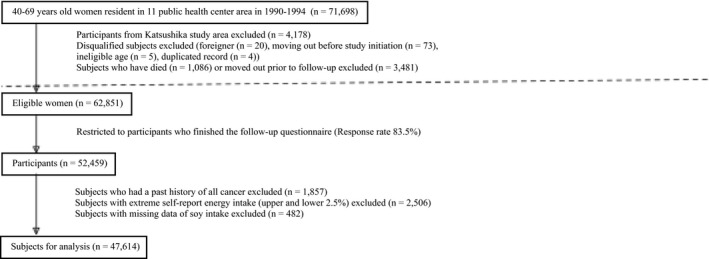
We included a total of 47,614 women aged 45-74 years in an analysis of the Japan Public Health Center-based Prospective Study (JPHC Study). A validated food frequency questionnaire (FFQ) was used for the assessment of dietary intake. Breast cancer incidence was analyzed by multivariate Cox proportional hazards regression models.
During an average of 15.5 years of follow-up, 825 breast cancer cases were newly identified. We found no association of intake of soy foods with breast cancer risk, regardless of fermentation, with multivariate hazard ratios (HRs) and 95% confidence intervals (CIs) for the highest quartiles of fermented and nonfermented soy food intake of 0.94 (0.67, 1.32) and 1.15 (0.85, 1.57) compared with the lowest quartile (p for trend = 0.305 and 0.393). Unlike nonfermented soy, higher intake of fermented soy foods was associated with a significant decrease in the risk of nonlocalized breast cancer. The HR and 95% CI in the highest compared to lowest intake category of fermented soy foods was 0.53 (0.28, 0.99) versus nonfermented soy foods 0.85 (0.51, 1.42) (p for trend = 0.026 and 0.797).
Our analyses showed that fermented soy foods had no association with overall breast cancer but may be associated with decreased risk of nonlocalized breast cancer.
虽然临床前研究表明发酵豆制品可能对乳腺癌有保护作用,但尚无前瞻性队列研究对此关联进行检验。
我们利用日本一项基于人群的前瞻性队列研究,检验了摄入发酵和非发酵豆制品与乳腺癌风险之间的关系。
我们纳入了日本公共卫生中心前瞻性研究(JPHC 研究)中总计 47614 名年龄 45-74 岁的女性。采用经过验证的食物频率问卷(FFQ)评估饮食摄入情况。采用多变量 Cox 比例风险回归模型分析乳腺癌发病情况。
在平均 15.5 年的随访期间,新确诊 825 例乳腺癌病例。无论发酵情况如何,我们均未发现摄入豆制品与乳腺癌风险相关,摄入最高四分位数发酵和非发酵豆制品与最低四分位数相比,乳腺癌风险的多变量危险比(HR)和 95%置信区间(CI)分别为 0.94(0.67, 1.32)和 1.15(0.85, 1.57)(趋势检验 p 值=0.305 和 0.393)。与非发酵豆制品不同,摄入较高水平的发酵豆制品与非局部乳腺癌风险显著降低相关。最高与最低摄入类别的发酵豆制品 HR 和 95%CI 为 0.53(0.28, 0.99),而非发酵豆制品为 0.85(0.51, 1.42)(趋势检验 p 值=0.026 和 0.797)。
我们的分析表明,发酵豆制品与总体乳腺癌无关,但可能与非局部乳腺癌风险降低有关。