Univ. Savoie Mont-Blanc, Univ. Grenoble Alpes, CNRS, EDYTEM, Chambéry, France.
Univ. Grenoble Alpes, Univ. Savoie Mont-Blanc, CNRS, LECA, Grenoble, France.
Glob Chang Biol. 2021 Apr;27(8):1662-1677. doi: 10.1111/gcb.15496. Epub 2021 Jan 16.
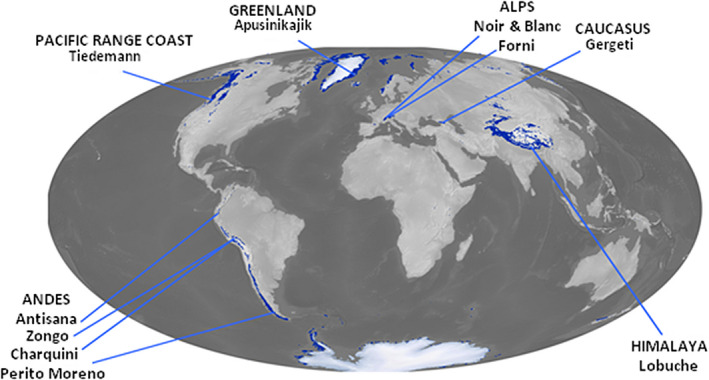
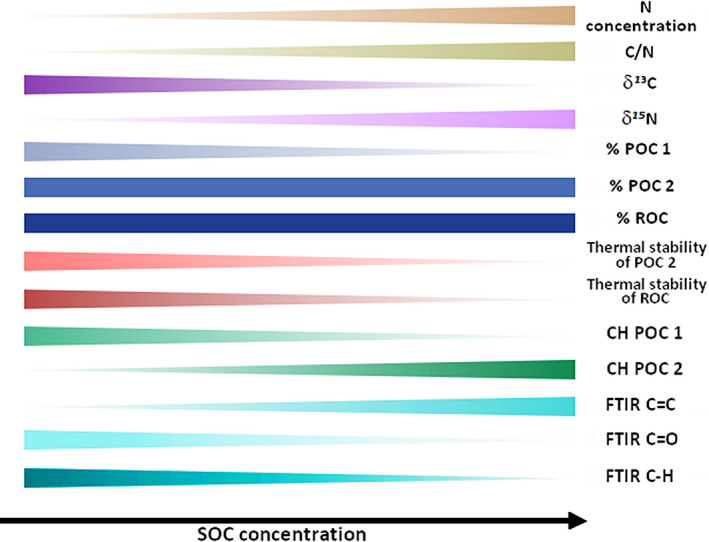
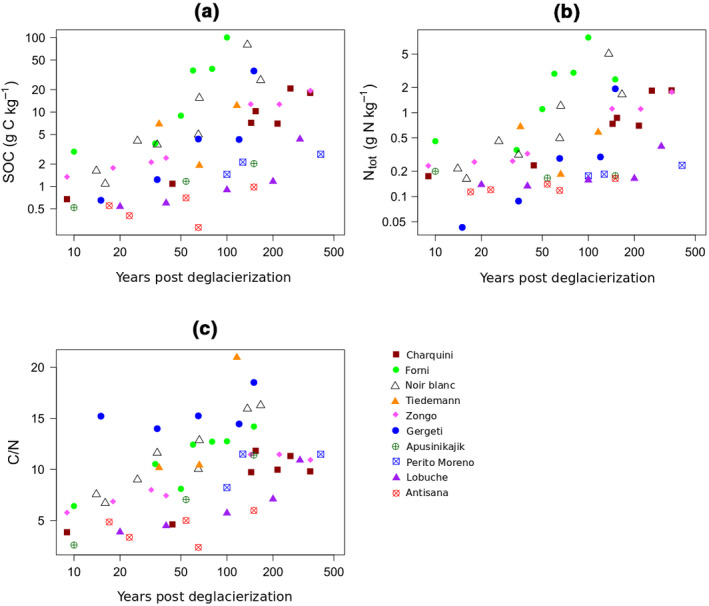
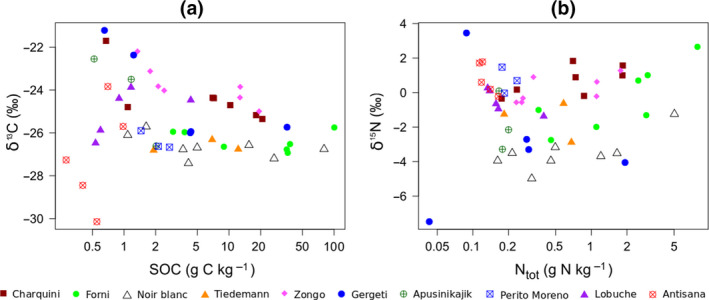
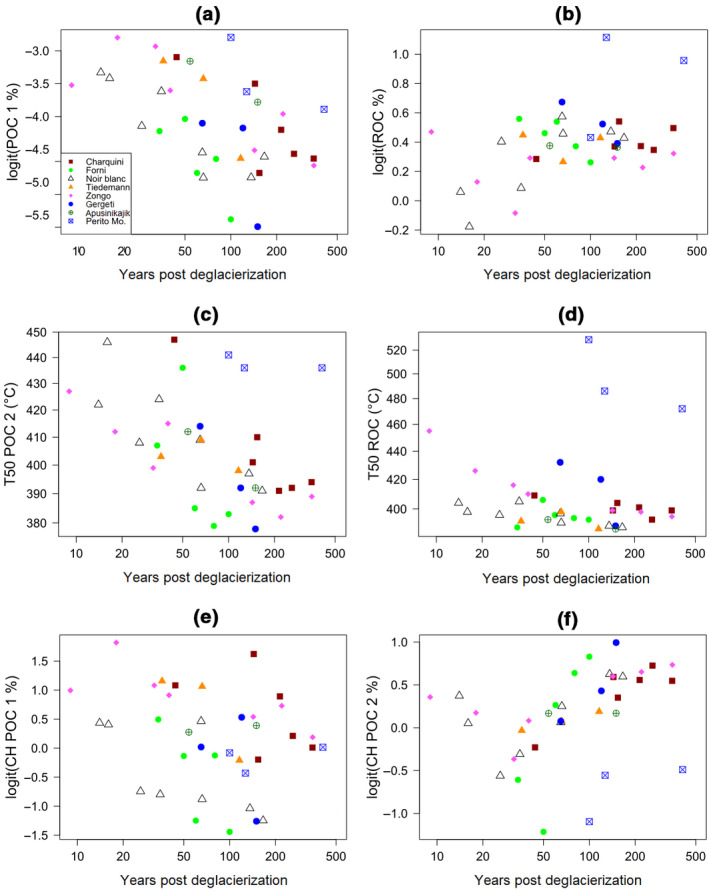
Since the last glacial maximum, soil formation related to ice-cover shrinkage has been one major sink of carbon accumulating as soil organic matter (SOM), a phenomenon accelerated by the ongoing global warming. In recently deglacierized forelands, processes of SOM accumulation, including those that control carbon and nitrogen sequestration rates and biogeochemical stability of newly sequestered carbon, remain poorly understood. Here, we investigate the build-up of SOM during the initial stages (up to 410 years) of topsoil development in 10 glacier forelands distributed on four continents. We test whether the net accumulation of SOM on glacier forelands (i) depends on the time since deglacierization and local climatic conditions (temperature and precipitation); (ii) is accompanied by a decrease in its stability and (iii) is mostly due to an increasing contribution of organic matter from plant origin. We measured total SOM concentration (carbon, nitrogen), its relative hydrogen/oxygen enrichment, stable isotopic ( C, N) and carbon functional groups (C-H, C=O, C=C) compositions, and its distribution in carbon pools of different thermal stability. We show that SOM content increases with time and is faster on forelands experiencing warmer climates. The build-up of SOM pools shows consistent trends across the studied soil chronosequences. During the first decades of soil development, the low amount of SOM is dominated by a thermally stable carbon pool with a small and highly thermolabile pool. The stability of SOM decreases with soil age at all sites, indicating that SOM storage is dominated by the accumulation of labile SOM during the first centuries of soil development, and suggesting plant carbon inputs to soil (SOM depleted in nitrogen, enriched in hydrogen and in aromatic carbon). Our findings highlight the potential vulnerability of SOM stocks from proglacial areas to decomposition and suggest that their durability largely depends on the relative contribution of carbon inputs from plants.
自末次冰期最大值以来,与冰盖收缩相关的土壤形成过程一直是碳积累为土壤有机物质(SOM)的主要汇之一,而这一现象正被正在发生的全球变暖所加速。在最近冰川消退的前缘地区,SOM 积累过程,包括控制碳和氮固存率以及新固存碳的生物地球化学稳定性的过程,仍未被充分了解。在这里,我们研究了在分布于四大洲的 10 个冰川前缘地区,在表土发育的最初阶段(长达 410 年)中 SOM 的积累情况。我们测试了 SOM 在冰川前缘地区的净积累是否取决于冰川消退后的时间和当地气候条件(温度和降水);(ii)是否伴随着其稳定性的降低;(iii)是否主要是由于植物来源的有机物质的贡献增加。我们测量了总 SOM 浓度(碳、氮)、其相对氢/氧丰度、稳定同位素(C、N)和碳官能团(C-H、C=O、C=C)组成及其在不同热稳定性碳库中的分布。我们表明,SOM 含量随时间而增加,在气候较温暖的前缘地区增加得更快。在所研究的土壤时间序列中,SOM 库的积累表现出一致的趋势。在土壤发育的最初几十年中,低含量的 SOM 主要由热稳定的碳库组成,而小且高度不稳定的碳库则很少。在所有地点,SOM 的稳定性随土壤年龄的增加而降低,这表明在土壤发育的最初几个世纪中,SOM 储存主要是由不稳定 SOM 的积累所主导,这表明植物向土壤输入碳(氮素贫化、富含氢和芳香碳的 SOM)。我们的研究结果突出了冰川前缘地区 SOM 储量对分解的潜在脆弱性,并表明其耐久性在很大程度上取决于植物碳输入的相对贡献。