Ali Solomon, Destaw Zelalem, Misganaw Awoke, Worku Asnake, Negash Legesse, Bekele Abebe, Zergaw Ababi, Walker Ally, Odell Chris, Naghavi Mohsen, Abate Ebba, Mirkuzie Alemnesh H
Ethiopian Public Health Institute (EPHI), Addis Ababa, Ethiopia.
Saint Paul's Hospital Millennium Medical College, Addis Ababa, Ethiopia.
Inj Epidemiol. 2020 Dec 21;7(1):67. doi: 10.1186/s40621-020-00292-9.
Mortality caused by injuries is increasing and becoming a significant global public health concern. Limited evidence from Ethiopia on road traffic, unintentional and intentional injuries indicate the potential public health impact of problems resulting from such injuries. However, there is a significant evidence gap about the actual national burden of all injuries in Ethiopia. This data base study aimed to reveal the national burden of different injuries in Ethiopia.
Data for this study were extracted from the estimates of the Global Burden of Diseases (GBD) 2017 study. Estimates of metrics such as Disability-Adjusted Life Years (DALYs), death rates, incidence, and prevalence were extracted. The metrics were then examined at different injury types, socio-demographic categories such as age groups and sex. Trends of the metrics were also explored for these categories across years from 2007 to 2017. The DALYs and deaths due to injuries in Ethiopia were also compared with other East African countries (specifically Kenya, Tanzania, Uganda, and Zambia) in order to evaluate regional differences across years, by sex and by different injury types such as transport injuries, unintentional injuries, self-harm and interpersonal violence.
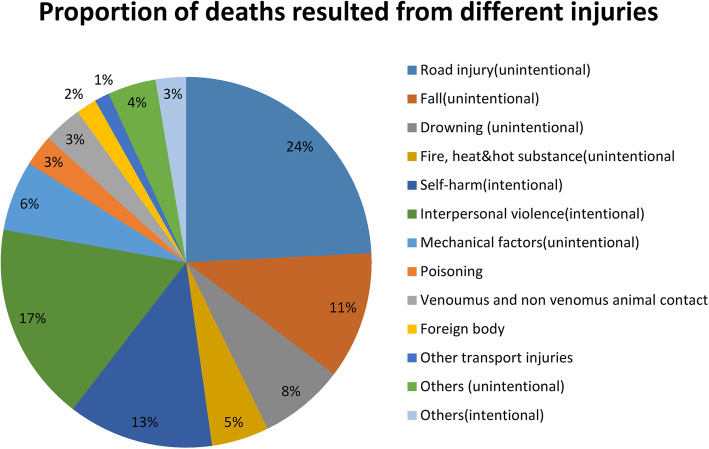
The age-standardized injury death rate has decreased to 69.4; 95% UI: (63.0-76.9) from 90.11; 95% UI: (82.41-97.73) in 2017 as compared with 2007. Road injury, falls, self-harm and interpersonal violence were the leading causes of mortality from injuries occurring in 2017. The age-standardized injury DALYs rate has decreased to 3328.2; 95% UI: (2981.7-3707.8) from 4265.55; 95% UI: (3898.11-4673.64) in 2017 as compared with 2007. The number of deaths resulting from injuries in 2017 was highest for males, children under 5 years, people aged 15-24.
The current age-standardized death rate and DALYs from injuries is high and the observed annual reduction is not satisfactory. There is a difference in gender and age regarding the number of deaths resulting from injuries. The data indicates that the current national efforts to address the public health impact of injuries in Ethiopia are not sufficient enough to bring a marked reduction. As a result, a more holistic approach to address all injuries is recommended in Ethiopia.
伤害导致的死亡率正在上升,成为全球重大的公共卫生问题。埃塞俄比亚关于道路交通、意外伤害和故意伤害的证据有限,这表明此类伤害所引发问题对公共卫生的潜在影响。然而,关于埃塞俄比亚所有伤害实际的国家负担,存在显著的证据空白。这项数据库研究旨在揭示埃塞俄比亚不同伤害的国家负担。
本研究的数据取自《2017年全球疾病负担(GBD)研究》的估计数据。提取了诸如伤残调整生命年(DALYs)、死亡率、发病率和患病率等指标的估计值。然后按不同伤害类型、年龄组和性别等社会人口类别对这些指标进行了分析。还探讨了2007年至2017年这些类别的指标随时间的变化趋势。为了评估不同年份、性别以及交通伤害、意外伤害、自残和人际暴力等不同伤害类型之间的区域差异,还将埃塞俄比亚因伤害导致的伤残调整生命年和死亡情况与其他东非国家(特别是肯尼亚、坦桑尼亚、乌干达和赞比亚)进行了比较。
与2007年相比,2017年年龄标准化伤害死亡率从90.11;95%可信区间:(82.41 - 97.73)降至69.4;95%可信区间:(63.0 - 76.9)。道路伤害、跌倒、自残和人际暴力是2017年伤害致死的主要原因。与2007年相比,2017年年龄标准化伤害伤残调整生命年率从4265.55;95%可信区间:(3898.11 - 4673.64)降至3328.2;95%可信区间:(2981.7 - 3707.8)。2017年因伤害导致死亡人数最多的是男性、5岁以下儿童以及15 - 24岁人群。
目前伤害的年龄标准化死亡率和伤残调整生命年率较高,且观察到的年度降幅并不理想。在伤害导致的死亡人数方面存在性别和年龄差异。数据表明,埃塞俄比亚目前应对伤害对公共卫生影响的国家努力不足以带来显著降低。因此,建议埃塞俄比亚采取更全面的方法来应对所有伤害。