National Data Management and Analytics Center for Health, Ethiopian Public Health Institute, Addis Ababa, Ethiopia.
Department of Global Public Health, Karolinska Institutet (KI), Stockholm, Sweden.
Front Public Health. 2023 May 22;11:1149966. doi: 10.3389/fpubh.2023.1149966. eCollection 2023.
The 2030 agenda for sustainable development goals has given injury prevention new attention, including halving road traffic injuries. This study compiled the best available evidence on injury from the global burden of diseases study for Ethiopia from 1990 to 2019.
Injury data on incidence, prevalence, mortality, disability-adjusted life years lost, years lived with disability, and years of life lost were extracted from the 2019 global burden of diseases study for regions and chartered cities in Ethiopia from 1990 to 2019. Rates were estimated per 100,000 population.
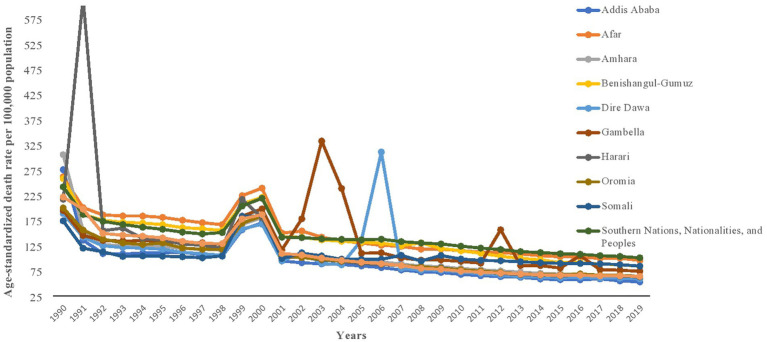
In 2019, the age-standardized rate of incidence was 7,118 (95% UI: 6,621-7,678), prevalence was 21,735 (95% UI: 19,251-26,302), death was 72 (95% UI: 61-83), disability-adjusted life years lost was 3,265 (95% UI: 2,826-3,783), years of live lost was 2,417 (95% UI: 2,043-2,860), and years lived with disability was 848 [95% UI: (620-1,153)]. Since 1990, there has been a reduction in the age-standardized rate of incidence by 76% (95% UI: 74-78), death by 70% (95% UI: 65-75), and prevalence by 13% (95% UI: 3-18), with noticeable inter-regional variations. Transport injuries, conflict and terrorism, interpersonal violence, self-harm, falls, poisoning, and exposure to mechanical forces were the leading causes of injury-related deaths and long-term disabilities. Since 1990, there has been a decline in the prevalence of transport injuries by 32% (95% UI: 31-33), exposure to mechanical forces by 12% (95% UI: 10-14), and interpersonal violence by 7.4% (95% UI: 5-10). However, there was an increment in falls by 8.4% (95% UI: 7-11) and conflict and terrorism by 1.5% (95% UI: 38-27).
Even though the burden of injuries has steadily decreased at national and sub-national levels in Ethiopia over the past 30 years, it still remains to be an area of public health priority. Therefore, injury prevention and control strategies should consider regional disparities in the burden of injuries, promoting transportation safety, developing democratic culture and negotiation skills to solve disputes, using early security-interventions when conflict arises, ensuring workplace safety and improving psychological wellbeing of citizens.
可持续发展目标 2030 议程赋予了伤害预防新的关注,包括将道路交通伤害减半。本研究汇编了全球疾病负担研究中 1990 年至 2019 年期间埃塞俄比亚可获得的最佳伤害证据。
从全球疾病负担研究中提取了 1990 年至 2019 年期间埃塞俄比亚各地区和特许城市的伤害发生率、患病率、死亡率、残疾调整生命年损失、残疾生存年和生命损失年的数据。按每 100,000 人口计算。
2019 年,年龄标准化发病率为 7,118(95%置信区间:6,621-7,678),患病率为 21,735(95%置信区间:19,251-26,302),死亡率为 72(95%置信区间:61-83),残疾调整生命年损失为 3,265(95%置信区间:2,826-3,783),生命损失年为 2,417(95%置信区间:2,043-2,860),残疾生存年为 848(95%置信区间:620-1,153)。自 1990 年以来,发病率的年龄标准化率下降了 76%(95%置信区间:74-78),死亡率下降了 70%(95%置信区间:65-75),患病率下降了 13%(95%置信区间:3-18),区域间存在明显差异。交通伤害、冲突和恐怖主义、人际暴力、自我伤害、跌倒、中毒和机械力暴露是伤害相关死亡和长期残疾的主要原因。自 1990 年以来,交通伤害的患病率下降了 32%(95%置信区间:31-33),机械力暴露下降了 12%(95%置信区间:10-14),人际暴力下降了 7.4%(95%置信区间:5-10)。然而,跌倒的发生率增加了 8.4%(95%置信区间:7-11),冲突和恐怖主义增加了 1.5%(95%置信区间:38-27)。
尽管埃塞俄比亚在过去 30 年中在国家和国家以下各级的伤害负担稳步下降,但它仍然是一个公共卫生优先事项领域。因此,伤害预防和控制策略应考虑到伤害负担的区域差异,促进交通安全,培养民主文化和解决争端的谈判技巧,在冲突出现时及时进行早期安全干预,确保工作场所安全,改善公民的心理健康。