Gupta Uttio, Gupta Yashdeep, Jose Divya, Mani Kalaivani, Jyotsna Viveka P, Sharma Gautam, Tandon Nikhil
Department of Endocrinology and Metabolism, All India Institute of Medical Sciences, New Delhi, India.
Department of Cardiology and All India Institute of Medical Sciences, New Delhi, India.
Int J Yoga. 2020 Sep-Dec;13(3):233-238. doi: 10.4103/ijoy.IJOY_33_20. Epub 2020 Sep 13.
This study was designed to evaluate the effectiveness of a yoga-based exercise program (YBEP) in improving glycemic control in people with type 2 diabetes mellitus.
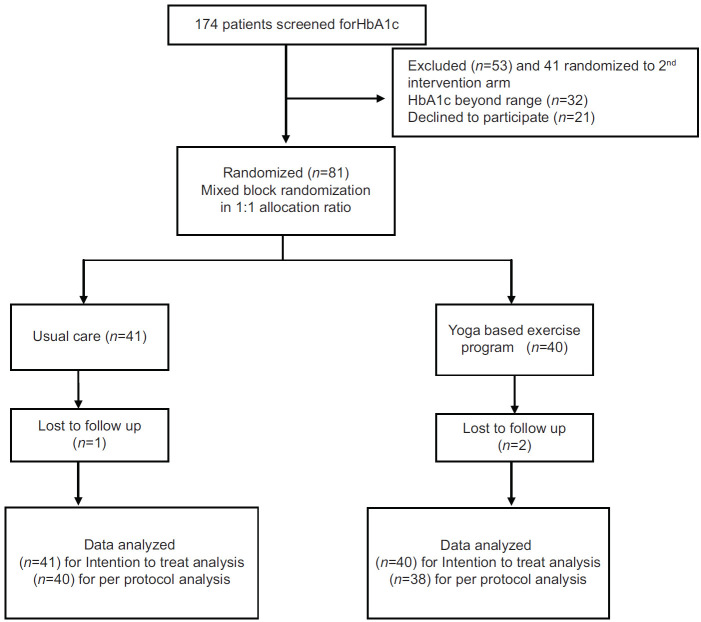
Patients on stable oral glucose-lowering agents for at least 3 months and HbA1c 7.5%-10% were randomized in 1:1 ratio. The primary outcome measure was the difference of change in mean HbA1c between groups.
The participants ( = 81) had mean (±standard deviation) age of 50.6 (±8.5) years and HbA1c of 8.5 ± 0.7% (68.97 ± 7.42 mmol/mol). The follow-up data were available in 96% (78/81) of participants. Of 40 participants, 25 (62.5%) attended ≥75% (≥10 out of 13) of the sessions in YBEP. On the intention to treat analysis, a favorable reduction (0.21% 95% confidence interval [-0.34, 0.75], = 0.454) in HbA1c was seen in YBEP group as compared to usual care. The reduction in HbA1c by ≥0.5% was observed in 44.7% of participants in YBEP as compared to 37.5% in usual care arm, respectively. Those who attended ≥75% of the sessions had better HbA1c reduction of 0.3% in comparison to 0.1% reduction seen in those who attended <75% of the sessions.
YBEP demonstrated a clinically relevant HbA1c reduction compared to usual care in participants who had attended at least 75% of the yoga sessions. The reduction in HbA1c by >0.5% in 44.7% in the yoga group, suggests, that it can be prescribed as an exercise to individuals who are unable to walk either due to limited joint mobility, adverse weather conditions, lack of space for walking, cultural or religious prohibitions for women for outdoor physical activity, and so on.CTRI registration no: CTRI/2017/05/008564.
本研究旨在评估基于瑜伽的运动计划(YBEP)对改善2型糖尿病患者血糖控制的有效性。
将至少3个月来一直服用稳定口服降糖药且糖化血红蛋白(HbA1c)水平在7.5%-10%之间的患者按1:1比例随机分组。主要结局指标是两组间平均HbA1c变化的差异。
参与者(n = 81)的平均(±标准差)年龄为50.6(±8.5)岁,HbA1c为8.5±0.7%(68.97±7.42 mmol/mol)。96%(78/81)的参与者有随访数据。在40名参与者中,25名(62.5%)参加了YBEP中≥75%(13次中的≥10次)的课程。在意向性分析中,与常规护理相比,YBEP组的HbA1c有显著降低(0.21%,95%置信区间[-0.34, 0.75],P = 0.454)。YBEP组中44.7%的参与者HbA1c降低≥0.5%,而常规护理组为37.5%。参加≥75%课程的参与者HbA1c降低了0.3%,优于参加<75%课程的参与者(降低0.1%)。
与常规护理相比,对于至少参加了75%瑜伽课程的参与者,YBEP显示出具有临床意义的HbA1c降低。瑜伽组中44.7%的参与者HbA1c降低>0.5%,这表明对于因关节活动受限、恶劣天气条件、缺乏行走空间、文化或宗教对女性户外体育活动的限制等原因而无法行走的个体,可以将其作为一种运动方式进行推荐。临床试验注册编号:CTRI/2017/05/008564。