Department of Obstetrics and Gynecology, The Affiliated Hospital of Southwest Medical University, Luzhou, China.
Department of Reproductive Center, The Affiliated Hospital of Southwest Medical University, Luzhou, China.
Front Endocrinol (Lausanne). 2020 Dec 4;11:595448. doi: 10.3389/fendo.2020.595448. eCollection 2020.
To retrospectively analyze the correlation between anti-Müllerian hormone (AMH) and the number of oocytes obtained by controlled ovarian hyperstimulation (COH) in women of different ages and explore the factors affecting fertilization and embryo transfer (IVF-ET) in clinical pregnancy of infertile women to provide evidence for infertile women to choose assisted reproduction strategies.
Infertile women who received IVF-ET or intracytoplasmic sperm injection and embryo transfer (ICSI-ET) treatment in the reproductive center of XX hospital between October 2018 and September 2019 were included. Patient data on medical records, age, body mass index (BMI), years of infertility, basic follicle-stimulating hormone (FSH), basic luteinizing hormone (LH), basic estradiol (E), anti-Müllerian hormone level (AMH), antral follicle count (AFC), gonadotropins (Gn) medication days, Gn dosage, endometrial thickness on transplantation day, the number of retrieved oocytes, the number of mature oocytes obtained, the number of embryos transferred, clinical pregnancy status, etc., were collected.
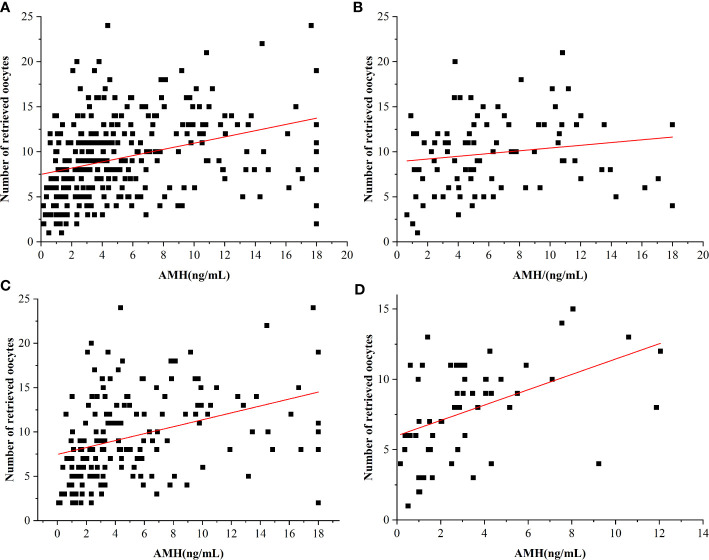
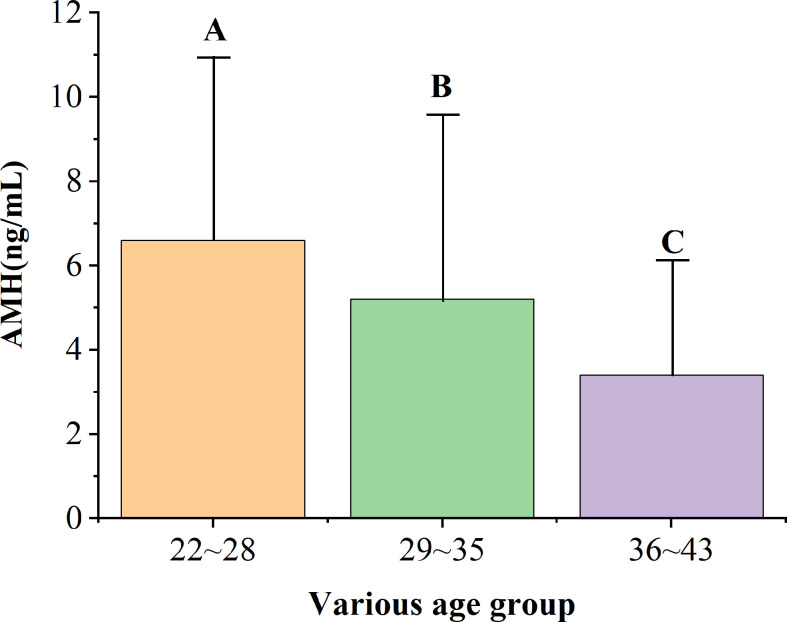
A total of 314 patients were enrolled in this study, with an average age of 31.0 ± 4.5 years. The infertility period ranged from 0-21 years. The AMH level showed a downward trend with increasing age. Overall, the AMH level of women of all ages was positively correlated with the number of retrieved oocytes ( = 0.335, < 0.001). The AMH level of women between 22 and 28 years old was positively correlated with the number of retrieved oocytes ( = 0.164, < 0.061) but it was not statistically significant. Similarly, the AMH level of women aged 29-35 and 36-43 was positively correlated with the number of retrieved oocytes ( = 0.356, < 0.001; = 0.461, < 0.001). The average age of the pregnant group (30.6 ± 4.4 years) was lower than that of the non-pregnant group (32.2 ± 4.6 years) ( < 0.001). The number of oocytes obtained (9.8 ± 4.5) and the number of embryos transferred (1.9 ± 0.4) in the pregnant group was significantly higher than that in the non-pregnant group (9.2 ± 4.5; 1.7 ± 0.5); the difference was statistically significant. The multivariate logistic regression model showed that age (OR = 0.574 95% CI: 0.350-0.940), AMH (OR = 1.430 95% CI: 1.130-1.820) and the number of oocytes obtained (OR = 1.360 95% CI: 1.030-1.790) were factors affecting clinical pregnancy.
We found that the level of AMH in infertile women decreased with age and the number of oocytes obtained in infertile women was positively correlated with AMH. Moreover, the number of oocytes and embryo transferred in the pregnant group was significantly higher than those in the non-pregnant group. Furthermore, age, AMH and the number of oocytes affected the clinical pregnancy.
回顾性分析抗苗勒管激素(AMH)与不同年龄段控制性卵巢超促排卵(COH)获得卵母细胞数的相关性,并探讨影响不孕患者临床妊娠的受精和胚胎移植(IVF-ET)的因素,为不孕患者选择辅助生殖策略提供依据。
选取 2018 年 10 月至 2019 年 9 月在 XX 医院生殖中心接受体外受精-胚胎移植(IVF-ET)或卵胞浆内单精子注射和胚胎移植(ICSI-ET)治疗的不孕患者。收集患者病历资料中的年龄、体质量指数(BMI)、不孕年限、基础卵泡刺激素(FSH)、基础黄体生成素(LH)、基础雌二醇(E)、抗苗勒管激素水平(AMH)、窦卵泡计数(AFC)、促性腺激素(Gn)用药天数、Gn 剂量、移植日子宫内膜厚度、获卵数、成熟卵数、移植胚胎数、临床妊娠情况等。
共纳入 314 例患者,平均年龄为(31.0±4.5)岁,不孕年限 0-21 年。AMH 水平随年龄增长呈下降趋势。总体上,各年龄段 AMH 水平与获卵数呈正相关( = 0.335, < 0.001)。22-28 岁女性的 AMH 水平与获卵数呈正相关( = 0.164, < 0.061),但差异无统计学意义。同样,29-35 岁和 36-43 岁女性的 AMH 水平与获卵数呈正相关( = 0.356, < 0.001; = 0.461, < 0.001)。妊娠组的平均年龄(30.6±4.4 岁)低于非妊娠组(32.2±4.6 岁)( < 0.001)。妊娠组的获卵数(9.8±4.5)和移植胚胎数(1.9±0.4)明显高于非妊娠组(9.2±4.5;1.7±0.5),差异有统计学意义。多因素 logistic 回归模型显示,年龄(OR=0.574,95%CI:0.350-0.940)、AMH(OR=1.430,95%CI:1.130-1.820)和获卵数(OR=1.360,95%CI:1.030-1.790)是影响临床妊娠的因素。
我们发现不孕妇女的 AMH 水平随年龄增长而降低,不孕妇女的获卵数与 AMH 呈正相关。此外,妊娠组的获卵数和胚胎移植数明显高于非妊娠组。此外,年龄、AMH 和获卵数影响临床妊娠。