Department of Reproductive Medicine Center, The Affiliated Changzhou Maternal and Child Health Care Hospital of Nanjing Medical University, Changzhou, 213000, Jiangsu, China.
Research Center for Bone and Stem Cells, Department of Anatomy, Histology and Embryology, Nanjing Medical University, Nanjing, 210029, China.
Sci Rep. 2020 Nov 12;10(1):19750. doi: 10.1038/s41598-020-76543-y.
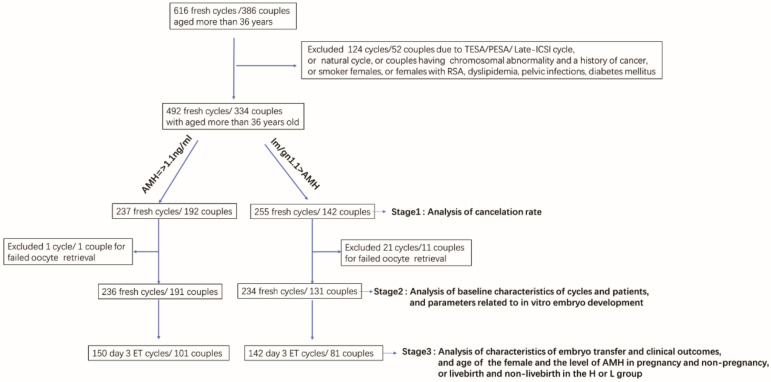
It has been widely acknowledged that anti-Müllerian hormone (AMH) is a golden marker of ovarian reserve. Declined ovarian reserve (DOR), based on experience from reproductive-aged women, refers to both the quantitative and qualitative reduction in oocytes. This view is challenged by a recent study clearly showing that the quality of oocytes is similar in young women undergoing IVF cycles irrespective of the level of AMH. However, it remains elusive whether AMH indicates oocyte quality in women with advanced age (WAA). The aim of this study was to investigate this issue. In the present study, we retrospectively analysed the data generated from a total of 492 IVF/ICSI cycles (from January 2017 to July 2020), and these IVF/ICSI cycles contributed 292 embryo transfer (ET) cycles (from June 2017 to September 2019, data of day 3 ET were included for analysis) in our reproductive centre. Based on the level of AMH, all patients (= > 37 years old) were divided into 2 groups: the AMH high (H) group and the AMH low (L) group. The parameters of in vitro embryo development and clinical outcomes were compared between the two groups. The results showed that women in the L group experienced severe DOR, as demonstrated by a higher rate of primary diagnosis of DOR, lower antral follicle count (AFC), higher level of basal follicle stimulating hormone (FSH) and cancelation cycles, lower level of E2 production on the day of surge, and fewer oocytes and MII oocytes retrieved. Compared with women in the H group, women in the L group showed slightly reduced top embryo formation rate but a similar normal fertilization rate and blastocyst formation rate. More importantly, we found that the rates of implantation, spontaneous miscarriage and livebirth were similar between the two groups, while the pregnancy rate was significantly reduced in the L group compared with the H group. Further analysis indicated that the higher pregnancy rate of women in the H group may be due to more top embryos transferred per cycle. Due to an extremely low implantation potential for transfer of non-top embryos from WAA (= > 37 years old) in our reproductive centre, we assumed that all the embryos that implanted may result from the transfer of top embryos. Based on this observation, we found that the ratio of embryos that successfully implanted or eventually led to a livebirth to top embryos transferred was similar between the H and the L groups. Furthermore, women with clinical pregnancy or livebirth in the H or L group did not show a higher level of serum AMH but were younger than women with non-pregnancy or non-livebirth. Taken together, this study showed that AMH had a limited role in predicting in vitro embryo developmental potential and had no role in predicting the in vivo embryo developmental potential, suggesting that in WAA, AMH should not be used as a marker of oocyte quality. This study supports the view that the accumulation of top embryos via multiple oocyte retrieval times is a good strategy for the treatment of WAA.
抗苗勒管激素(AMH)被广泛认为是卵巢储备的黄金标志物。基于对生殖年龄女性的经验,卵巢储备功能下降(DOR)是指卵母细胞数量和质量的减少。然而,最近的一项研究清楚地表明,在接受 IVF 周期的年轻女性中,无论 AMH 水平如何,卵母细胞的质量都是相似的,这一观点对上述观点提出了挑战。然而,AMH 是否能指示高龄(>37 岁)女性的卵母细胞质量仍不清楚。本研究旨在探讨这一问题。在本研究中,我们回顾性分析了 2017 年 1 月至 2020 年 7 月期间在我们生殖中心进行的总共 492 个 IVF/ICSI 周期(包括 292 个胚胎移植(ET)周期的数据(2017 年 6 月至 2019 年 9 月进行的第 3 天 ET 数据包括在内))的数据分析。根据 AMH 水平,所有患者(>37 岁)被分为 2 组:AMH 高(H)组和 AMH 低(L)组。比较两组患者体外胚胎发育和临床结局的参数。结果显示,L 组患者经历了严重的 DOR,表现为原发性 DOR 发生率较高,基础窦卵泡计数(AFC)较低,基础卵泡刺激素(FSH)水平较高,取消周期较多,促排卵日 E2 水平较低,获得的卵母细胞和 MII 卵母细胞较少。与 H 组患者相比,L 组患者的优质胚胎形成率略低,但正常受精率和囊胚形成率相似。更重要的是,我们发现两组的着床率、自然流产率和活产率相似,而 L 组的妊娠率明显低于 H 组。进一步分析表明,H 组患者较高的妊娠率可能是由于每周期移植的优质胚胎较多。由于我们生殖中心的高龄(>37 岁)患者非优质胚胎的着床潜力极低,我们假设所有着床的胚胎都可能来自优质胚胎的移植。基于这一观察结果,我们发现 H 组和 L 组中成功着床或最终导致活产的胚胎与移植的优质胚胎的比例相似。此外,H 组或 L 组有临床妊娠或活产的患者血清 AMH 水平并没有升高,且均较未妊娠或未活产的患者年轻。综上所述,本研究表明 AMH 在预测体外胚胎发育潜能方面作用有限,在预测体内胚胎发育潜能方面也没有作用,提示在高龄患者中,AMH 不应作为卵母细胞质量的标志物。本研究支持这样一种观点,即通过多次取卵来积累优质胚胎是高龄患者治疗的一种良好策略。