Danelli Tiago, Duarte Felipe Crepaldi, de Oliveira Thilara Alessandra, da Silva Raquel Soares, Frizon Alfieri Daniela, Gonçalves Guilherme Bartolomeu, de Oliveira Caio Ferreira, Tavares Eliandro Reis, Yamauchi Lucy Megumi, Perugini Marcia Regina Eches, Yamada-Ogatta Sueli Fumie
Programa de Pós-graduação em Fisiopatologia Clínica e Laboratorial, Universidade Estadual de Londrina-Rodovia Celso Garcia Cid, PR 445 km 380, Campus Universitário, Londrina, Paraná, Brazil.
Departamento de Patologia, Análises Clínicas e Toxicológicas, Centro de Ciências da Saúde, Universidade Estadual de Londrina, Londrina, Brazil.
Interdiscip Perspect Infect Dis. 2020 Dec 3;2020:3808036. doi: 10.1155/2020/3808036. eCollection 2020.
can asymptomatically colonize the human anterior nares and skin, and nasal colonization by this bacterium represents a potential risk for development of invasive infections. The aim of this study was to determine the prevalence of nasal carriage among healthcare workers and students attending a university hospital and to characterize the isolates phenotypically and molecularly.
A cross-sectional study was performed with 324 volunteers. Cultures from nasal samples were obtained and isolates were characterized according to their antimicrobial susceptibility profile and four virulence factors-encoding genes. MRSA isolates were characterized regarding their oxacillin/cefoxitin susceptibility, SCC and REP-PCR types. Potential risks for and MRSA carriage were analyzed.
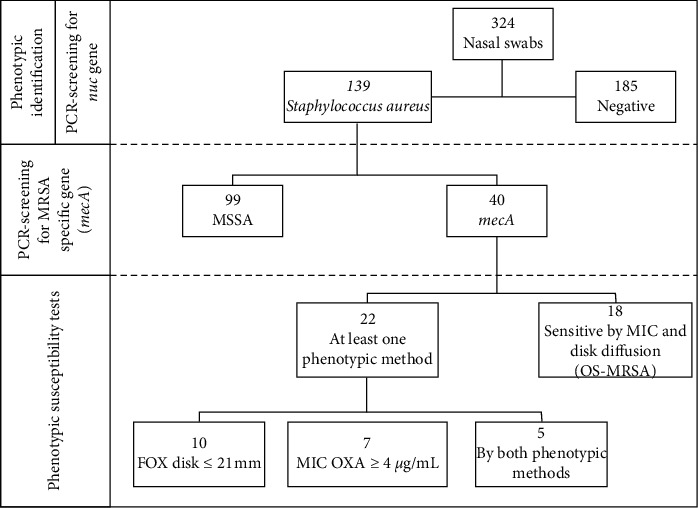
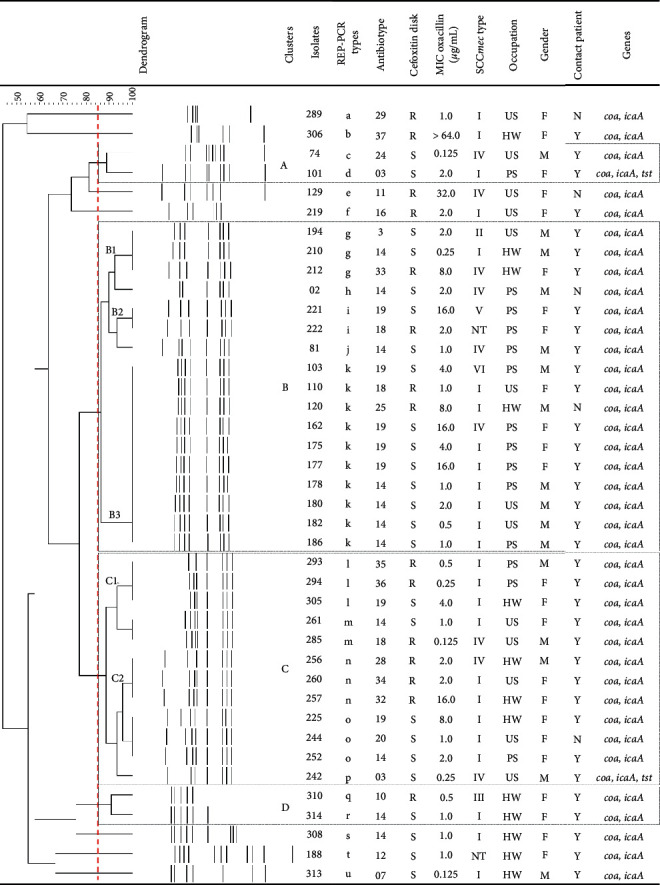
Of 324 nasal samples, 42.9% were identified as , of which 28.8% were MRSA. carriers were significantly higher in males and students (OR = 2.898, 95%CI 1.553-5.410); however, no variables were associated with MRSA carriage. All isolates were susceptible to vancomycin and the highest rate of resistance was observed for penicillin (90.6%). All isolates harbored the gene, and 97.8%, the gene; 15.8% and 6.5% were positive for and genes, respectively. Among MRSA isolates, 45% carried the gene but were phenotypically susceptible to oxacillin/cefoxitin; two harbored the and none had genes. All MRSAs were distributed into six SCC types and type I (62.5%) was the most frequent. REP-PCR typing identified four main clusters among MRSA isolates.
High prevalence of healthcare workers and students were identified as nasal carriers of exhibiting different antimicrobial resistance profiles, including -positive oxacillin-susceptible (OS-MRSA) and the presence of virulence-encoding genes. Both cohorts may represent potential sources for the emergence of a successful strain highly adapted to the hospital environment.
可无症状定植于人类前鼻孔和皮肤,该细菌的鼻腔定植是侵袭性感染发生的潜在风险。本研究的目的是确定在一家大学医院工作的医护人员和学生中鼻腔携带的流行情况,并从表型和分子水平对分离株进行特征分析。
对324名志愿者进行了一项横断面研究。采集鼻腔样本进行培养,并根据其抗菌药物敏感性谱和四个毒力因子编码基因对分离株进行特征分析。对耐甲氧西林金黄色葡萄球菌(MRSA)分离株的苯唑西林/头孢西丁敏感性、葡萄球菌盒式染色体(SCC)和重复序列PCR(REP-PCR)类型进行了特征分析。分析了携带和MRSA的潜在风险。
在324份鼻腔样本中,42.9%被鉴定为携带,其中28.8%为MRSA。男性和学生中的携带者显著更高(比值比=2.898,95%置信区间1.553-5.410);然而,没有变量与MRSA携带相关。所有分离株对万古霉素敏感,青霉素的耐药率最高(90.6%)。所有分离株都携带基因,97.8%携带基因;分别有15.8%和6.5%的分离株对和基因呈阳性。在MRSA分离株中,45%携带基因,但表型上对苯唑西林/头孢西丁敏感;两株携带基因,无一株携带基因。所有MRSA被分为六种SCC类型,I型(62.5%)最常见。REP-PCR分型在MRSA分离株中确定了四个主要簇。
医护人员和学生中鼻腔携带的流行率较高,这些携带者表现出不同的抗菌药物耐药谱,包括携带基因的苯唑西林敏感金黄色葡萄球菌(OS-MRSA)以及毒力编码基因的存在。这两个人群都可能是出现高度适应医院环境的成功菌株的潜在来源。