Zerjav Marie, DiAdamo Autumn, Grommisch Brittany, Katherine Amato, Chai Hongyan, Peng Gang, Li Peining
Department of Genetics, Yale University School of Medicine, New Haven, CT, USA.
Diagnostic Genetics Sciences Program, University of Connecticut, Storrs, CT, USA.
Case Rep Genet. 2020 Dec 2;2020:8897541. doi: 10.1155/2020/8897541. eCollection 2020.
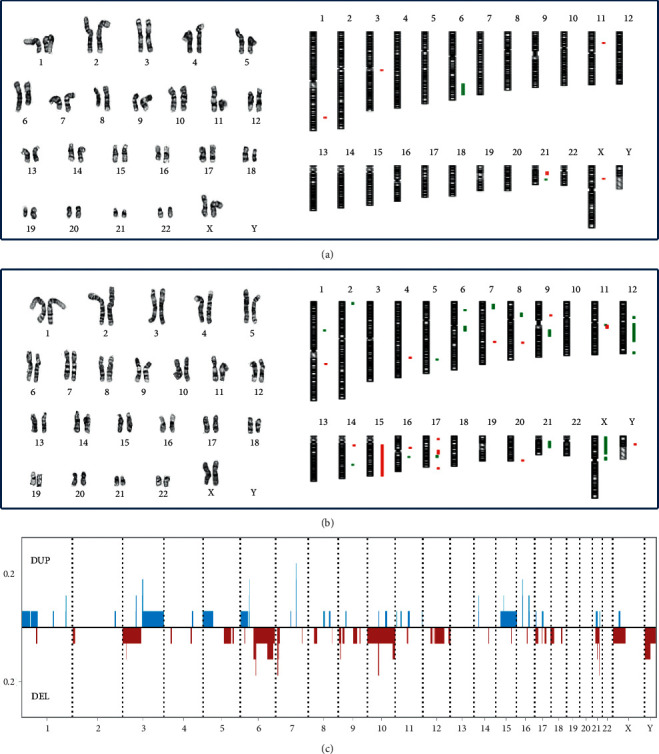
Salivary gland tumors (SGTs) of parotid origin are a group of diverse neoplasms which are difficult to classify due to their rarity and similar morphologic patterns. Chromosome analysis can detect clonal abnormalities, and array comparative genomic hybridization (aCGH) analysis can define copy number alterations (CNAs) from tumor specimens. Of the 19 cases of various types of SGTs submitted for cytogenomic analyses, an abnormal clone was detected in nine cases (47%), and CNAs were detected in 14 cases (74%). Recurrent rearrangements involving the PLAG1 gene at 8q12, recurrent CNAs including deletions of 6q, 9p (CDKN2A), and 17p (TP53), loss of Y chromosome, and gain of chromosome 7 were defined from these cases. Combined karyotyping and aCGH analyses could improve diagnostic yield. Future study for more precisive correlation of SGT classification with cytogenomic abnormalities will facilitate better diagnosis and treatment.
腮腺来源的唾液腺肿瘤(SGTs)是一组多样的肿瘤,由于其罕见性和相似的形态学模式,难以进行分类。染色体分析可以检测到克隆性异常,而阵列比较基因组杂交(aCGH)分析可以从肿瘤标本中确定拷贝数改变(CNA)。在提交进行细胞基因组分析的19例各种类型的SGTs中,9例(47%)检测到异常克隆,14例(74%)检测到CNA。从这些病例中确定了涉及8q12处PLAG1基因的反复重排、包括6q、9p(CDKN2A)和17p(TP53)缺失的反复CNA、Y染色体丢失以及7号染色体增加。联合核型分析和aCGH分析可以提高诊断率。未来关于SGT分类与细胞基因组异常更精确相关性的研究将有助于更好的诊断和治疗。