Bian Jianxin, Cui Licao, Wang Xiaoyu, Yang Guang, Huo Fulin, Ling Hubin, Chen Liqin, She Kuijun, Du Xianghong, Levi Boaz, Levi Adi Jonas, Yan Zhaogui, Nie Xiaojun, Weining Song
State Key Laboratory of Crop Stress Biology in Arid Areas College of Agronomy and Yangling Branch of China Wheat Improvement Center Northwest A&F University Yangling Shaanxi 712100 China.
College of Life Science Jiangxi Agricultural University Nanchang Jiangxi 330045 China.
Adv Sci (Weinh). 2020 Nov 13;7(24):2000709. doi: 10.1002/advs.202000709. eCollection 2020 Dec.
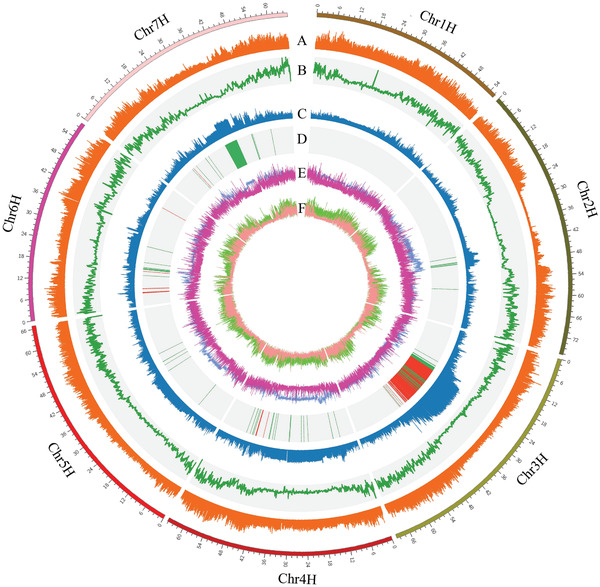
Microgeographic adaptation is a fundamental driving force of evolution, but the underlying causes remain undetermined. Here, the phenotypic, genomic and transcriptomic variations of two wild barley populations collected from sharply divergent and adjacent micro-geographic sites to identify candidate genes associated with edaphic local adaptation are investigated. Common garden and reciprocal transplant studies show that large phenotypic differentiation and local adaptation to soils occur between these populations. Genetic, phylogenetic and admixture analyses based on population resequencing show that significant genetic divergences occur between basalt and chalk populations. These divergences are consistent with the phenotypic variations observed in the field. Genome sweep analyses reveal 162.7 Mb of selected regions driven by edaphic local adaptation, in which 445 genes identified, including genes associated with root architecture, metal transport/detoxification, and ABA signaling. When the phenotypic, genomic and transcriptomic data are combined, HvMOR, encoding an LBD transcription factor, is determined to be the vital candidate for regulating the root architecture to adapt to edaphic conditions at the microgeographic scale. This study provides new insights into the genetic basis of edaphic adaptation and demonstrates that edaphic factors may contribute to the evolution and speciation of barley.
微地理适应性是进化的一个基本驱动力,但其潜在原因仍未确定。在此,对从截然不同且相邻的微地理位点采集的两个野生大麦种群的表型、基因组和转录组变异进行了研究,以确定与土壤局部适应性相关的候选基因。共同园和 reciprocal transplant 研究表明,这些种群之间存在较大的表型分化和对土壤的局部适应性。基于种群重测序的遗传、系统发育和混合分析表明,玄武岩和白垩种群之间存在显著的遗传差异。这些差异与在田间观察到的表型变异一致。基因组扫描分析揭示了由土壤局部适应性驱动的 162.7 Mb 选定区域,其中鉴定出 445 个基因,包括与根系结构、金属运输/解毒和 ABA 信号传导相关的基因。当结合表型、基因组和转录组数据时,编码 LBD 转录因子的 HvMOR 被确定为在微地理尺度上调节根系结构以适应土壤条件的关键候选基因。本研究为土壤适应性的遗传基础提供了新的见解,并表明土壤因素可能有助于大麦的进化和物种形成。 (注:“reciprocal transplant”可能是“ reciprocal translocation”的错误表述,若为后者,意思是“相互易位” ,但按原文翻译存疑,这里先按原文翻译)