Yu Bingbo, Dong Bing, He Jiang, Huang Hui, Huang Jinsheng, Wang Yong, Liang Jianwen, Zhang Jianning, Qiu Yumin, Shen Jun, Shuai Xintao, Tao Jun, Xia Wenhao
Department of Hypertension and Vascular Disease The First Affiliated Hospital of Sun Yat-sen University National-Guangdong Joint Engineering Laboratory for Diagnosis and Treatment of Vascular Diseases Key Laboratory on Assisted Circulation Ministry of Health Guangzhou 510080 China.
Department of Cardiovascular The Eighth Affiliated Hospital of Sun Yat-sen University Shenzhen 518000 China.
Adv Sci (Weinh). 2020 Nov 9;7(24):2001657. doi: 10.1002/advs.202001657. eCollection 2020 Dec.
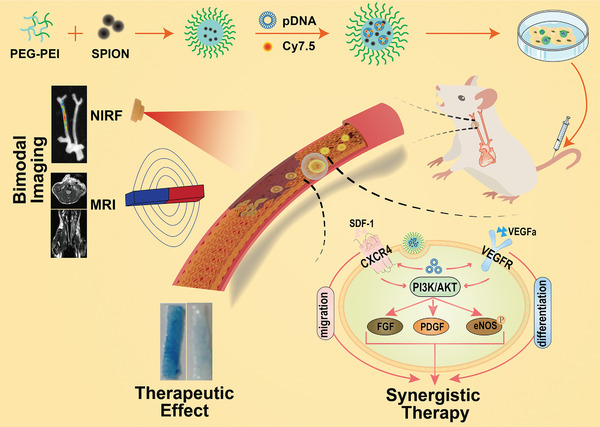
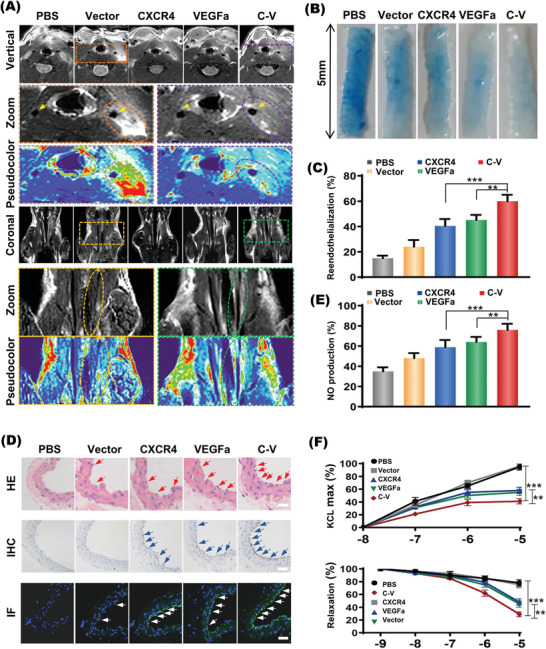
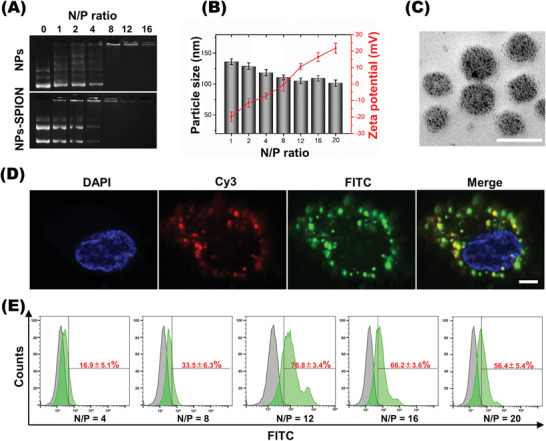
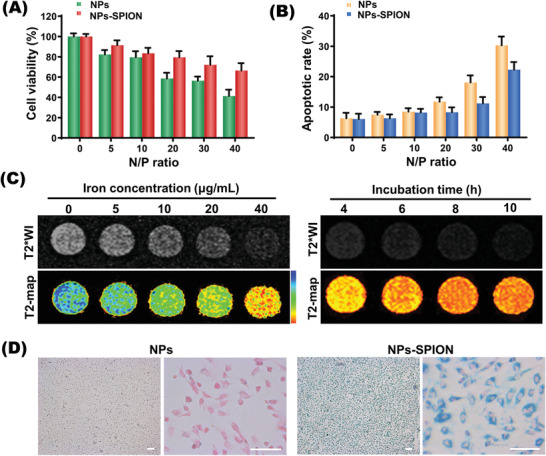
A major challenge to treat vascular endothelial injury is the restoration of endothelium integrity in which endothelial progenitor cells (EPCs) plays a central role. Transplantation of EPCs as a promising therapeutic means is subject to two interrelated processes, homing and differentiation of EPCs in vivo, and thus a lack of either one may greatly affect the outcome of EPC-based therapy. Herein, a polymeric nanocarrier is applied for the codelivery of CXCR4 and VEGFa genes to simultaneously promote the migration and differentiation of EPCs. Moreover, MRI T contrast agent SPION and NIR dye Cy7.5 are also loaded into the nanocarrier in order to track EPCs in vivo. Based on the synergistic effect of the two codelivered genes, an improved reendothelialization of EPCs is achieved in a rat carotid denuded model. The results show the potential of this bimodal imaging-visible nanomedicine to improve the performance of EPCs in repairing arterial injury, which may push forward the stem cell-based therapy of cardiovascular disease.
治疗血管内皮损伤的一个主要挑战是恢复内皮完整性,其中内皮祖细胞(EPCs)起着核心作用。作为一种有前景的治疗手段,EPCs移植受制于两个相互关联的过程,即EPCs在体内的归巢和分化,因此缺少其中任何一个过程都可能极大地影响基于EPC治疗的效果。在此,一种聚合物纳米载体被用于共同递送CXCR4和VEGFa基因,以同时促进EPCs的迁移和分化。此外,磁共振成像T造影剂超顺磁性氧化铁纳米颗粒(SPION)和近红外染料Cy7.5也被载入纳米载体,以便在体内追踪EPCs。基于两种共同递送基因的协同效应,在大鼠颈动脉剥脱模型中实现了EPCs更好的再内皮化。结果显示了这种双模态成像可见纳米药物在改善EPCs修复动脉损伤性能方面的潜力,这可能会推动基于干细胞的心血管疾病治疗。