Guo Yanfei, Xing Zhenzhen, Shan Guangliang, Janssens Jean-Paul, Sun Tieying, Chai Di, Liu Weiming, Wang Yuxia, Ma Yali, Tong Yaqi, Huang Yilin, Cao Yang, Wang Chen
National Clinical Research Center for Respiratory Diseases, Beijing, China.
Department of Respiratory and Critical Care Medicine, Beijing Hospital, Beijing, China.
Front Med (Lausanne). 2020 Dec 3;7:581763. doi: 10.3389/fmed.2020.581763. eCollection 2020.
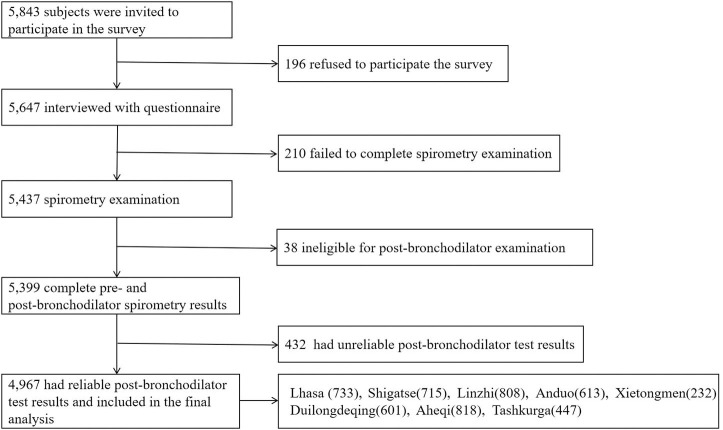
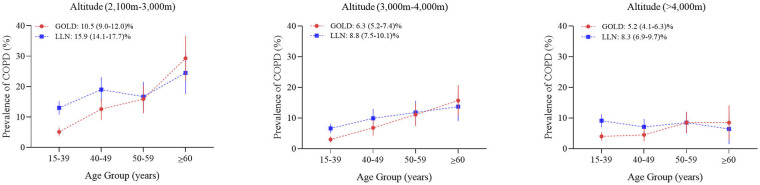
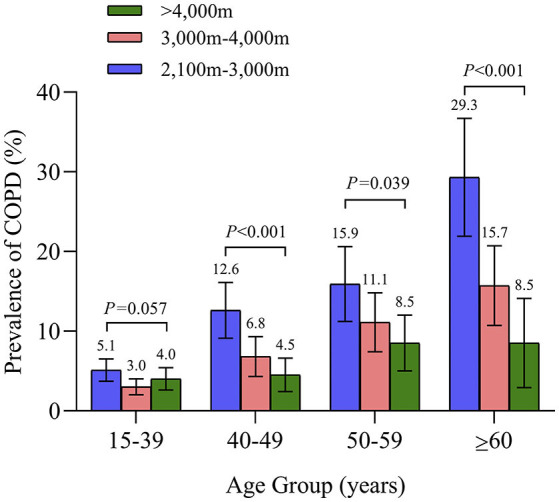
Four hundred million people live at high altitude worldwide. Prevalence and risk factors for COPD in these populations are poorly documented. We examined the prevalence and risk factors for COPD in residents living at an altitude of 2,100-4,700 m. We performed a cross-sectional survey in Xinjiang and Tibet autonomous region. A multistage stratified sampling procedure was used to select a representative population aged 15 years or older from eight high altitude regions. All participants underwent pre- and post-bronchodilator measurement of forced expiratory volumes. COPD was diagnosed according to 2019 Global Initiative for Chronic Obstructive Lung Disease (GOLD) criteria. Between June, 2015 and August 2016, 4,967 subjects were included. Median age was 38.0 years (range: 15-91 years; inter-quartile range: 28-49 years); 51.4% participants were female. Overall prevalence of spirometry-defined COPD was 8.2% (95% CI 7.4-8.9%): 9.3% in male (95% CI 8.2-10.4%), and 7.1% in female (95% CI 6.1-8.2%). By multivariable logistic regression analysis, COPD was significantly associated with being aged ≥40 years (odds ratio: 2.25 [95% CI 1.72-2.95], < 0.0001), exposure to household air pollution (OR: 1.34 [95% CI 1.01-1.79], = 0.043), and a history of tuberculosis (OR: 1.79 [95% CI 1.23-2.61], = 0.030), while living at a higher altitude (OR: 0.45 [95% CI 0.33-0.61], < 0.0001) and having a higher educational level (OR: 0.64 [95% CI 0.43-0.95], = 0.025) were associated with a lower prevalence of COPD. Our results show that the spirometry-defined COPD is a considerable health problem for residents living at high altitudes and COPD prevalence was inversely correlated with altitude. Preventing exposure to household air pollution and reducing the incidence of tuberculosis should be public health priorities for high altitude residents.
全球有4亿人生活在高海拔地区。这些人群中慢性阻塞性肺疾病(COPD)的患病率和危险因素鲜有文献记载。我们调查了生活在海拔2100 - 4700米居民中COPD的患病率和危险因素。我们在新疆维吾尔自治区和西藏自治区进行了一项横断面调查。采用多阶段分层抽样程序,从八个高海拔地区选取了具有代表性的15岁及以上人群。所有参与者均接受了支气管扩张剂使用前后的用力呼气量测量。COPD根据2019年慢性阻塞性肺疾病全球倡议(GOLD)标准进行诊断。2015年6月至2016年8月期间,共纳入4967名受试者。中位年龄为38.0岁(范围:15 - 91岁;四分位间距:28 - 49岁);51.4%的参与者为女性。肺活量测定定义的COPD总体患病率为8.2%(95%置信区间7.4 - 8.9%):男性为9.3%(95%置信区间8.2 - 10.4%),女性为7.1%(95%置信区间6.1 - 8.2%)。通过多变量逻辑回归分析,COPD与年龄≥40岁显著相关(比值比:2.25 [95%置信区间1.72 - 2.95],P < 0.0001)、接触家庭空气污染(OR:1.34 [95%置信区间1.01 - 1.79],P = 0.043)以及有结核病史(OR:1.79 [95%置信区间1.23 - 2.61],P = 0.030)相关,而生活在更高海拔地区(OR:0.45 [95%置信区间0.33 - 0.61],P < 0.0001)和教育水平较高(OR:0.64 [95%置信区间0.43 - 0.95],P = 0.025)与COPD患病率较低相关。我们的研究结果表明,肺活量测定定义的COPD是高海拔地区居民面临的一个相当严重的健康问题,且COPD患病率与海拔呈负相关。预防接触家庭空气污染和降低结核病发病率应成为高海拔地区居民公共卫生工作的重点。