Al-Dwaikat Tariq N, Aldalaykeh Mohammed, Ta'an Wafa'a, Rababa Mohammad
Jordan University of Science and Technology Faculty of Nursing, P.O. Box 3030, Irbid, 22110, Jordan.
Heliyon. 2020 Dec 9;6(12):e05695. doi: 10.1016/j.heliyon.2020.e05695. eCollection 2020 Dec.
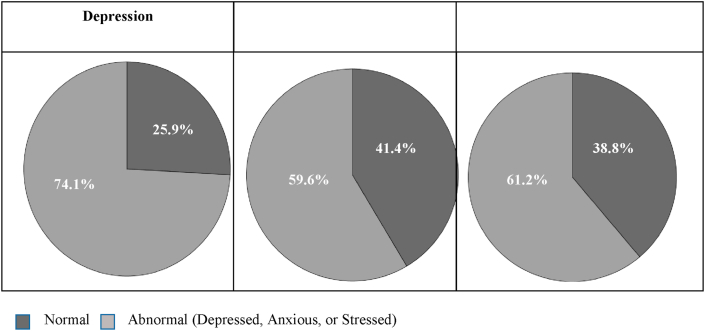
During the outbreak of the COVID-19 pandemic, interpersonal interactions are restricted to social networks. Undergraduate students are isolated in their homes and dorms. Loneliness is closely related to psychological distress. Fear of contracting the disease will worsen psychological distress. The purpose of this study was to assess the severity of depression, anxiety, and stress symptoms among undergraduate students and their relationships with social networking sites usage during the COVID-19 lockdown. An online survey was used to recruit 456 participants for this cross-sectional descriptive study. Self-reported questionnaires were used to collect data on students' demographics, depression, anxiety, stress, and social networking usage. The results revealed that the majority of students had symptoms of depression (74.1%), anxiety (59.6%), and stress (61.2%). Female students had higher depression and anxiety symptoms than males. Senior-level students' psychological distress symptoms were significantly different from those of junior level. The largest percentage of students (91.9%) used social networking sites for entertainment. The academic usage of social networking sites was negatively ( < .05) correlated with depression and stress scores, while entertainment usage was positively correlated with anxiety. Age was not found to be significantly correlated with psychological distress. Academic and entertainment use of social networking sites were successfully associated with psychological distress symptoms after controlling for demographics. During this unprecedented time of undergraduate students' course of study, they were experiencing higher than average distress symptoms. These symptoms could be mitigated by continuing the regular academic activities and delivering the most accurate up-to-date information on the COVID-19 through social networking sites.
在新冠疫情大流行期间,人际互动局限于社交网络。本科生被隔离在家中和宿舍。孤独与心理困扰密切相关。对感染疾病的恐惧会加剧心理困扰。本研究的目的是评估新冠疫情封锁期间本科生抑郁、焦虑和压力症状的严重程度及其与社交网站使用之间的关系。采用在线调查的方式招募了456名参与者进行这项横断面描述性研究。使用自填式问卷收集学生的人口统计学信息、抑郁、焦虑、压力和社交网络使用情况的数据。结果显示,大多数学生有抑郁症状(74.1%)、焦虑症状(59.6%)和压力症状(61.2%)。女生的抑郁和焦虑症状比男生更严重。高年级学生的心理困扰症状与低年级学生有显著差异。最大比例的学生(91.9%)使用社交网站进行娱乐。社交网站的学术用途与抑郁和压力得分呈负相关(<.05),而娱乐用途与焦虑呈正相关。未发现年龄与心理困扰有显著相关性。在控制人口统计学因素后,社交网站的学术和娱乐用途与心理困扰症状成功相关。在本科生这一前所未有的学习阶段,他们经历着高于平均水平的困扰症状。通过在社交网站上持续开展常规学术活动并提供关于新冠疫情的最准确的最新信息,这些症状可能会得到缓解。