Dal Ahsen Ezel Bildik, Hubbe Martin A, Pal Lokendra, Gule M Emin
Faculty of Forestry, Department of Forest Products Chemistry and Technology, Istanbul University-Cerrahpasa, Valide Sultan Cad. No:1, 34473 Bahcekoy, Istanbul, Turkey.
Department of Forest Biomaterials, NC State University, 2820 Faucette Dr., Campus Box 8001, Raleigh, North Carolina 27695, United States.
ACS Omega. 2020 Dec 1;5(49):31559-31566. doi: 10.1021/acsomega.0c03610. eCollection 2020 Dec 15.
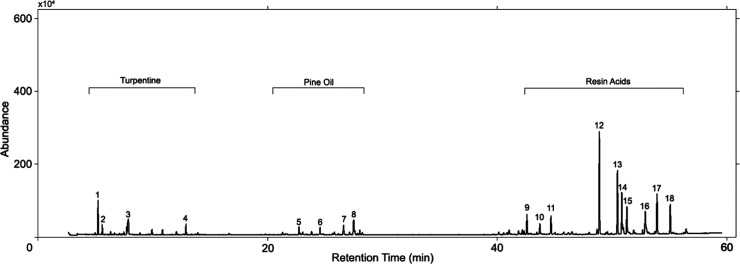
The aim of this work is to obtain better water resistance properties with additives to starch at the size press. A further goal is to replace petroleum-based additives with environmentally friendly hydrophobic agents obtained by derivatization of wood rosin. A crude wood rosin (CWR) sample was methylated and analyzed with gas chromatography-mass spectrometry (GC-MS). Methyl abietate, dehydroabietic acid, and abietic acid were the main constituents of the sample. The crude wood rosin samples were fortified with fumaric acid and then esterified with pentaerythritol. Fortified and esterified wood rosin samples were dissolved in ethanol and emulsified with cationic starch to make them suitable as hydrophobic additives for surface treatment formulations in mixtures with starch. These hydrophobic agents (2% on a dry weight basis in a cationic starch solution) were applied to paperboard, bleached kraft paper, and test liner paper using a rod coater with a target pickup of 3-5 gsm. The solution pickup was controlled by varying the rod number. The amounts of hydrophobic material applied in the preparation of the paper samples were 32.2, 48.6, and 35.1 lb/ton pickup compared to three types of base papers. Basic surface features of fortified and fortified and esterified rosin-treated paper were compared with base paper and paper treated with starch alone. Lower Cobb values were obtained for fortified and esterified samples than for linerboard samples that had been surface-sized just by starch. Thus, as novel hydrophobic additive agents, derivatives of CWR can be a green way to increase hydrophobicity while reducing starch consumption in papermaking.
这项工作的目的是通过在表面施胶时向淀粉中添加添加剂来获得更好的耐水性。另一个目标是用通过木松香衍生化得到的环保型疏水剂替代石油基添加剂。对粗木松香(CWR)样品进行甲基化处理,并采用气相色谱 - 质谱联用仪(GC - MS)进行分析。甲基枞酸酯、脱氢枞酸和枞酸是该样品的主要成分。用富马酸对粗木松香样品进行强化,然后与季戊四醇进行酯化反应。将强化和酯化后的木松香样品溶解在乙醇中,并与阳离子淀粉乳化,使其适合作为与淀粉混合用于表面处理配方的疏水添加剂。这些疏水剂(在阳离子淀粉溶液中按干重计为2%)使用棒式涂布器涂覆在纸板、漂白牛皮纸和测试挂面纸上,目标施胶量为3 - 5 gsm。通过改变棒数来控制溶液施胶量。与三种类型的原纸相比,制备纸样时疏水性材料的施胶量分别为32.2、48.6和35.1磅/吨。将强化和强化酯化松香处理纸的基本表面特性与原纸和仅用淀粉处理的纸进行了比较。强化和酯化样品的科布值低于仅通过淀粉进行表面施胶的挂面纸板样品。因此,作为新型疏水添加剂,CWR的衍生物可以成为一种在造纸过程中增加疏水性同时减少淀粉消耗的绿色方法。