Department of Cardiovascular, Endocrine-Metabolic Diseases and Aging, Istituto Superiore di Sanità, Rome, Italy.
Department of Geriatrics, Centro Medicina dell'Invecchiamento, Fondazione Policlinico A. Gemelli IRCCS, Rome, Italy.
Aging Clin Exp Res. 2021 Jan;33(1):193-199. doi: 10.1007/s40520-020-01764-0. Epub 2020 Dec 21.
Epidemiological data obtained during the initial wave of the COVID-19 epidemic showed that persons dying with COVID-19 were typically older men with multiple chronic conditions. No studies have assessed if the characteristics of patients dying with COVID-19 have changed in the second phase of the epidemic, when the initial wave subsided. The aim of the present study was to compare characteristics of patients dying with COVID-19 in Italy in the first 'peak' phase of the epidemic and in its second phase.
Medical charts of patients with COVID-19 who died while in hospital in Italy were reviewed to extract information on pre-existing comorbidities, in-hospital complications, and disease trajectories. The course of the epidemic was classified in two 3-month periods: March-May 2020 and June-August 2020.
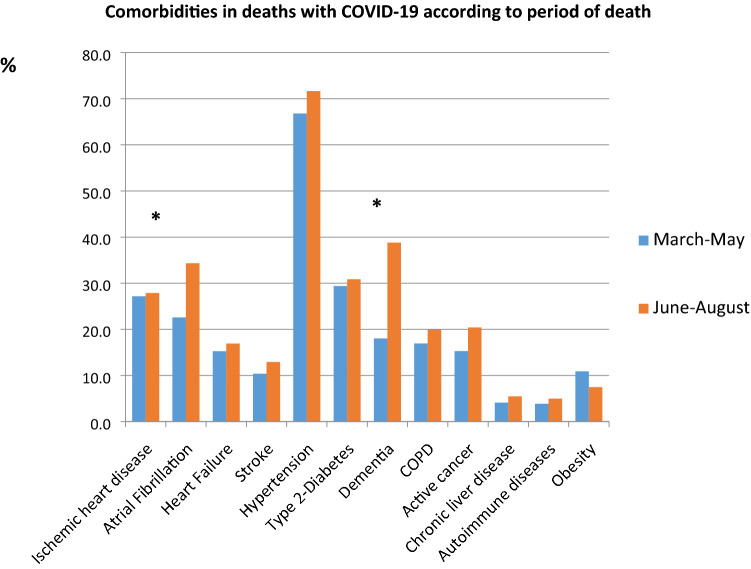
Overall, in the Italian population, 34,191 COVID-19 deaths occurred in March-May 2020 and 1,404 in June-August 2020. Patients dying in March-May were significantly younger (80.1 ± 10.6 vs. 82.8 ± 11.1 years, p < 0.001) and less frequently female (41.9% vs. 61.8%, p < 0.001) than those dying in June-August. The medical charts of 3533 patients who died with PCR-confirmed SARS-CoV-2 infection in March-May 2020 (10.3% of all deaths occurring in this period) and 203 patients who died in June-August 2020 (14.5% of all deaths occurring in this period) were analysed. Patients who died in March-May 2020, compared to those who died in June-August 2020, had significantly lower rates of multiple comorbidities (3 or more comorbidities: 61.8% vs 74.5%, p = 0.001) and superinfections (15.2% vs. 52.5%, p < 0.001). Treatment patterns also substantially differed in the two study periods, with patients dying in March-May 2020 being less likely to be treated with steroids (41.7% vs. 69.3%, p < 0.001) and more likely to receive antivirals (59.3% vs. 41.4%, p < 0.001). Survival time also largely differed, with patients dying in March-May 2020 showing a shorter time from symptoms onset to death (mean interval: 15.0 vs. 46.6 days, p < 0.001). The differences observed between the two periods remained significant in a multivariate analysis.
The clinical characteristics of patients dying with COVID-19 in Italy, their treatment and symptom-to-death survival time have significantly changed overtime. This is probably due to an improved organization and delivery of care and to a better knowledge of disease treatment.
COVID-19 疫情初期的流行病学数据显示,死于 COVID-19 的患者通常为患有多种慢性疾病的老年男性。目前尚未有研究评估 COVID-19 死亡患者的特征是否在疫情的第二阶段(初始波消退后)发生变化。本研究旨在比较意大利 COVID-19 患者在疫情第一波“高峰期”和第二波的死亡特征。
回顾性分析意大利住院期间死于 COVID-19 的患者的病历,以提取患者的既往合并症、院内并发症和疾病进展轨迹信息。将疫情进程分为两个 3 个月的时间段:2020 年 3 月至 5 月和 2020 年 6 月至 8 月。
总体而言,在意大利人群中,2020 年 3 月至 5 月期间有 34191 例 COVID-19 死亡,2020 年 6 月至 8 月期间有 1404 例。3 月至 5 月期间死亡的患者明显比 6 月至 8 月期间死亡的患者年轻(80.1±10.6 岁 vs. 82.8±11.1 岁,p<0.001)且女性比例较低(41.9% vs. 61.8%,p<0.001)。对 2020 年 3 月至 5 月期间经 PCR 确诊 SARS-CoV-2 感染且死亡的 3533 例患者(该期间所有死亡患者的 10.3%)和 2020 年 6 月至 8 月期间死亡的 203 例患者(该期间所有死亡患者的 14.5%)的病历进行了分析。与 2020 年 6 月至 8 月期间死亡的患者相比,2020 年 3 月至 5 月期间死亡的患者合并症(3 种或以上合并症:61.8% vs. 74.5%,p=0.001)和合并感染(15.2% vs. 52.5%,p<0.001)的发生率显著较低。两个研究期间的治疗模式也有很大差异,2020 年 3 月至 5 月期间死亡的患者使用类固醇的可能性较小(41.7% vs. 69.3%,p<0.001),而接受抗病毒治疗的可能性较大(59.3% vs. 41.4%,p<0.001)。生存时间也有很大差异,2020 年 3 月至 5 月期间死亡的患者从出现症状到死亡的时间更短(平均间隔:15.0 天 vs. 46.6 天,p<0.001)。多变量分析显示,两个时期之间观察到的差异仍然显著。
意大利 COVID-19 死亡患者的临床特征、治疗和症状至死亡的生存时间随时间显著变化。这可能是由于护理的组织和提供方式得到了改善,以及对疾病治疗的认识得到了提高。