Department of Cardiology, Centre Hospitalier de Versailles, Le Chesnay, France.
Emergency Department, Centre Hospitalier de Versailles, Le Chesnay, France.
PLoS One. 2020 Dec 21;15(12):e0244349. doi: 10.1371/journal.pone.0244349. eCollection 2020.
Angiotensin-converting enzyme 2 is the receptor that severe acute respiratory syndrome coronavirus 2 (SARS-CoV-2) uses for entry into lung cells. Because ACE-2 may be modulated by angiotensin-converting enzyme inhibitors (ACEIs) and angiotensin II receptor blockers (ARBs), there is concern that patients treated with ACEIs and ARBs are at higher risk of coronavirus disease 2019 (COVID-19) pneumonia.
This study sought to analyze the association of COVID-19 pneumonia with previous treatment with ACEIs and ARBs.
We retrospectively reviewed 684 consecutive patients hospitalized for suspected COVID-19 pneumonia and tested by polymerase chain reaction assay. Patients were split into two groups, according to whether (group 1, n = 484) or not (group 2, n = 250) COVID-19 was confirmed. Multivariable adjusted comparisons included a propensity score analysis.
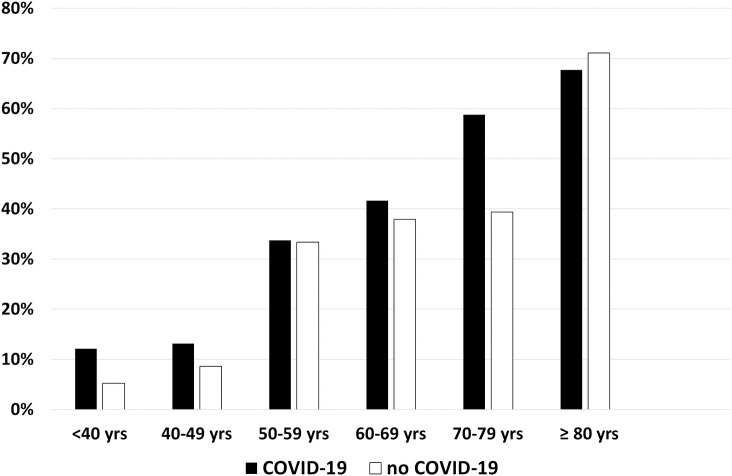
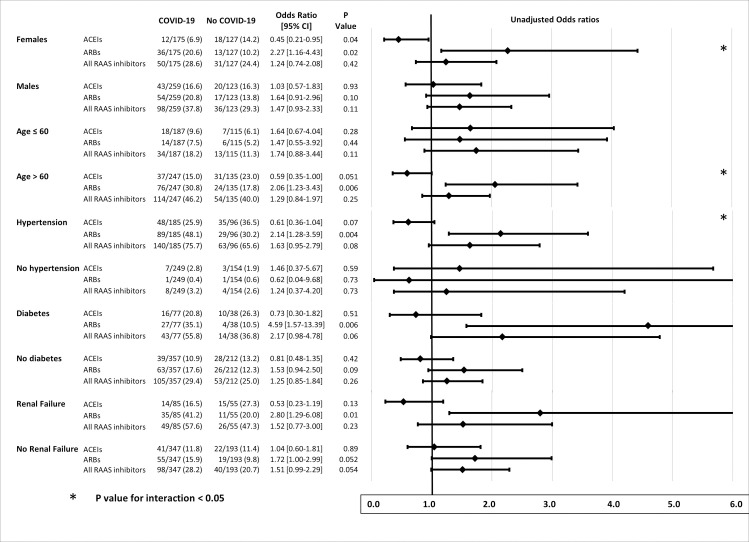
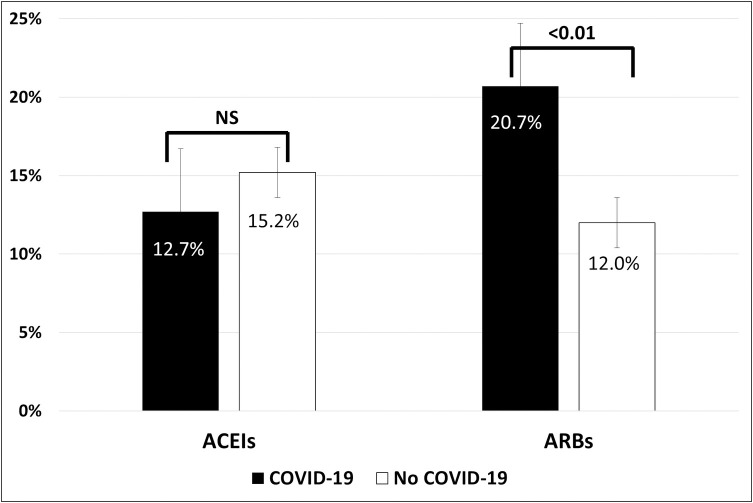
The mean age was 63.6 ± 18.7 years, and 302 patients (44%) were female. Hypertension was present in 42.6% and 38.4% of patients in groups 1 and 2, respectively (P = 0.28). Treatment with ARBs was more frequent in group 1 than group 2 (20.7% vs. 12.0%, respectively; odds ratio [OR] 1.92, 95% confidence interval [CI] 1.23-2.98; P = 0.004). No difference was found for treatment with ACEIs (12.7% vs. 15.7%, respectively; OR 0.81, 95% CI 0.52-1.26; P = 0.35). Propensity score-matched multivariable logistic regression confirmed a significant association between COVID-19 and previous treatment with ARBs (adjusted OR 2.36, 95% CI 1.38-4.04; P = 0.002). Significant interaction between ARBs and ACEIs for the risk of COVID-19 was observed in patients aged > 60 years, women, and hypertensive patients.
This study suggests that ACEIs and ARBs are not similarly associated with COVID-19. In this retrospective series, patients with COVID-19 pneumonia more frequently had previous treatment with ARBs compared with patients without COVID-19.
血管紧张素转换酶 2 是严重急性呼吸综合征冠状病毒 2(SARS-CoV-2)进入肺细胞的受体。由于血管紧张素转换酶抑制剂(ACEIs)和血管紧张素 II 受体阻滞剂(ARBs)可能调节 ACE-2,因此有人担心接受 ACEIs 和 ARBs 治疗的患者患 2019 年冠状病毒病(COVID-19)肺炎的风险更高。
本研究旨在分析 COVID-19 肺炎与 ACEIs 和 ARBs 先前治疗的关系。
我们回顾性分析了 684 例连续住院疑似 COVID-19 肺炎并经聚合酶链反应检测的患者。根据是否确诊 COVID-19(第 1 组,n=484 例)或未确诊 COVID-19(第 2 组,n=250 例)将患者分为两组。多变量调整比较包括倾向评分分析。
平均年龄为 63.6±18.7 岁,302 例(44%)为女性。第 1 组和第 2 组的高血压发生率分别为 42.6%和 38.4%(P=0.28)。第 1 组中 ARB 治疗的比例明显高于第 2 组(分别为 20.7%和 12.0%;比值比[OR]1.92,95%置信区间[CI]1.23-2.98;P=0.004)。ACEI 治疗无差异(分别为 12.7%和 15.7%;OR 0.81,95%CI 0.52-1.26;P=0.35)。倾向评分匹配的多变量逻辑回归证实,COVID-19 与 ARB 治疗前有显著相关性(调整 OR 2.36,95%CI 1.38-4.04;P=0.002)。在年龄>60 岁、女性和高血压患者中观察到 ARB 和 ACEI 治疗 COVID-19 风险之间存在显著的交互作用。
本研究表明,ACEIs 和 ARBs 与 COVID-19 的相关性并不相同。在这项回顾性研究中,与没有 COVID-19 的患者相比,COVID-19 肺炎患者更频繁地接受 ARB 治疗。