Sattar Yasar, Mukuntharaj Pradeeksha, Zghouzi Mohamed, Suleiman Abdul-Rahman M, Attique Hassan, Ullah Waqas, Sana Muhammad Khawar, Zaher Nathan, Mehmood Maham, Doshi Rajkumar P, Panchal Ankur, Mir Tanveer, Nadeem Muhammad, Ali Omar E, Mohamed Mohamad, Bagur Rodrigo, Elgendy Islam Y, Mamas Mamas A, Alraies M Chadi
Icahn School of Medicine at Mount, Sinai Elmhurst Hospital, Queens, NY, USA.
Grant Medical College and Sir JJ Group of Hospitals, Mumbai, India.
High Blood Press Cardiovasc Prev. 2021 Jul;28(4):405-416. doi: 10.1007/s40292-021-00462-w. Epub 2021 Jun 28.
The safety of renin-angiotensin-aldosterone system inhibitors (RAASi) among COVID-19 patients has been controversial since the onset of the pandemic.
Digital databases were queried to study the safety of RAASi in COVID-19. The primary outcome of interest was mortality. The secondary outcome was seropositivity improvement/viral clearance, clinical manifestation progression, and progression to intensive care units. A random-effect model was used to compute an unadjusted odds ratio (OR).
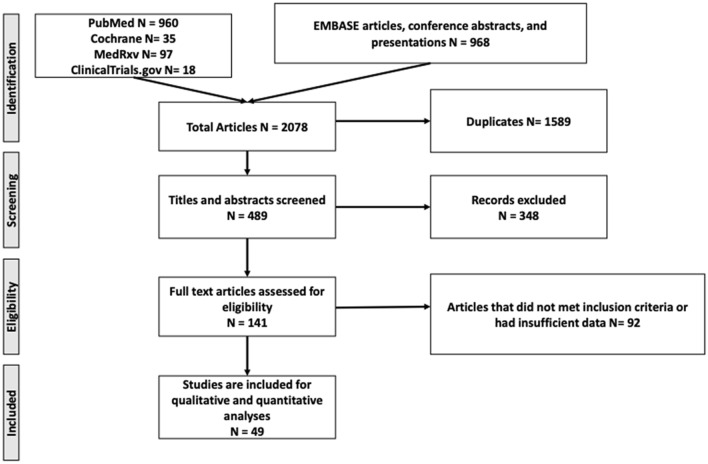
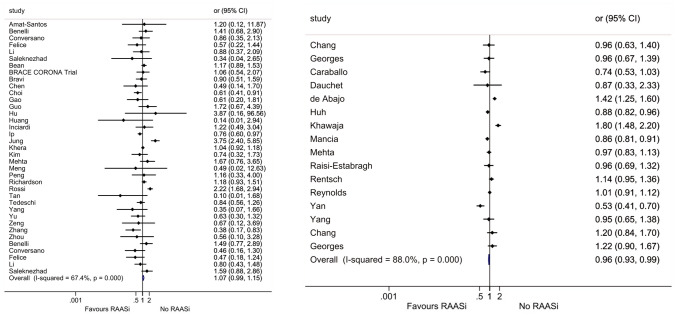
A total of 49 observational studies were included in the analysis consisting of 83,269 COVID-19 patients (RAASi n = 34,691; non-RAASi n = 48,578). The mean age of the sample was 64, and 56% were males. We found that RAASi was associated with similar mortality outcomes as compared to non-RAASi groups (OR 1.07; 95% CI 0.99-1.15; p > 0.05). RAASi was associated with seropositivity improvement including negative RT-PCR or antibodies, (OR 0.96; 95% CI 0.93-0.99; p < 0.05). There was no association between RAASi versus control with progression to ICU admission (OR 0.99; 95% CI 0.79-1.23; p > 0.05) or higher odds of worsening of clinical manifestations (OR 1.04; 95% CI 0.97-1.11; p > 0.05). Metaregression analysis did not change our outcomes for effect modifiers including age, sex, comorbidities, RAASi type, or study type on outcomes.
COVID-19 is not a contraindication to hold or discontinue RAASi as they are not associated with higher mortality or worsening symptoms. Continuation of RAASi might be associated with favorable outcomes in COVID-19, including seropositivity/viral clearance.
自大流行开始以来,肾素-血管紧张素-醛固酮系统抑制剂(RAASi)在新冠肺炎患者中的安全性一直存在争议。
查询数字数据库以研究RAASi在新冠肺炎中的安全性。感兴趣的主要结局是死亡率。次要结局是血清学阳性改善/病毒清除、临床表现进展以及进展到重症监护病房。使用随机效应模型计算未调整的比值比(OR)。
分析共纳入49项观察性研究,包括83269例新冠肺炎患者(使用RAASi的患者n = 34691;未使用RAASi的患者n = 48578)。样本的平均年龄为64岁,56%为男性。我们发现,与未使用RAASi的组相比,使用RAASi与相似的死亡率结局相关(OR 1.07;95%可信区间0.99 - 1.15;p > 0.05)。RAASi与血清学阳性改善相关,包括逆转录聚合酶链反应(RT-PCR)阴性或抗体阴性(OR 0.96;95%可信区间0.93 - 0.99;p < 0.05)。使用RAASi与对照组相比,在进展到入住重症监护病房方面没有关联(OR 0.99;95%可信区间0.79 - 1.23;p > 0.05),在临床表现恶化的较高几率方面也没有关联(OR 1.04;95%可信区间0.97 - 1.11;p > 0.05)。Meta回归分析并未改变我们关于效应修饰因素(包括年龄、性别、合并症、RAASi类型或研究类型)对结局影响的结果。
新冠肺炎不是停用或继续使用RAASi的禁忌证,因为它们与更高的死亡率或症状恶化无关。继续使用RAASi可能与新冠肺炎的良好结局相关,包括血清学阳性/病毒清除。